

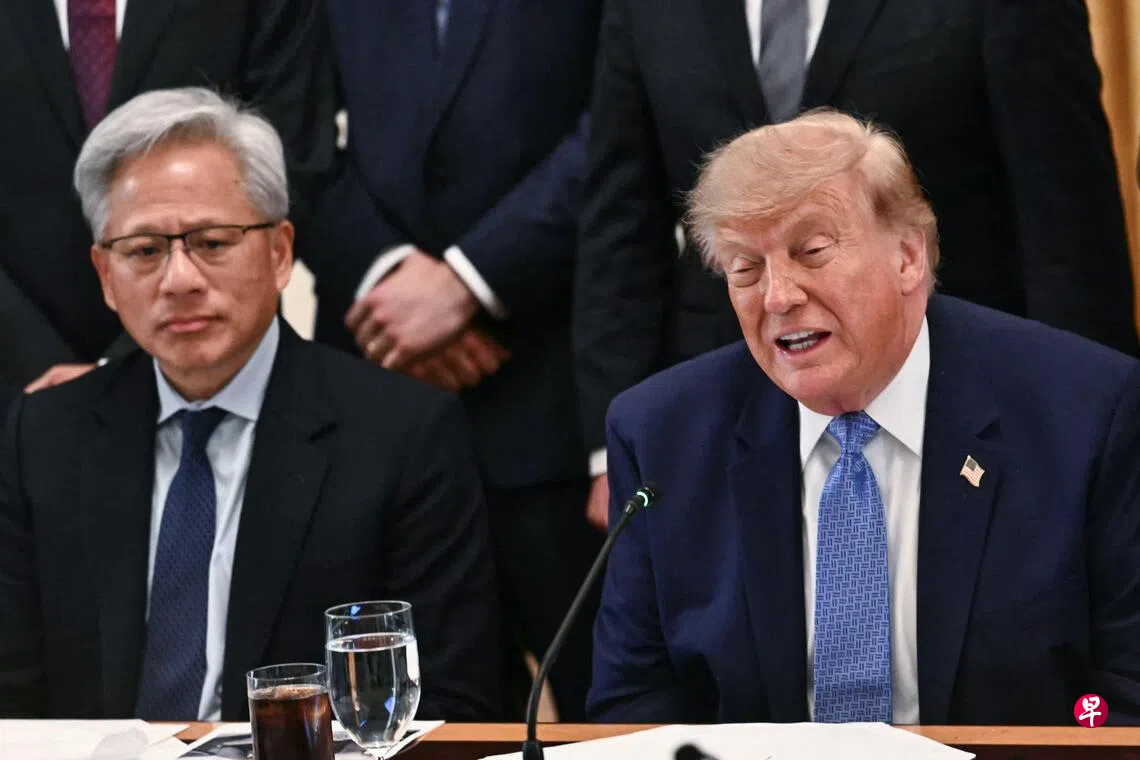
As Shenzhen prepares to host the Asia-Pacific Economic Cooperation (APEC) Economic Leaders’ Meeting, China and the US are activating trade mechanisms while continuing to tussle over technology security. The White House has confirmed that US President Donald J. Trump will meet Chinese President Xi Jinping on the sidelines of APEC. Although the controversy surrounding Nvidia founder Jensen Huang has raised concerns that US export controls on China may have been circumvented, US officials say Trump is not expected to raise the matter at the meeting.
Analysts interviewed said the Huang controversy casts a technology security shadow over the Xi-Trump meeting in Shenzhen and complicates negotiations, but will not reverse the two leaders’ broader push to keep relations stable.
China and the US held their trade council’s first formal meeting ahead of the leaders’ talks. China’s Ministry of Commerce said on Saturday (14 November) that the two sides held a video conference on Friday (13 November). They had “candid, in-depth and constructive exchanges” on implementing the outcomes of earlier consultations, covering tariffs, a “30 billion for 30 billion” reciprocal tariff reduction arrangement, agricultural trade and other issues of concern.
No new agreement was announced. China’s Ministry of Commerce said both sides would continue to strengthen communication through the trade council and work to address their respective economic and trade concerns, “helping to build a constructive China-US relationship of strategic stability based on respect, fairness and reciprocity”. China and the US had earlier agreed to extend their trade truce until 10 January next year. Both sides still need to complete domestic procedures to finalise implementation arrangements.
Meanwhile, the technology security controversy continues to unfold. US media have reported that Alice Huang, a former executive at Singapore artificial intelligence (AI) company Megaspeed, was one of the women with whom Jensen Huang had extramarital affairs. US authorities suspect Alice Huang of involvement in Chinese intelligence activities and are investigating whether Megaspeed helped Chinese companies obtain chips subject to export controls.
However, Reuters reported that Trump is not expected to raise the matter when he meets Xi on 19 November. The report quoted a US official as saying that a national security review and investigations were under way, and that “we probably will not share details with the Chinese side at this stage”.
The controversy also reflects divisions within the US over export controls. In an interview with CNBC on Friday, US Treasury Secretary Scott Bessent criticised the Commerce Department for not placing Megaspeed on the Entity List. He said the Treasury, Defense and State departments, along with the Office of the United States Trade Representative, all supported listing Megaspeed, but the final decision rested with the Commerce Department. He also questioned whether Nvidia had adequately vetted its customers to prevent chips from being transshipped through third parties.
The chairs of three relevant US House committees have written to Jensen Huang, asking him to attend a closed-door briefing on 18 November. They have also urged Congress to incorporate several bills on advanced chip security and export controls into the National Defense Authorization Act.
On China-US AI cooperation, Bessent had previously said that Trump and Xi would use their Shenzhen meeting to advance dialogue on the risks of “superintelligence”. They would exchange experience in evaluating and testing advanced models before release, ensure that human judgement remains paramount, and establish direct channels for notifying each other of major incidents.
Li Mingjiang, an associate professor at the S. Rajaratnam School of International Studies at Singapore’s Nanyang Technological University, told Lianhe Zaobao that the Jensen Huang controversy would have a slight impact on the atmosphere of the Xi-Trump meeting and provide fresh grounds for further US restrictions on advanced chip exports. However, it “will not have a decisive impact on the meeting”, as both countries’ leaders still want to maintain stable relations.
He assessed that reciprocal tariff concessions and purchases of agricultural products and energy would be relatively easy to advance, while core technologies, supply chains and rare earths would be “more difficult”. The US might consider restricting Chinese companies’ use of high-end US-made chips through rented computing capacity in third countries. China, meanwhile, might become more cautious about supplying rare earths and adopt a wait-and-see approach, concerned that Trump’s team may struggle to withstand congressional pressure to tighten policy towards China.
Li said China-US AI cooperation had little connection to the Huang controversy. He expected dialogue on AI issues to be “more about form than substance” initially, as neither side would be willing to disclose sensitive information. Mechanisms such as notifications of major incidents would still require a long period of coordination.
Sun Chenghao, an associate research fellow at Tsinghua University’s Centre for International Security and Strategy, said some US lawmakers were linking allegations still under investigation to approvals for chip exports to China, reinforcing the tendency to frame technology cooperation as a security issue and raising the political cost of White House adjustments to export policy. The controversy might not dominate the meeting, but could affect whether its outcomes can be delivered, making it harder for Donald J. Trump to make lasting, credible arrangements on technology restrictions.
He said Trump had an incentive to showcase economic achievements after his midterm election setback, emphasising concrete deals on purchases and market access. China, meanwhile, attached greater importance to policy stability and respect for its core interests. If economic and trade concessions were repeatedly disrupted by new restrictions, it would undermine both sides’ confidence in implementing their commitments.
On communication about AI risks, Sun said both sides needed to define the thresholds for reporting major incidents, identify the responsible agencies, set deadlines for acknowledging receipt of notifications and conduct simulation exercises. Although the Huang controversy would heighten US companies’ concerns about participating in dialogue and increase political resistance to cooperation on chips and cloud computing capacity, both sides still needed to maintain a minimum level of cooperation on risks. He said the Shenzhen meeting could identify follow-up tasks, responsible agencies and a timetable, with working-level consultations continuing and implementation reviewed during the G20 summit in Miami. “Achieving this kind of sustained follow-through would itself constitute substantive progress.”
