

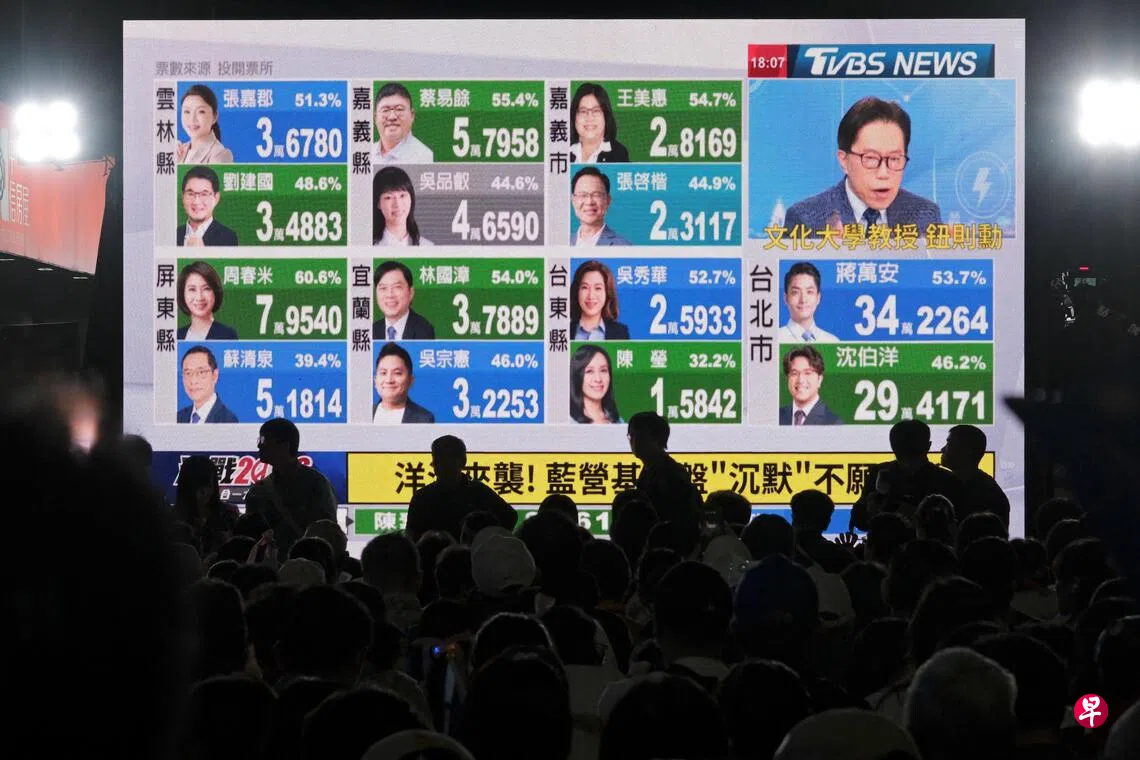
Taiwan’s opposition Kuomintang (KMT) is facing internal calls for a review after its defeat in the “nine-in-one” local elections. KMT secretary-general Lee Chien-lung and deputy secretary-general Lee Che-hua, who also heads the party’s Organisation and Development Committee, offered to resign. But party chairwoman Cheng Li-wun declined to accept their resignations, citing imminent legislative by-elections and council speaker elections.
Cheng’s planned visit to the UK, which was due to begin on 2 December, has also been cancelled. Chen I-hsin, head of the KMT’s Culture and Communications Committee, said on Sunday (29 November) that Cheng would prioritise post-election work and join the party leadership team in preparing for the next round of challenges.
Taiwan held its 2026 “nine-in-one” local elections on Saturday (28 November). Of the 22 city and county leadership posts nationwide, the KMT won 11, narrowly retaining Taipei and New Taipei, collectively known as the “two Taipeis”. Not only did it win three fewer seats than at the previous election, it also unexpectedly lost Taichung. Although the Democratic Progressive Party (DPP) failed to capture either Taipei or New Taipei, it still made substantial gains, winning 10 cities and counties, five more than at the last election.
While Cheng has not faced direct internal pressure to step down, criticism has come her way. Re-elected Miaoli County magistrate Chung Tung-chin criticised the party headquarters’ election strategy as “chaotic” and its nomination process as overly dependent on personal discretion. He urged Cheng to convene key party officials, leaders of the six special municipalities and former party chairpersons to discuss strategy for the 2028 presidential election.
China Times News reported that Lee Chien-lung came to Cheng’s defence, saying that KMT campaigns in the six special municipalities had distanced themselves so thoroughly from her before the election, only to blame her afterwards for failing to provide sufficient campaign support. “How is she supposed to bear that?” he asked.
Lee Chien-lung and Lee Che-hua both offered to resign after the election. But Cheng said legislative by-elections and elections for council speakers and deputy speakers in cities and counties would follow immediately after the local polls. She has held off accepting their resignations pending further discussion at a meeting next week.
Eight incumbent constituency legislators — seven from the DPP and one from the KMT — were elected as city mayors or county magistrates. As the current legislative term ends on 31 January 2028, more than a year will remain on their terms when they vacate their seats. Under the Civil Servants Election and Recall Act, by-elections must be held within three months, meaning they must take place by 24 March next year at the latest.
The DPP’s election strategy succeeded in keeping Taipei Mayor Chiang Wan-an tied down in the city as he sought re-election. Taichung Mayor Lu Shiow-yen, who campaigned for Chiang, was caught off guard by an electoral setback on her own turf, as Taichung switched from KMT to DPP control after eight years.
That evening, Lu apologised for failing to hand over the mayoralty to KMT candidate Chiang Chi-chen. Her plans to “take on greater responsibilities in future” may also have to be put on hold.
Lu stressed on Sunday that she would return her attention to municipal affairs and remain focused on them until the final second before she leaves office on 25 December.
TPP wins 34 council seats nationwide
Notably, the Taiwan People’s Party (TPP), a third political force, had been thought at risk of fading into irrelevance because of the legal cases involving its founding chairman, Ko Wen-je. Yet, in a surprise outcome, while none of its candidates won city or county leadership posts, the party secured 34 council seats nationwide, more than double the 14 it won at the previous election. These comprised 15 seats in the six special municipalities and 19 in other cities and counties, making it widely regarded as the biggest winner of this election.
Tu Sheng-tsung, an associate professor and head of Ming Chuan University’s Department of Radio and Television, praised the TPP’s nomination strategy on Facebook. The party cut its slate from 86 candidates at the previous election to 64, decisively abandoning constituencies where it had no chance of winning or risked splitting its own vote. All six of its candidates in Taipei, for example, were elected, “turning diffuse support into a grassroots foothold”.
Hong Yao-nan, director of Tamkang University’s Centre for Cross-Strait Relations, also told a symposium at the Institute for National Policy Research on Sunday that the TPP could have declined or faded into irrelevance in this election. Instead, it seized the opportunity presented by Chiang Wan-an’s desire for KMT-TPP cooperation. The KMT lost 20 to 30 council seats nationwide, all of which went to the TPP, allowing the latter to establish local roots.
In an interview with Lianhe Zaobao, Qi Dongtao, a senior research fellow at the National University of Singapore’s East Asian Institute, highlighted that the election showed cooperation between the KMT and TPP had indeed worked. He said the TPP deserved some credit for the KMT’s retention of Taipei and New Taipei. By contrast, the two parties’ failure to cooperate in Hsinchu County and Zhubei City had led to defeat.
He said: “This also means the TPP will have more bargaining power in 2028. But coordination will not be easy, and I expect another difficult phase of negotiations to begin next year.”
