

The “Yang wave” generated by Puma Shen, the Democratic Progressive Party (DPP) candidate, was more than the “illusion” described by former Taipei mayor Ko Wen-je. It helped turn several Kuomintang (KMT)-held cities and counties from blue to green, but could not shake the KMT’s deep-rooted hold on Taipei and New Taipei.
The results of Taiwan’s “nine-in-one” local elections were announced on Saturday (28 November). KMT supporters demonstrated the “spiral of silence” effect, with incumbent Taipei mayor Chiang Wan-an winning re-election and Lee Sichuan narrowly winning the New Taipei mayoral race. However, the DPP flipped several constituencies in central Taiwan from blue to green and recaptured Taichung after eight years of KMT rule.
The elections were seen as a precursor to the 2028 presidential election and a “midterm test” for President Lai Ching-te’s administration. They directly affect the balance of power between Taiwan’s blue and green camps and will shape their preparations for the 2028 presidential race.
The balance between the two camps in Taiwan’s six special municipalities shifted significantly from 2022. Four years ago, the KMT won Taipei, New Taipei, Taoyuan and Taichung, while the DPP held Tainan and Kaohsiung. This time, the green camp flipped Taichung and retained Kaohsiung and Tainan, while the blue camp held Taipei, New Taipei and Taoyuan. The six cities are now split evenly between the two camps, compared with four for the blue camp and two for the green camp previously. Broadly, however, the local political pattern of a blue north, green south and swing centre remains intact.
The DPP also wrested Hsinchu county, Changhua county, Yilan county, Chiayi city and Yunlin county from the KMT, while the KMT took Penghu county from the DPP. Of Taiwan’s 22 city and county leadership posts, the DPP won 10, five more than in the previous elections. The KMT won 11, including Miaoli and Kinmen counties, which independent candidates had won in the previous elections, but its total fell by three. Ann Kao, backed by the Taiwan People’s Party (TPP), was re-elected mayor of Hsinchu city as an independent.
Turnout was 65.04% in the six special municipalities and 64.99% in the city and county leadership elections.
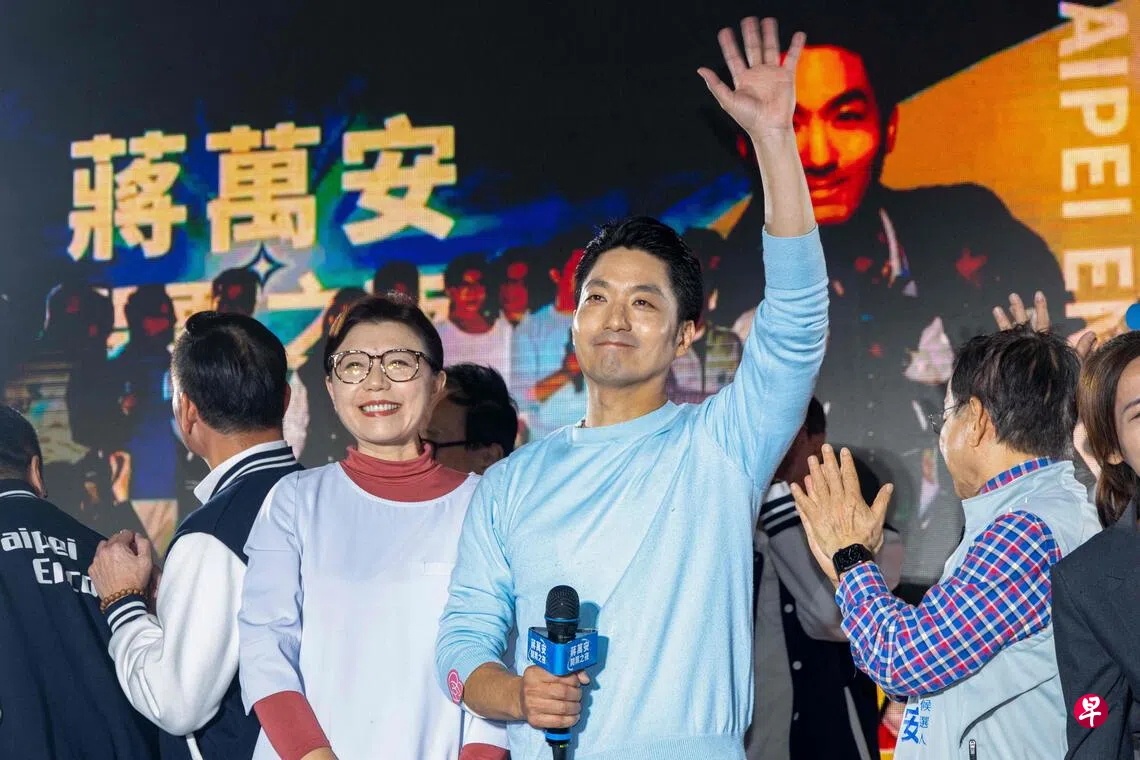
In Taipei, where the contest was fiercest, Chiang was initially favoured to win re-election. As campaigning entered its final stages, however, the “Yang wave” generated by DPP candidate Shen gathered momentum, and the mayoral race briefly tightened. Chiang ultimately won by 116,726 votes, with an 8.03-percentage-point lead in the vote share.
Chiang arrived at his campaign headquarters at about 8pm on Saturday and delivered his victory speech: “Tonight, after a long and fiercely contested democratic contest, we held on together to the very end.” He also thanked residents who had not voted for him, saying “every vote against us, every hesitation” would spur him and his team to do better.
Chiang said Taichung mayor Lu Shiow-yen, who chaired his campaign, had steadied the team at a critical moment. TPP founding chairman Ko Wen-je and current chairman Huang Kuo-chang were among those who had also come to his aid. He said he would continue working with the TPP on municipal and city council affairs.
Chiang also thanked his wife, Shih Fang-keng, who had canvassed widely for him during the campaign. He briefly choked up and shed tears before turning to embrace her.
Shortly before that, at about 7.50pm, Shen had taken to the stage outside his campaign headquarters to concede defeat. Many supporters shouted: “You haven’t lost” and “You were great”.
Shen urged everyone to trust the vote count, stressing: “Taiwan’s democracy is worthy of trust. We can lose an election, but we cannot lose Taiwan’s democracy.”
He said: “Whoever won today, this is a victory for Taipei and a victory for democracy. Taiwan’s democracy is therefore still the winner.” He also said he alone bore responsibility for the defeat and asked supporters not to blame residents who had not voted for him, “because the will of the people is always right”.
Lai, who is also DPP chairman, had strongly backed drafting Shen to run for Taipei mayor. He embraced Shen before delivering his remarks on stage. Lai said that while he accepted the result rationally, he still felt for Shen and his supporters after all their hard work. Invoking a Taiwanese saying about snails retaining water to survive the winter, he urged supporters to remain united and said Shen would continue building his presence in Taipei.
Margins below three percentage points in New Taipei and Taichung
The winning margins in the New Taipei and Taichung mayoral races were both below three percentage points. The DPP’s Su Chiao-hui lost to Lee Sichuan in New Taipei by about 65,000 votes, while KMT candidate Johnny Chiang lost to the DPP’s Ho Hsin-chun in Taichung by about 35,000 votes.
Qi Dongtao, a senior research fellow at the National University of Singapore’s East Asian Institute, told Lianhe Zaobao that the local elections amounted to a “small loss” for the KMT and a “small win” for the DPP.
He said holding Taipei and New Taipei had “allowed the KMT to breathe a sigh of relief”, but losing Taichung was a considerable surprise.
Qi said the “Yang wave” may have stirred a sense of crisis among blue-camp supporters and mobilised the party’s base in Taipei and New Taipei. It may also have prompted the KMT to focus its campaign support on Taipei and underestimate the risk of losing Taichung. The wave’s spillover effect may also have helped Ho win.
On the KMT’s preparations for the 2028 presidential election, Qi said Lu deserved credit for helping Chiang Wan-an’s campaign, but the loss of Taichung had weakened her advantage in seeking the presidential nomination. Chiang’s larger-than-expected winning margin had further consolidated his standing within the party, while holding Taipei and New Taipei had eased pressure on party chairwoman Cheng Li-wun to step down. How the three coordinate their next moves will pose a challenge for the KMT.
Qi said: “A small loss poses a greater challenge than a heavy defeat to coordination and unity within the KMT.”
