

Taiwan’s rival political camps held competing rallies on the same day in the Kaohsiung mayoral race. Kuomintang (KMT) candidate Ko Chih-en sought to turn her post-debate momentum into votes as her camp stepped up attacks on the Democratic Progressive Party’s (DPP) New Tide faction. DPP candidate Lai Jui-lung, meanwhile, received a personal show of support from President Lai Ching-te, who also chairs the party.
Morale in Ko’s camp soared after the debate on 30 October, with internal assessments suggesting she could scrape a win if turnout rises. Academics, however, say overturning the DPP’s dominance in this stronghold will be a considerable challenge, given the resources the party commands in both central and local government.
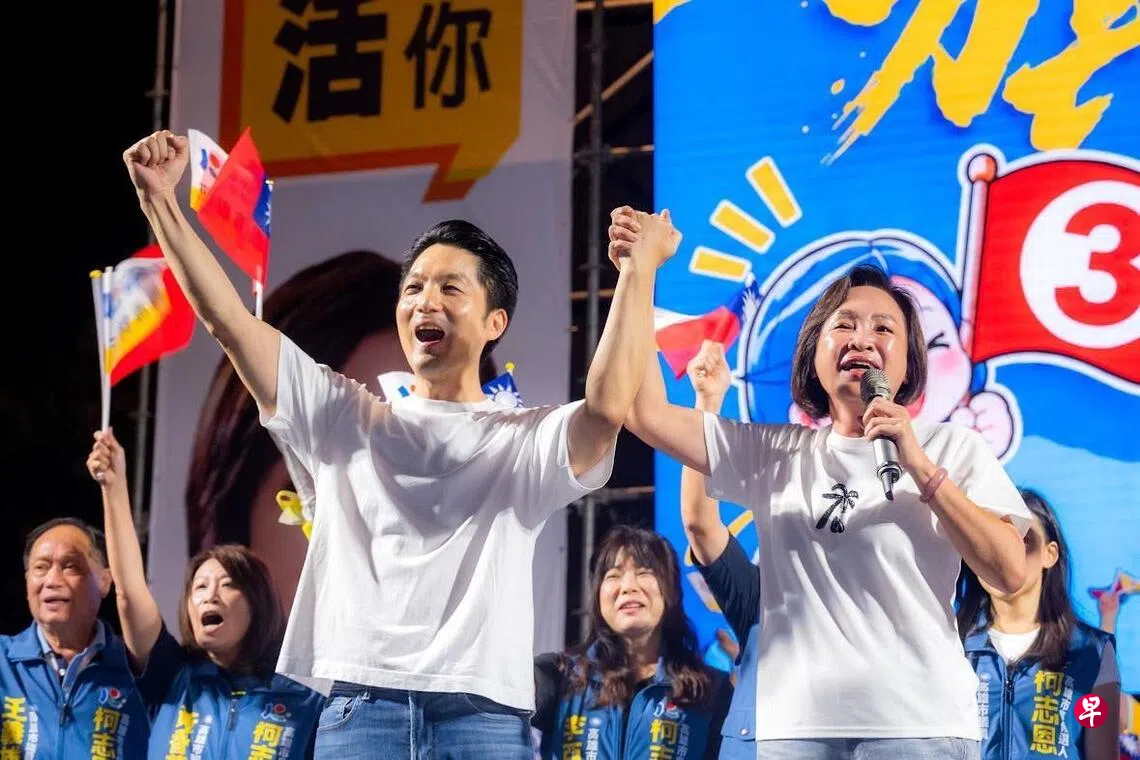
On Saturday (7 November), Ko held the third and final rally in her “Three Shan” series in Kaohsiung’s Qishan district. Organisers said it drew more than 20,000 people. Taipei Mayor Chiang Wan-an, who is seeking re-election, travelled south to support her. Taiwan People’s Party (TPP) chairman Huang Kuo-chang and former Legislative Yuan speaker Wang Jin-pyng, who chairs Ko’s campaign headquarters, also attended. Hsu Kuo-tai, a founding member of the DPP and former legislator, spoke in support of her too.
Addressing her post-debate momentum, Ko said in her speech that she had spent the past four years travelling across Kaohsiung and understood residents’ concerns. “It’s not that I’m a good speaker. It’s that I want to speak up for everyone.” She also highlighted the uneven distribution of resources since Kaohsiung city and county merged, accusing the DPP of long neglecting development in the former county’s districts because it assumed voters there “would vote for it anyway”.
A 53-year-old Qishan resident who gave her surname as Jiang told Lianhe Zaobao (LHZB) that, despite the DPP’s many years in power in Kaohsiung, there had been little development in Qishan, and most young people had to leave to find work elsewhere. She had therefore come of her own accord to support Ko, wanting to “give another party a try”.
Huang and Hsu directed their attacks at the DPP’s New Tide faction. Huang said that although Lai Jui-lung called himself a “son of a worker”, he had followed the party line or been absent from votes on labour rights, making him a typical member of “New Tide’s voting bloc”. Huang also pledged the TPP’s full support for Ko.
Hsu accused New Tide of smearing fellow DPP legislator Lin Tai-hua during the party’s Kaohsiung mayoral primary, saying the faction “has no compassion”. Chiang did not name New Tide, but stressed that politicians should answer to the people, not factions.
On the same day, at almost the same time, Lai Jui-lung held a rival rally in Kaohsiung’s Gangshan district. Lai Ching-te travelled south to campaign for him for the third time. Kaohsiung Mayor Chen Chi-mai, Presidential Office Secretary-General Pan Men-an and Interior Minister Liu Shyh-fang were among those who attended. The DPP’s Taipei mayoral candidate, Puma Shen, lent his support remotely through a pre-recorded video.
Lai Ching-te stressed that Kaohsiung’s development in recent years was the result of cooperation between central and local government. He urged voters to support Lai Jui-lung as the city’s next mayor so that Kaohsiung could keep progressing and “never turn back”. Lai Jui-lung pledged to develop a semiconductor packaging and testing centre, establish an industrial upgrading fund and continue advancing transport infrastructure projects.
Academic: Ko is fighting alone in Kaohsiung
These were also the first major rallies held by Ko and Lai Jui-lung since their debate. A senior campaign official in Ko’s camp told LHZB that she had “trounced” Lai in the debate, giving the team a morale boost.
He noted that the DPP had long governed Kaohsiung and had a larger support base than the KMT, making turnout “the key to victory or defeat”. In his assessment, Ko would have “no chance” if turnout remained at around 58%, the level in the previous election. But if it rose to 66% to 67%, she would have a chance of a narrow victory.
Explaining why Ko’s camp was concentrating its attacks on the DPP’s New Tide faction, he said: “Targeting New Tide is a strategic consideration.” The three other contenders whom Lai Jui-lung defeated in the DPP primary were not members of New Tide. If their supporters could be left “feeling disgruntled” and persuaded to sit out the election, weakening the DPP camp’s voter mobilisation, while Ko’s supporters were encouraged to turn out, she would have a fighting chance.
Chu Chao-hsiang, an adjunct professor at Chinese Culture University’s Graduate Institute of National Development and Mainland China Studies, said Ko had gained momentum after the debate, “but it has not yet been enough to turn the race around completely”.
He said the race could shift only if Ko actively mobilised voters in the final weeks before polling day, creating a sense of urgency — either that defeat was looming or that victory was within reach — to bring potential pan-Blue voters to the polls. Otherwise, even if Lai Jui-lung had “made every possible mistake” in the debate, he could still win narrowly in Kaohsiung, where turnout among DPP supporters tends to be high.
Liu Chao-lung, an associate professor in the Department of Public Affairs and Civic Education at National Changhua University of Education, said Ko faced more than the disadvantage of a much smaller voter base. He described her as fighting alone in Kaohsiung, while Lai Jui-lung had the backing of incumbent mayor Chen Chi-mai’s record in office and the resources of DPP-led central and local governments. “It’s a whole group of people fighting against you alone.”
Liu said the KMT had long neglected to cultivate political talent in Kaohsiung. Local factions that once had the ability to mobilise voters had also gradually declined. The party was fielding fewer candidates who could win, and its grassroots organisations’ ability to mobilise voters had weakened accordingly.
He said the KMT’s former heavyweights no longer wielded the political influence they once had, and the party lacked senior figures who could lift Ko’s electoral prospects. Even with Wang Jin-pyng personally taking on the chairmanship of her campaign headquarters, the support he could provide remained very limited.
