

As Taiwan’s nine-in-one local elections enter their final stretch, Kuomintang (KMT) Kaohsiung mayoral candidate Ko Chih-en has regained momentum following a televised debate, with some supporters even dubbing her a “female warrior”. Figures in the pan-Blue camp say her performance has not only lifted supporters’ morale but also attracted voters who previously paid little attention to the Kaohsiung race, extending her reach beyond her usual base.
The debate was held last Friday (30 October). Ko went on the offensive, criticising Democratic Progressive Party (DPP) candidate Lai Jui-lung for being backed by the party’s New Tide faction and bluntly calling him a “New Tide baby”. During her closing statement in the final 10 minutes, she announced that she would set aside her prepared remarks. Taking aim at Lai’s description of himself as the next to take the baton as Kaohsiung’s “fourth runner”, she accused the DPP of treating the city as its exclusive preserve and vowed to “strike out” her opponent.
Clips of the exchanges were subsequently circulated on social media platforms including Facebook and Threads. Taiwanese media, citing pan-Blue figures, reported that the videos had reached beyond political echo chambers. Ko also found the public more enthusiastic than before when she canvassed for votes at traditional markets after the debate.
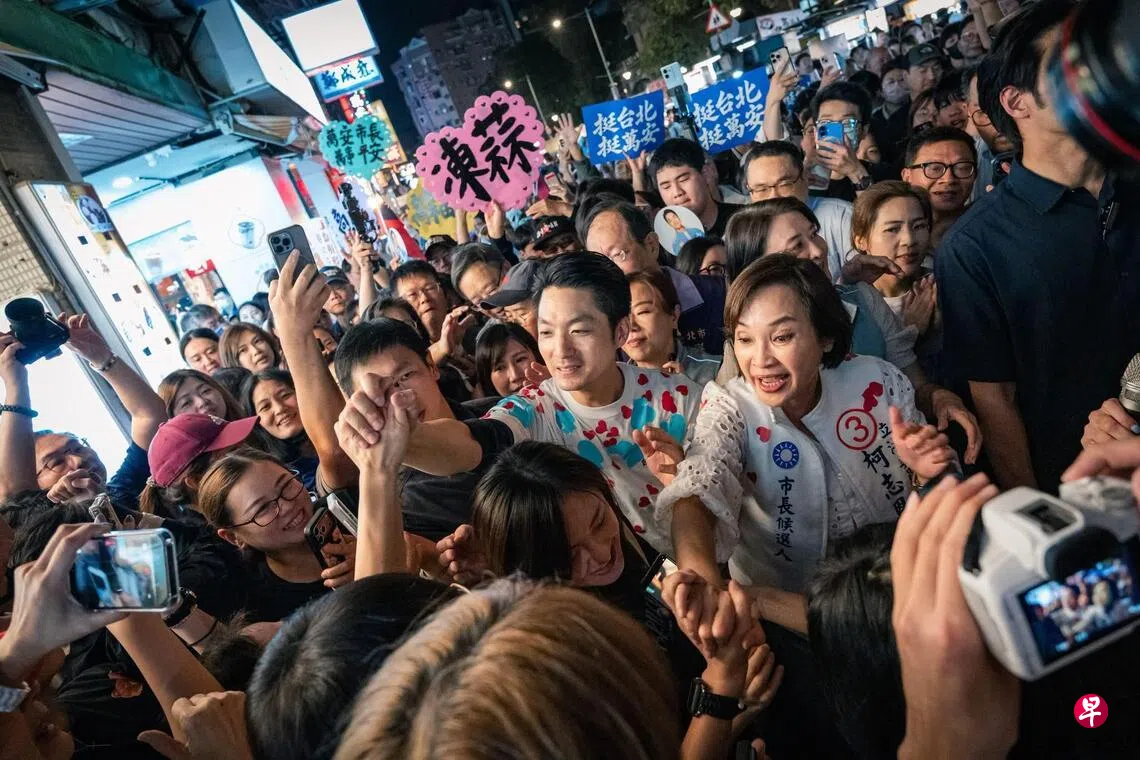
Ko’s campaign office said that, to sustain the benefits of this wider reach, she made a special trip north on Tuesday (3 November) evening to canvass at Ningxia Night Market with Taipei Mayor Chiang Wan-an, who is seeking re-election. Supporters chanted “Turn Kaohsiung around, Taipei will win” as the pair shook hands, posed for photographs and signed autographs along the way.
Academics interviewed said Ko’s debate performance had helped lift morale in the pan-Blue camp and build campaign momentum. But whether the enthusiasm can extend further beyond her existing supporters and translate into votes remains to be seen.
Liu Chia-wei, a professor in the Department of Public Administration and Policy at National Taipei University who watched the entire debate, told Lianhe Zaobao (LHZB) that Ko was well prepared, forceful in her attacks and composed. She highlighted Ko’s questioning of Lai’s ties with solar power businesses, which Lai failed to address adequately. The candidates also clashed over amendments to the Act Governing the Allocation of Government Revenues and Expenditures, as well as party and factional interests, with barely a lull throughout the debate.
However, Liu Chia-wei noted that existing electoral research suggests candidate debates generally have only a limited impact on election outcomes. “Most people have already made up their minds,” she said. Debates do more to consolidate existing support than to change voters’ intentions.
On the pan-Blue camp’s claim that Ko had successfully broadened her appeal, Liu Chia-wei said this was also a campaign strategy. Ko’s joint appearance with Chiang in Taipei helped sustain her post-debate momentum and, by linking campaigns in the north and south, created an impression of growing support.
DPP keeps campaign low-key: Can final ‘Three Mountains’ rally energise the race?
Liu Chao-lung, an associate professor in the Department of Public Affairs and Civic Education at National Changhua University of Education, also said Ko had regained momentum after the debate. But a persistent gap remains between the pan-Blue and pan-Green support bases in Kaohsiung. Even in 2018, when Han Kuo-yu rode a wave of enthusiasm dubbed the “Han wave” to win the mayoralty, defeated DPP candidate Chen Chi-mai still secured 44.8% of the vote, demonstrating the pan-Green camp’s solid support base.
Two polls on the Kaohsiung mayoral election released on Monday (2 November), by United Daily News and Fengcan Media, both showed Lai ahead of Ko, with leads of seven and 20.4 percentage points respectively. The United Daily News poll was conducted over a period spanning the televised debate on 30 October, while Fengcan Media’s survey was completed before the debate.
Liu Chao-lung said Ko had continued to cultivate support in Kaohsiung over the past few years and had performed reasonably well in the 2022 mayoral election. However, the DPP was pursuing a low-key campaign in Kaohsiung, avoiding moves that would heat up election issues because “the quieter the race, the better it is for the incumbent”.
In the 2022 nine-in-one local elections, Ko challenged the DPP’s Chen Chi-mai, who was seeking re-election as Kaohsiung mayor. She secured 40.16% of the vote, losing to Chen’s 58.1%.
Ko will hold the third and final rally in her “Three Mountains” series in Qishan on Saturday (7 November), with Chiang expected to travel south to lend his support. When Han ran for Kaohsiung mayor, he also held a succession of large rallies in Fengshan, Qishan and Gangshan, eventually ending the DPP’s long grip on the city.
Liu Chao-lung explained that Fengshan and Gangshan had military academies and military dependants’ villages in the past and were traditional pan-blue strongholds. Qishan, meanwhile, has a proportion of Hakka voters and strong clan associations. Successful mobilisation for the “Three Mountains” rallies would therefore help bolster the pan-Blue camp’s momentum. Whether Saturday’s finale in Qishan can sustain the post-debate enthusiasm and turn online buzz into an in-person turnout will be a key development to watch.
