

Taiwanese President Lai Ching-te has appointed Stan Shih, Acer co-founder and honorary chairman, to represent Taiwan at the Asia-Pacific Economic Cooperation (APEC) Economic Leaders’ Meeting in Shenzhen, mainland China, next week. Lai said Taiwan would participate in this year’s APEC meetings on the principle of equal engagement.
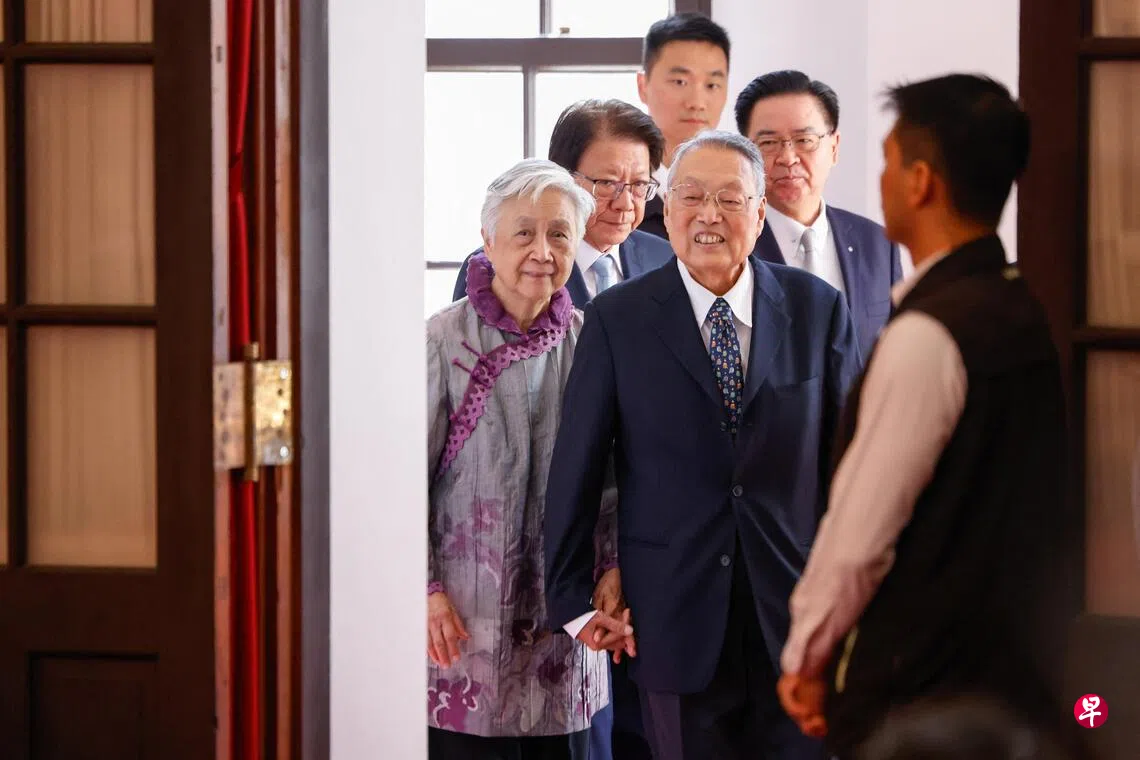
Taiwan’s Presidential Office announced the appointment on Wednesday (11 November) and held a pre-departure press conference for the delegation on Thursday (12 November) morning, attended by Lai, Shih and Shih’s wife, Carolyn Yeh.
Lai said at the press conference: “APEC is the Asia-Pacific region’s most important multilateral mechanism for economic and trade cooperation. All members engage with one another on an equal footing, and Taiwan will participate in this year’s APEC meetings on the same basis.”
He also thanked like-minded countries for continuing to emphasise the importance of Taiwan’s participation in the various meetings throughout the preparations for APEC. He expressed hope that Shih would convey Taiwan’s key positions on three fronts — regional economic and trade cooperation, technological development and supply chain resilience — to all APEC leaders and the international community.
Lai stressed that Taiwan’s active participation in APEC affairs is not only about safeguarding its own economic interests, but also about sharing its experience and making its voice heard internationally. Taiwan also plays a critical role in the global semiconductor supply chain and is an important partner in artificial intelligence (AI) innovation and development, as well as digital transformation. Faced with geopolitical challenges, energy issues and supply chain restructuring, Taiwan would remain a stable and trusted force in the Asia-Pacific region and deepen cooperation with key partners, he said.
Shih, 81, previously served as Taiwan’s representative at the APEC Economic Leaders’ Meeting in Sydney, Australia, in 2007. He thanked Lai for entrusting him with the role, giving him the opportunity to represent Taiwan at the meeting again after 19 years, and said he was “fully aware of the weight of this responsibility”.
Shih said AI was a key topic at this year’s APEC meetings and also an area of strength for Taiwan. He would use the opportunity to engage with leaders of other economies and convey the three positions outlined by Lai, highlighting Taiwan’s importance as an international partner and continuing its role in APEC as a “partner in shared interests”.
Responding to questions from the media after the press conference, Presidential Office spokesperson Karen Kuo said Taiwan, as a full APEC member, is entitled to participate fully in its proceedings and would demand immediate redress if it faced unfair treatment. Taiwan had also previously asked mainland China for written guarantees of the delegation’s personal safety and conditions allowing it to participate with equality and dignity.
In an interview with Lianhe Zaobao (LHZB), Chih-sheng Wang, secretary-general of the Asia-Pacific Elite Interchange Association, noted that Taiwan usually gives priority to candidates with government experience when choosing its representative to the APEC leaders’ meeting, followed by highly respected business leaders. Shih’s experience as Taiwan’s representative in 2007, coupled with his standing in the business community, made him a suitable choice.
Responding to the Kuomintang Caucus’s criticism that the appointment had been announced too late, Wang said that, with mainland China hosting APEC this year, the two sides of the Taiwan Strait might have needed to communicate and coordinate on the arrangements, although the actual process was not known to outsiders. “Both Taiwan and the mainland have been relatively more cautious about the choice of representative for this APEC meeting.”
Mainland China’s Ministry of Foreign Affairs and Taiwan Affairs Office had both previously stressed that Taiwan’s participation would be handled in accordance with the one-China principle, the provisions of the relevant APEC memorandum of understanding and established practice. The Taiwan Affairs Office spokesperson did not directly answer questions on whether mainland officials would interact with Taiwan’s representative or facilitate exchanges between Taiwan’s representative and other economies.
