

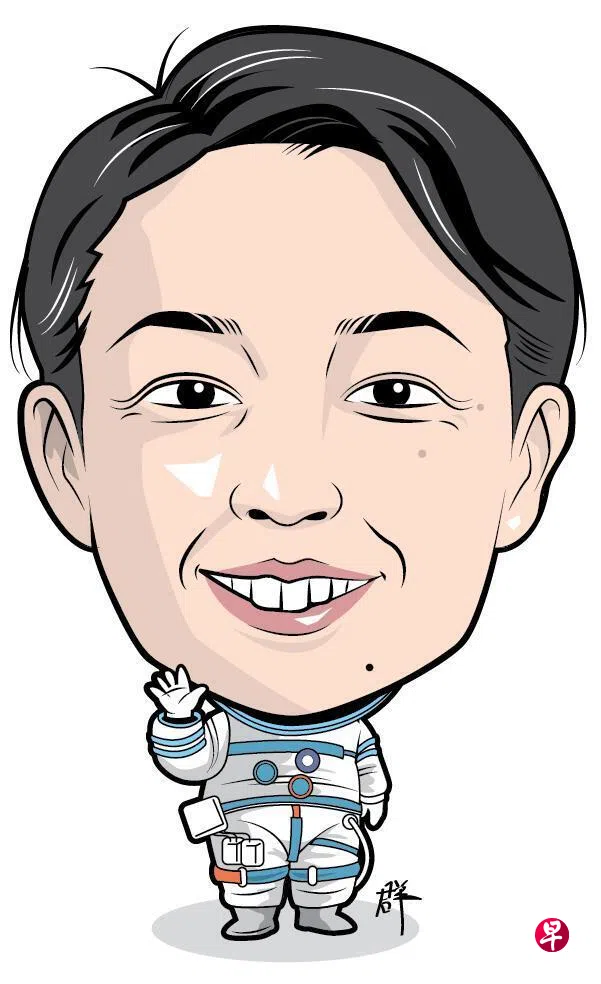
China’s Shenzhou-24 crewed spacecraft successfully lifted off on Wednesday (25 November). Drawing the most attention was Pakistani astronaut Muhammad Zeeshan Ali, who made history as the first foreign astronaut to enter China’s Tiangong space station. For Hong Kongers, however, the mission has another important highlight: Lai Ka-ying, the first Hong Kong-born astronaut, is about to complete her six-month stay in space and return to Earth aboard Shenzhou-23.
Lai, now 44, was born in Hong Kong in November 1982 and has ancestral roots in Shunde, Guangdong. In 1997, on the eve of Hong Kong’s return to China, the then 15-year-old joined her family on the streets of Tsim Sha Tsui to witness the historic moment. Among her most vivid memories of that night are watching police officers on duty change their cap badges and seeing her parents beside her moved to tears.
After secondary school, Lai enrolled in computer science at the University of Hong Kong, continuing through to a doctorate with a focus on computer forensics and cyber crime. The internet industry was booming at the time, and with her qualifications, she could easily have found a well-paid private-sector job. Instead, she joined the Hong Kong Police Force’s technical services department, eventually rising to the rank of superintendent.
Lai’s doctoral supervisor once told the media that she had shown considerable patience in her university research and could remain highly focused while processing large volumes of data. Before conducting experiments, she would often think carefully about what might go wrong at each stage and how to respond. These seemingly ordinary personal qualities later proved to be precisely what she needed to become a qualified astronaut.
In 2022, China began selecting its fourth batch of astronaut candidates, opening recruitment for payload specialists to Hong Kong and Macao for the first time. The news generated an enthusiastic response in Hong Kong. A total of 120 people applied that year, and the Hong Kong government ultimately recommended 40 candidates. After several rounds of rigorous assessments, Lai became the only Hong Kong candidate selected.
In August 2024, Lai formally joined China’s astronaut corps and began a demanding training programme. For a mother of three in her 40s, setting aside a familiar job and family life to become a student again was no easy task. Yet in just over a year, she completed more than 200 training subjects across eight categories, clocking over 1,700 hours of instruction and passing her flight qualification assessment with excellent results.
In May this year, Lai was selected for the Shenzhou-23 crew, becoming China’s fourth woman to travel into space and the first female payload specialist aboard the Chinese space station.
Twenty-nine years ago, Lai was a teenage girl looking up at the sky from Tsim Sha Tsui. Today, she can look down from hundreds of kilometres above at the city where she grew up. Her six months in space have been far from easy. Besides studying the growth and genetic changes of rice in space, she has operated the station’s robotic arm from inside the cabin to support her crewmates during a spacewalk to carry out repairs. Her years of experience handling precision technical work in the police force have found a new application in space.
For Hong Kongers, one of Lai’s most memorable appearances was during a lesson broadcast from the Chinese space station specifically for Hong Kong and Macao students in September this year. Speaking in familiar Cantonese, she introduced them to life in space and joined her crewmates in demonstrating a range of engaging science experiments. When discussing the small cakes baked aboard the station, she recalled her favourite Hong Kong street snack, egg waffles. For many children in Hong Kong, space had suddenly become a little less remote and a little more familiar.
Hong Kong is a city dominated by finance, trade and property. The prevailing view is that medicine, law and finance offer the best careers for young people seeking success. Those pursuing scientific research have a relatively limited sense of the career possibilities open to them. Lai has shown Hong Kong’s young people that studying science and pursuing research can also open up a world of opportunities.
As Lai prepares to return to Earth, the first space journey by Hong Kong’s first astronaut is drawing to a close. But for the city’s younger generation, her extraordinary journey marks the beginning of many new dreams.
