

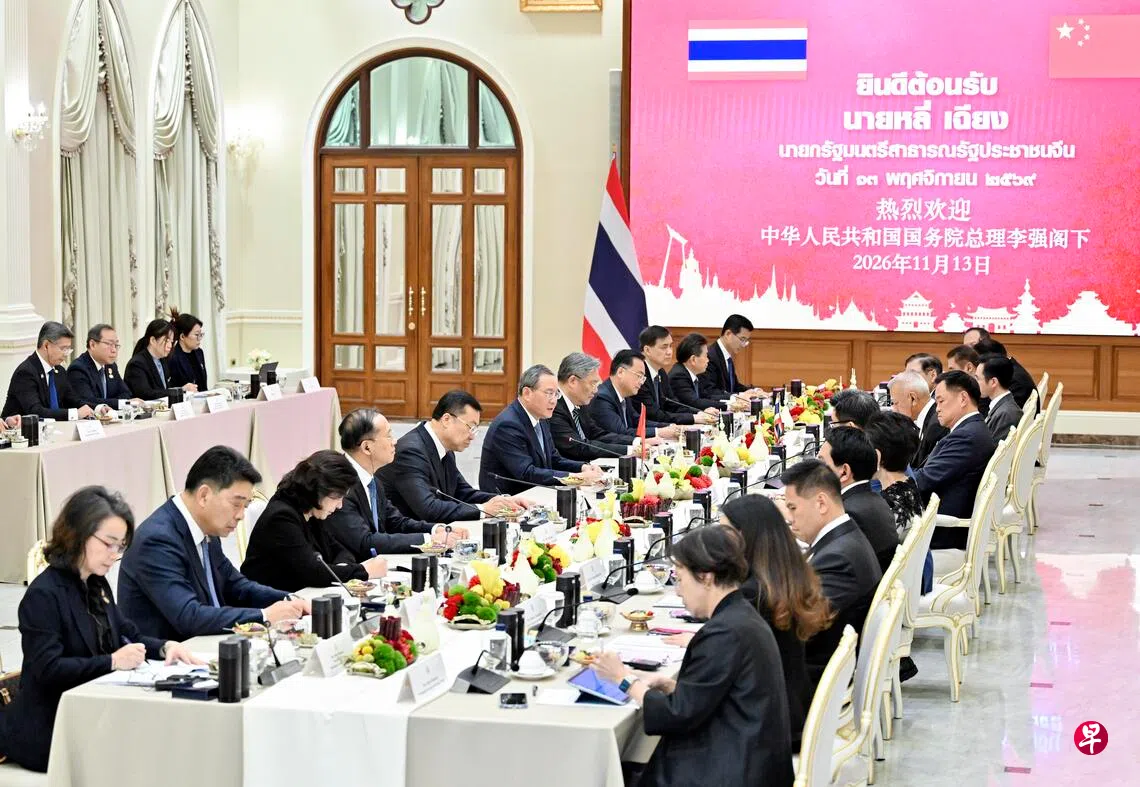
(Bangkok, agencies) Chinese Premier Li Qiang said on his first visit to Thailand that China was willing to expand cooperation with the country in finance, new energy, semiconductors and artificial intelligence (AI). The two countries signed eight cooperation documents covering areas including security, the automotive industry and agriculture.
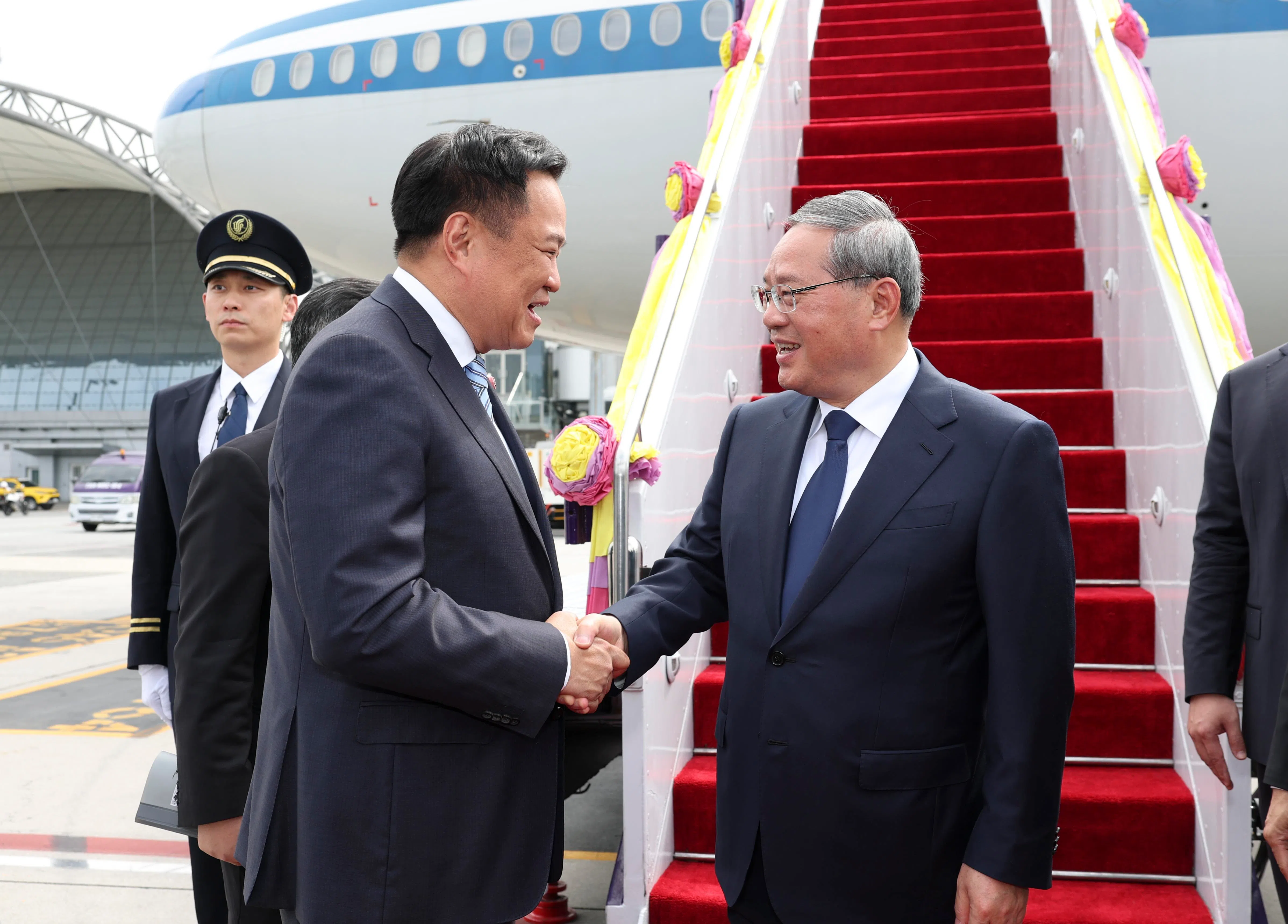
According to Xinhua and the Thai government’s social media accounts, Li is making an official visit to Thailand from Friday to Sunday (13 to 15 November) at the invitation of Thai Prime Minister Anutin Charnvirakul. This is the first official visit to Thailand by a Chinese premier since 2019. Anutin personally welcomed Li at the airport in Bangkok when he arrived on a chartered flight on Friday.
At the start of their talks on Friday, Li noted that Anutin had made an official visit to China in July this year. “With my visit to Thailand, the two countries’ prime ministers have exchanged visits within four months, fully demonstrating the high level of bilateral relations,” he said.
Li said China was willing to work with Thailand to better align their development strategies, implement major projects such as the China-Thailand railway, accelerate consultations on a new five-year plan for economic and trade cooperation, and expand cooperation in finance, new energy, semiconductors and AI. China was willing to import more high-quality Thai products and encourage Chinese companies to invest and do business in Thailand, he said, expressing hope that Thailand would provide a fair, stable and predictable business environment.
He also said both sides should strengthen exchanges and cooperation in disaster prevention and mitigation, water resources management, education, tourism and the media, and step up efforts to combat illegal and criminal activities so that people could enjoy more tangible benefits from China-Thailand cooperation.
After the talks, the two leaders jointly witnessed the signing of eight cooperation documents covering the automotive industry, vocational education, agriculture, customs and security, among other areas. The Thai government said the agreements were expected to create opportunities for Thai farmers, businesses and workers.
The Thai press release did not provide details of Anutin’s remarks. According to the Chinese account, Anutin said during the talks that Thailand was willing to strengthen high-level exchanges with China, make use of mechanisms such as the “2+2” strategic dialogue between their foreign and defence ministers, expand bilateral trade, and deepen mutually beneficial cooperation in agriculture, finance, connectivity, electric vehicles, AI, e-commerce, science and technology, and other areas.
According to the Chinese press release, Anutin also told Li that Thailand was willing to continue providing a favourable business environment for Chinese companies investing in the country, strengthen bilateral law enforcement and security cooperation, combat crimes such as online gambling and telecommunications fraud, and ensure the safety of Chinese tourists.
Thailand’s The Nation reported that Thai Tourism and Sports Minister Surasak Phancharoenworakul said earlier this month that Thailand and China planned to set up a joint working group to protect tourists and combat scams that lure Chinese citizens across the border into Myanmar. The proposed cooperation came as Chinese tourist arrivals in Thailand fell 13.57% year on year in October, the first decline since February this year. The Chinese embassy in Thailand had earlier issued a travel safety advisory.
On Saturday (14 November), Li also met Sophon Saram, president of Thailand’s National Assembly and speaker of the House of Representatives, before attending a China-Thailand business roundtable with Anutin. Li called on businesses from both countries to expand bilateral cooperation beyond food and dining into digital, AI and green sectors. He also said China encouraged Chinese companies to further localise their operations in Thailand.
Li said construction of the China-Thailand railway was progressing steadily, the Pinglu Canal had officially opened to navigation, and “soft connectivity” in areas such as economic and trade rules, standards and finance was continuing to improve. Chinese and Thai businesses should make their industrial and supply chains more complementary and integrated, and work towards the alignment and mutual recognition of industry standards, he said. Through more efficient coordination, they could jointly enhance their competitiveness and move up global value chains.
