

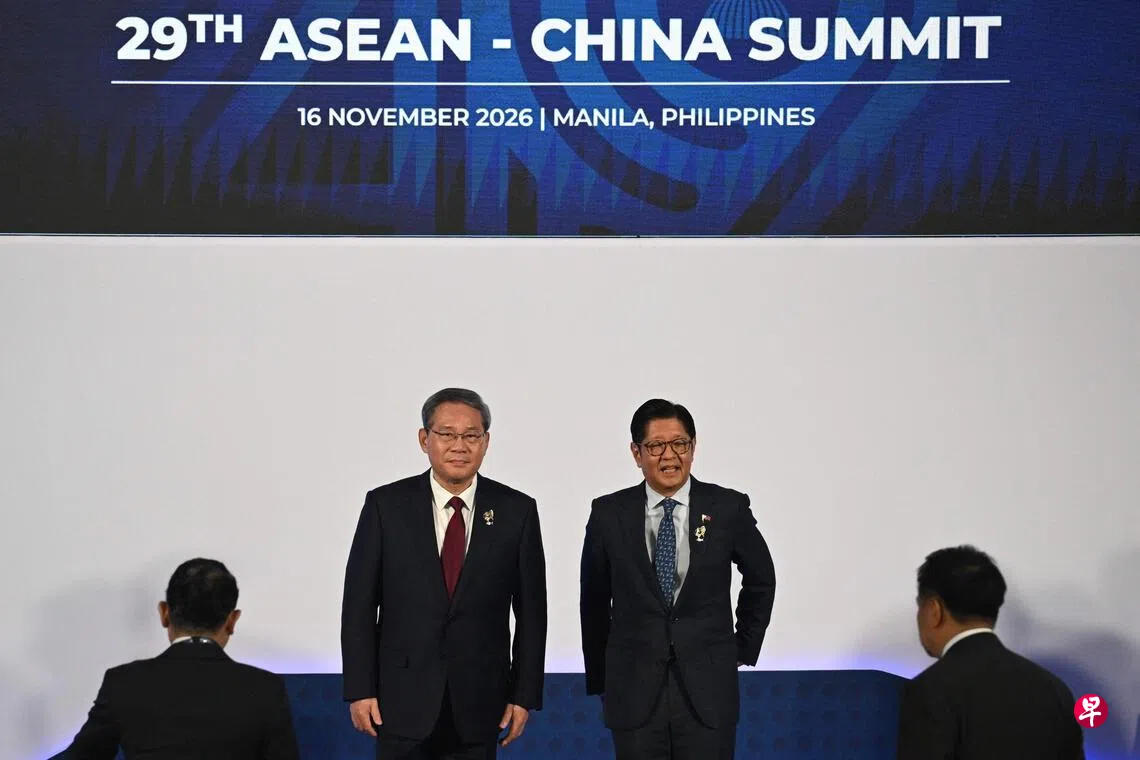
Chinese Premier Li Qiang said at the ASEAN-China Summit that longstanding friendly ties between China and ASEAN had withstood international turbulence, with both sides remaining firmly committed to multilateralism despite a sharp increase in global economic and trade restrictions.
Speaking at the ASEAN-China Summit in Manila, the Philippines, on Monday (16 November), Li said unilateralism and protectionism had gained ground internationally over the past five years, while geopolitical conflicts had erupted one after another, Xinhua reported. Against this backdrop, China-ASEAN cooperation had bucked the trend and delivered encouraging results. Bilateral trade exceeded US$1 trillion (S$1.29 trillion) last year, up 20.1% from 2021. Cumulative two-way investment has surpassed US$500 billion, an increase of more than 50% from five years ago.
Li stressed that the achievements of the past five years had been hard-won. They showed that the longstanding friendship between China and ASEAN countries had not faded amid international turbulence, but had instead grown more mature and resilient as they confronted challenges together. China and ASEAN had long supported and promoted economic globalisation and regional integration. Even as international economic and trade restrictions increased sharply, they remained firmly committed to multilateralism and free trade, continually expanding the benefits of cooperation.
He said that, in a turbulent world, China and ASEAN should stand even more firmly together, overcome interference and build a closer China-ASEAN community with a shared future, bringing greater stability and certainty to global development and prosperity.
Li said the more complex and challenging the international situation became, the more China and ASEAN needed to strengthen strategic mutual trust, remain committed to properly managing differences through dialogue and consultation, jointly oppose external interference, and safeguard regional peace and stability. China looked forward to the early conclusion of a Code of Conduct in the South China Sea to provide a firm institutional foundation for lasting peace and stability in the South China Sea.
He said China and ASEAN should seize the opportunity presented by the entry into force of the protocol to upgrade their free trade area to version 3.0 to deepen cooperation in industrial and supply chains, accelerate physical connectivity through infrastructure such as railways and roads, and strengthen institutional connectivity through mechanisms, standards and rules. China welcomed the establishment of a China-ASEAN energy cooperation partnership and an energy ministers’ meeting mechanism. It was ready to work with ASEAN to make next year’s year of artificial intelligence cooperation a success, pursue “AI Plus” cooperation and explore alignment with the ASEAN Digital Economy Framework Agreement, creating a powerful engine for high-quality regional economic development.
Li concluded by saying that China would continue contributing to the ASEAN-China Cooperation Fund and was ready to strengthen cooperation with ASEAN in poverty reduction, disaster prevention and mitigation, and food security to promote sustainable development in the region. The China-ASEAN Digital Academy would offer 100 full scholarships to ASEAN countries next year. The China-ASEAN Maternal and Child Health Cooperation Centre was ready to work with ASEAN countries to train 1,000 professionals over the next three years, and welcomed participation from all parties. China was also ready to strengthen law enforcement cooperation with ASEAN to jointly combat transnational crime.
