

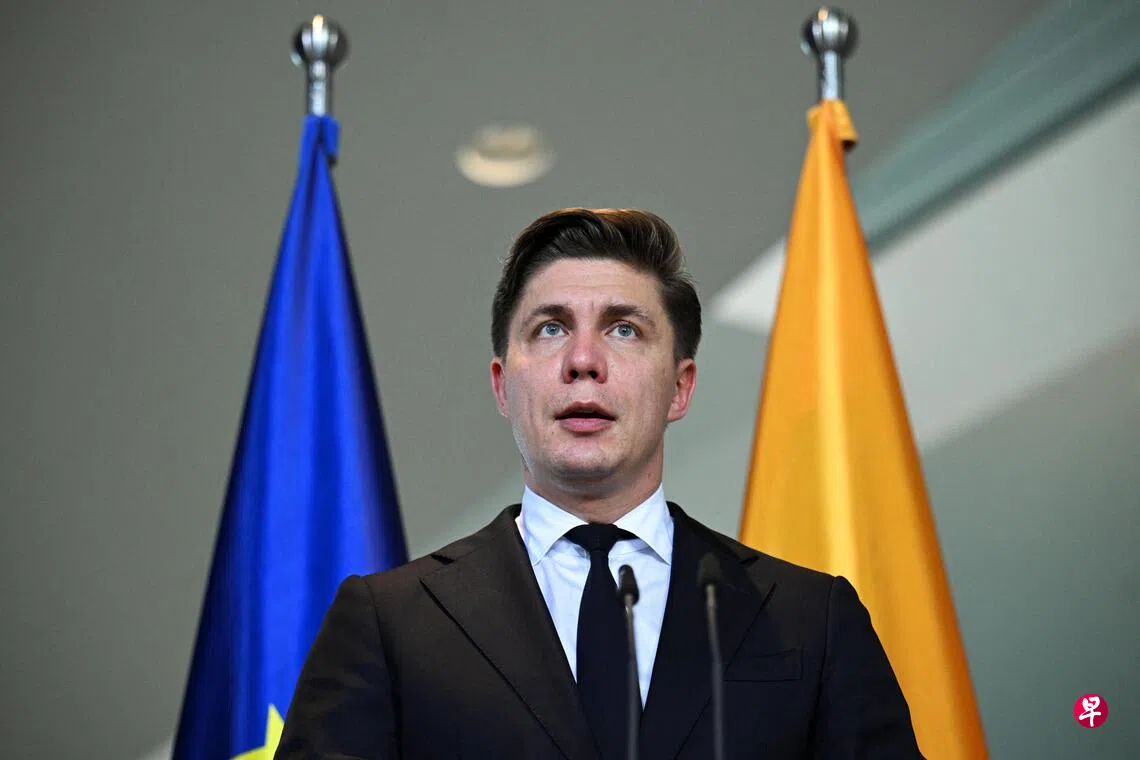
Lithuanian Prime Minister Mindaugas Sinkevičius said in an interview that Lithuania has the right to unilaterally revoke the legal status of Taiwan’s representative office in the country if it refuses to change its name.
The Lithuanian news agency on Wednesday (25 November) quoted Sinkevičius as saying: “We have heard the statements, and perhaps those decisions could change. If not, the state has a certain degree of legal discretion to take unilateral decisions. We would not want that, but this option could be used”.
Asked whether this meant revoking the Taiwan office’s legal status, Sinkevičius confirmed that Lithuania had the right to make such a decision.
He said: “We have diplomatic representation in our country – embassies. In addition to diplomatic missions, we also have other offices with diplomatic status – the office of [Belarusian opposition leader] Sviatlana Tsikhanouskaya and the Taiwanese office. These accredited offices were established by ministerial order […]. Since the legal basis for establishing them exists, it is natural that legislation also provides for scenarios in which such offices can either be expanded or scaled down. There is therefore room for legal manoeuvre here.”
In response to queries, Taiwan’s representative office in Lithuania said it respected the public debate over renaming the office, but had no intention of changing its name.
Separately, Lithuanian National Radio and Television reported that Matulionis, the Lithuanian president’s national security adviser, told Lithuania’s News Radio on Tuesday (24 November) that Taiwan should acknowledge its “mistake” and rename its representative office in Vilnius.
Taiwan’s representative office in Lithuania was established in 2021. Its English and Lithuanian names refer to it as the “Taiwanese Representative Office in Lithuania”, while its Chinese name refers to it as the Taiwan representative office. Beijing viewed Lithuania’s decision to allow Taiwan to establish the office as an overt show of support for Taipei’s pursuit of greater autonomy and international recognition.
Matulionis said: “The Foreign Ministry is in contact with Chinese representatives and is also trying to maintain contacts with Taiwan’s representatives in order to resolve this naming issue fundamentally in good faith. I think the ball is not in our court here, but in Taiwan’s court, and Taiwan should admit a certain mistake was made.”
He said the “mistake” was that the office had different names in different languages, and expressed hope that Lithuania’s Ministry of Foreign Affairs could find an “elegant” solution.
According to Matulionis, the naming dispute could be resolved without confrontation, but whether such a compromise would satisfy mainland China remained unknown.
According to Lithuanian online news outlet Delfi, Lithuanian Deputy Foreign Minister Verbickas and senior diplomat Šlepavičius presented an informal document to three people, including Taiwan’s representative to Lithuania, Constance Wang, at a meeting on 24 September. It called for the office to be renamed before the People’s Republic of China’s National Day on 1 October.
The report said Lithuania’s aim was to restore normal diplomatic relations with Beijing. Citing the document, it said the Taiwan office’s current name was hindering the development of economic ties between Lithuania and Taiwan. In exchange for a name change, Lithuania’s Ministry of Foreign Affairs pledged to send a vice-ministerial delegation to Taiwan, sign a confidentiality agreement on investment prospects between Lithuania and Taiwan, and begin negotiations on an avoidance of double-taxation agreement.
Lithuanian Member of Parliament Vėgėlė announced on 6 November that mainland Chinese diplomats were expected to visit on 11 and 12 November to meet representatives of Lithuania’s Ministry of Foreign Affairs and a group of MPs seeking to normalise diplomatic relations between Vilnius and Beijing.
Lithuanian President Nausėda revealed earlier this month that the Ministry of Foreign Affairs had briefed him on a possible name change for Taiwan’s representative office.
