

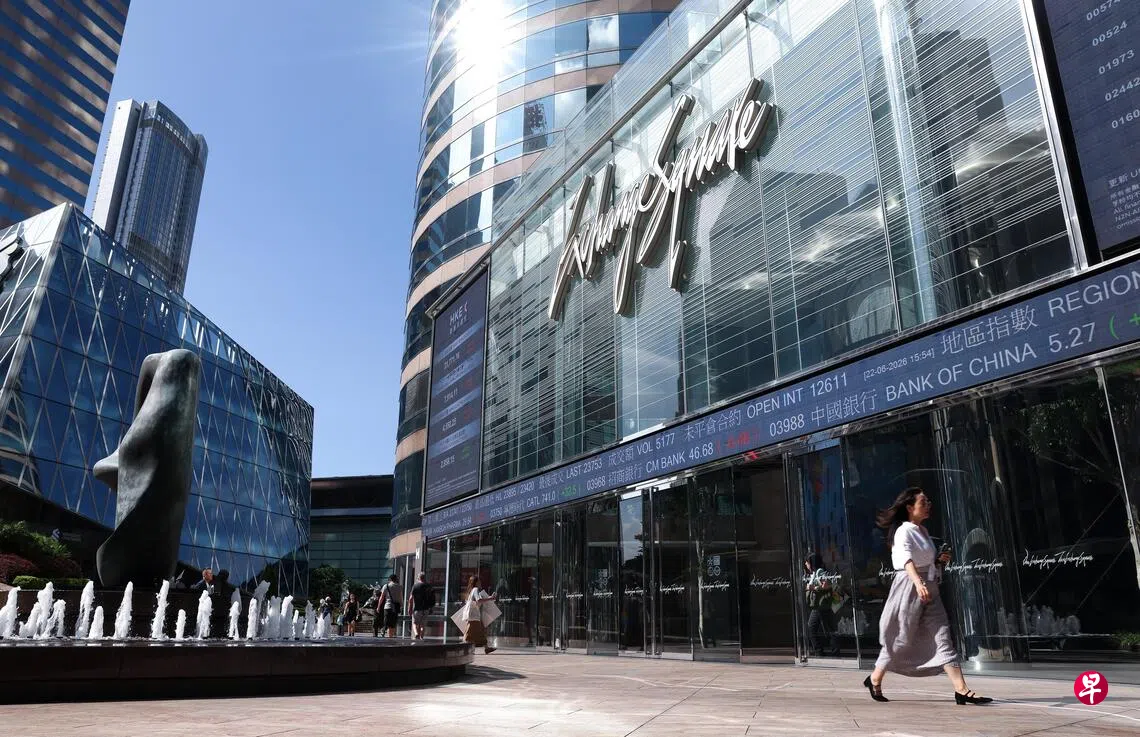
Mainland Chinese investors are pulling out of Hong Kong stocks at the fastest pace in more than five years, while large sums are flowing into exchange-traded funds tracking long-term government bonds as investors seek shelter in a rising bond market.
Data compiled by Bloomberg show that, as of Thursday (29 October), mainland Chinese traders had sold HK$24 billion (S$3.9 billion) worth of Hong Kong stocks through the Stock Connect programme since the start of October. At this pace, monthly outflows from Hong Kong stocks are on course to reach their highest level since 2021.
Hong Kong stocks have fallen for three consecutive months as enthusiasm for artificial intelligence (AI) cools and financing costs rise. The Hang Seng Index has lost 6.7% so far this month, marking its biggest monthly decline since June. The Hang Seng Tech Index has also erased almost all its gains since Beijing introduced large-scale monetary stimulus in September 2024.
Mainland Chinese investors have long been steadfast buyers of Hong Kong stocks, providing support during market downturns. Their retreat does not bode well for Hong Kong. Historically, the Hang Seng Index has tended to undergo a prolonged correction once mainland fund flows turn negative.
Jasmine Duan, a senior investment strategist at RBC Wealth Management Asia, believes the Hong Kong market could fall a further 10% to 15% before stocks truly bottom out. “The market remains most sensitive to US Treasury yield movements and fund flow dynamic.”
Technology stocks have borne the brunt of the sell-off, with mainland investors offloading large holdings in companies including chipmaker SMIC, e-commerce platform Alibaba and electric vehicle maker Xiaomi.
Scarlett Liu, an Asia-Pacific equity derivatives strategist at BNP Paribas, said many investors in Hong Kong stocks were concerned that high corporate capital expenditure (capex) could squeeze profit margins.
A lacklustre start to the third-quarter earnings season for Hong Kong-listed companies, coupled with Beijing’s cautious approach to introducing strong fiscal stimulus, has also disappointed investors.
Ping An Insurance’s earnings report this week showed a sharp drop in profit as investment returns fell. Tsingtao Brewery’s results also missed market expectations.
As A-shares and Hong Kong stocks continue to fall, Chinese investors are buying heavily into exchange-traded funds (ETFs) tracking long-term government bonds, seeking shelter in the bond market rally.
Data compiled by Bloomberg show that two onshore ETFs linked to 30-year government bonds attracted net inflows of 13.8 billion yuan (S$2.6 billion) in October, the highest level since July 2025.
The inflows have pushed the market values of both government bond funds to record highs. Since the start of the second half of this year, the Pengyang CCDC 30-Year Treasury Bond ETF has risen 57%, while the Bosera SSE 30-Year Treasury Bond ETF has gained 68%.
Liao Zhiming, chief fixed-income analyst at Huayuan Securities, said in a report that investors particularly favoured longer-dated bonds, which had room for further gains in the fourth quarter.
He expects lower borrowing costs and reduced bond supply to push the 30-year government bond yield towards 2% by the end of the year, from about 2.05% currently.
