

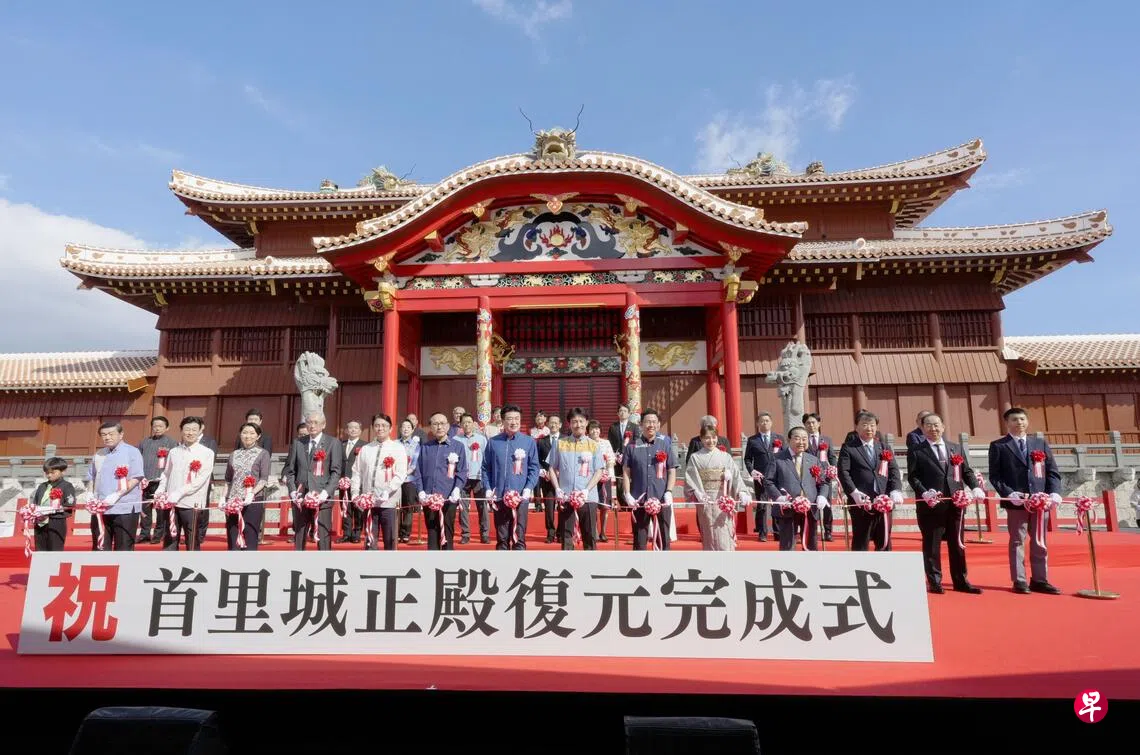
All mainland Chinese representatives invited to a recent ceremony marking the reopening of Shuri Castle’s restored main hall in Okinawa, Japan, were absent. Mainland authorities had earlier protested against the Okinawa prefectural government’s invitation to Taiwanese representatives. Japanese media assessed that this may have prompted the decision not to attend.
According to reports by Kyodo News and Japanese broadcaster NHK on Thursday (26 November), the restored main hall of Shuri Castle in Naha, Okinawa prefecture, officially reopened to the public on Monday (23 November). The prefectural government held a ceremony that day, inviting representatives from countries and regions with which Okinawa maintains exchanges.
The Okinawa prefectural government said those invited included representatives from Fujian province in mainland China, which has a friendship relationship with Okinawa, the Chinese Consulate-General in Fukuoka, and the Naha branch of the Taipei Economic and Cultural Representative Office in Japan. However, the prefectural government did not confirm the attendance of any mainland Chinese representatives at the ceremony that day.
The prefectural government disclosed that the Chinese Consulate-General in Fukuoka had expressed displeasure beforehand over the invitation to Taiwanese representatives. Okinawa Governor Genta Koja told a press conference on Thursday that the prefectural government had not specifically asked mainland authorities why their representatives were absent.
Separately, Japan’s central government held a ceremony last Sunday (22 November) to mark the completion of restoration work on Shuri Castle’s main hall. Taiwanese representatives were invited, but no mainland Chinese representatives were invited.
The Okinawa General Bureau of Japan’s Cabinet Office explained that Taiwan had been invited because it had supplied red cypress timber for the reconstruction of Shuri Castle. Mainland China had not been directly involved in the restoration work and was therefore not among those invited. The bureau also said it had received no protest from China over the matter.
According to Taiwan’s United Daily News (《联合报》), Taiwan-Japan Relations Association chairman Frank Hsieh and Taiwan’s representative to Japan, Lee Yi-yang, were among those who attended the central government’s ceremony marking the completion of restoration work. Taiwan was represented mainly by officials from its representative office’s Naha branch at the reopening ceremony hosted by the Okinawa prefectural government the following day.
Official exchanges between Okinawa and Taiwan have previously drawn Beijing’s displeasure. Mainland authorities lodged protests with the Okinawa prefectural government when then-governor Denny Tamaki visited Taiwan in 2023 and when he congratulated Lai Ching-te on his election as Taiwan’s president in 2024.
Shuri Castle, the centuries-old former royal palace of the Ryukyu Kingdom, was severely damaged during the Battle of Okinawa towards the end of the Second World War and later rebuilt. In October 2019, a major fire destroyed several of its principal buildings, including the main hall.
