

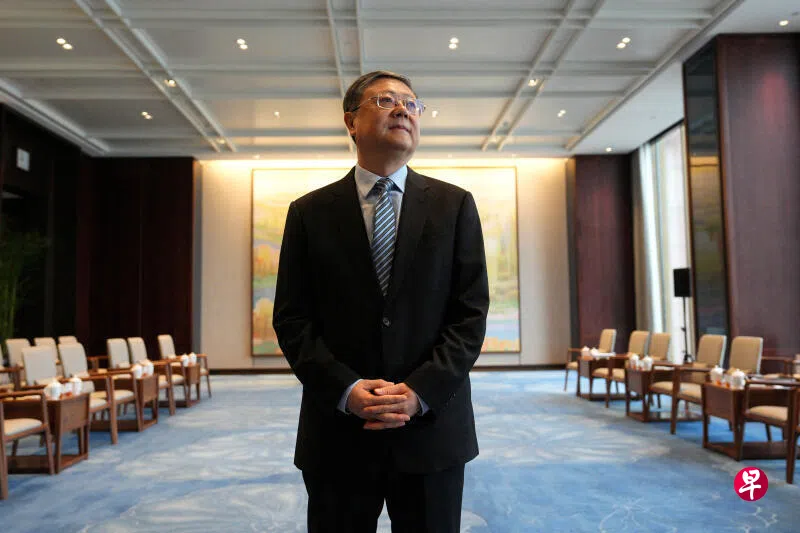
The shock waves from Tuesday’s (24 November) official announcement of the downfall of Chen Jining, a member of the Chinese Communist Party (CCP) Politburo and Shanghai party secretary, continue to reverberate in China and abroad. Chen is the fourth of the current Politburo’s 24 members, including its Standing Committee members, to fall from grace. After the official announcement that he was “suspected of serious violations of discipline and the law”, many people, once they had gathered their thoughts, instinctively turned to the next question: will Chen be the last? Are there more to come?
Beyond the lack of obvious warning signs, what has most shocked observers is the potential for further political advancement reflected in Chen’s track record, and what it means for Beijing’s top leadership to purge its own ranks so deeply.
Chen, 62, began his career as an academic. After obtaining a doctorate from Imperial College London, he returned at 34 to teach at his alma mater, Tsinghua University. In February 2012, after six years as a vice-president, the 48-year-old Chen was promoted to president, becoming one of the youngest people to head Tsinghua. People’s Daily reported on his vigorous efforts to reform the university and described him as “low-key and approachable”. Even as president, he frequently cycled around campus. On one occasion, to avoid interrupting a thesis defence already under way, he stood at the back and listened for more than two hours.
Three years later, Chen moved from academia into government. With his background as a water treatment expert, he took charge of the Ministry of Environmental Protection, becoming the youngest minister in the State Council at the time. Two years later, he joined Beijing’s municipal leadership, serving first as vice-mayor and then mayor. After the CCP’s 20th Party Congress in 2022, he became a Politburo member and Shanghai party secretary, entering the ranks of party and state leaders. For years, Chen was seen as young and promising. He was widely tipped to rise further and become a strong contender for a key position on the Politburo Standing Committee after next year’s 21st Party Congress.
Instead, his career has been cut short over disciplinary and legal issues. To outside observers, the turn of events was abrupt and swift. Unlike previously disgraced Politburo members Ma Xingrui and He Weidong, who had been reassigned or had “disappeared” without explanation before the official announcements, Chen’s case more closely resembles the abrupt manner in which former Central Military Commission vice-chairman Zhang Youxia was officially purged this January.
The speed with which the leadership acted sends two signals: first, that the authorities had been conducting an in-depth investigation for some time; second, that political issues may weigh more heavily among Chen’s suspected “serious violations of discipline and the law”, requiring swift and decisive action. With nearly a year to go before the 21st Party Congress, there is also still room to make subsequent personnel arrangements.
But it would not be accurate to say there had been no signals at all. Zhonggui Zhongju, a video account that closely follows Chinese politics, picked up a detail from a review of public reports. The 9th China International Import Expo opened in Shanghai on 5 November, with Politburo Standing Committee member and Vice Premier Ding Xuexiang delivering a speech at the opening ceremony. Yet Chen, Shanghai’s top official, was absent. Later that day, Chen accompanied Ding to a meeting with Slovakia’s visiting deputy prime minister. The anomaly did not immediately attract media attention, but those involved and others close to the matter would probably already have sensed something was amiss.
Other signs had appeared even earlier, although they were less direct and harder to discern. Various media outlets have compiled lists of officials who graduated from or taught at Tsinghua, and who have fallen from grace over the past year or more. They include former Central South University president Zhang Yaoxue and former Xi’an party secretary Fang Hongwei. More recent cases include former Shenzhen mayor Qin Weizhong, whose downfall was announced on 21 September. Born in the 1970s, Qin had been a rising political star at vice-ministerial rank with apparently bright career prospects. Another was former Beijing executive vice-mayor Xia Linmao, who fell on 22 October.
Other senior officials with Tsinghua backgrounds have been prematurely sidelined to less prominent roles. Among them is former Hebei party secretary Ni Yuefeng, 61, who holds a Tsinghua doctorate. He was removed as party secretary in July and subsequently transferred to the National People’s Congress.
Tsinghua has long been a cradle of top talent in China, so it is hardly surprising that some of the officials who had fallen from grace have connections to the university. Nevertheless, the distinct “Tsinghua network” colouring the career trajectories of certain officials invariably draws attention. In particular, after these officials fell from grace one after another, some commentators turned their attention to former CCP Organisation Department head Chen Xi, who spent more than 20 years studying and working at Tsinghua before going on to oversee party organisation and personnel matters.
Chen Xi, now 73, stepped down from the Politburo after the 20th Party Congress in 2022. Unusually, however, he remained head of the Organisation Department until April 2023, when he handed over to fellow Tsinghua graduate and Politburo member Li Ganjie. In another rare arrangement, Chen Xi also remained president of the Central Party School, with Politburo Standing Committee member Cai Qi taking over only in June this year.
Li and Chen Jining were both born in 1964, and both served as environmental protection minister, with Li succeeding him in 2017. They entered the Politburo together in 2022. As noted earlier, Li took charge of the Organisation Department in 2023, but spent only two years in that powerful and pivotal post before another highly unusual transfer in April last year, when he became head of the United Front Work Department.
The authorities have yet to disclose the specific details of Chen Jining’s disciplinary and legal violations. Tsinghua, however, has already moved swiftly to remove his name from the “Past Leaders” section of its website. On the day the investigation into Chen was announced, a two-day national conference on the party’s internal regulations opened in Beijing. In instructions to the conference, CCP General Secretary Xi Jinping called for “upholding rules-based party governance as the fundamental approach to managing and governing the party”.
Since 2012, the CCP leadership has maintained an intensive anti-corruption campaign, stepping up its efforts further in recent years. Besides investigating financial corruption, it has made clear that it will not tolerate forming factions or “cliques”. As the 21st Party Congress approaches, the leadership’s emphasis on “political discipline and political rules” is likely to reach new heights. Chen’s downfall sends an unequivocal warning to the entire party and serves as a deterrent: members must strictly observe the “rules” and remain loyal and honest. Otherwise, the shock of Chen’s downfall will not be the last, and further upheaval lies ahead.
