

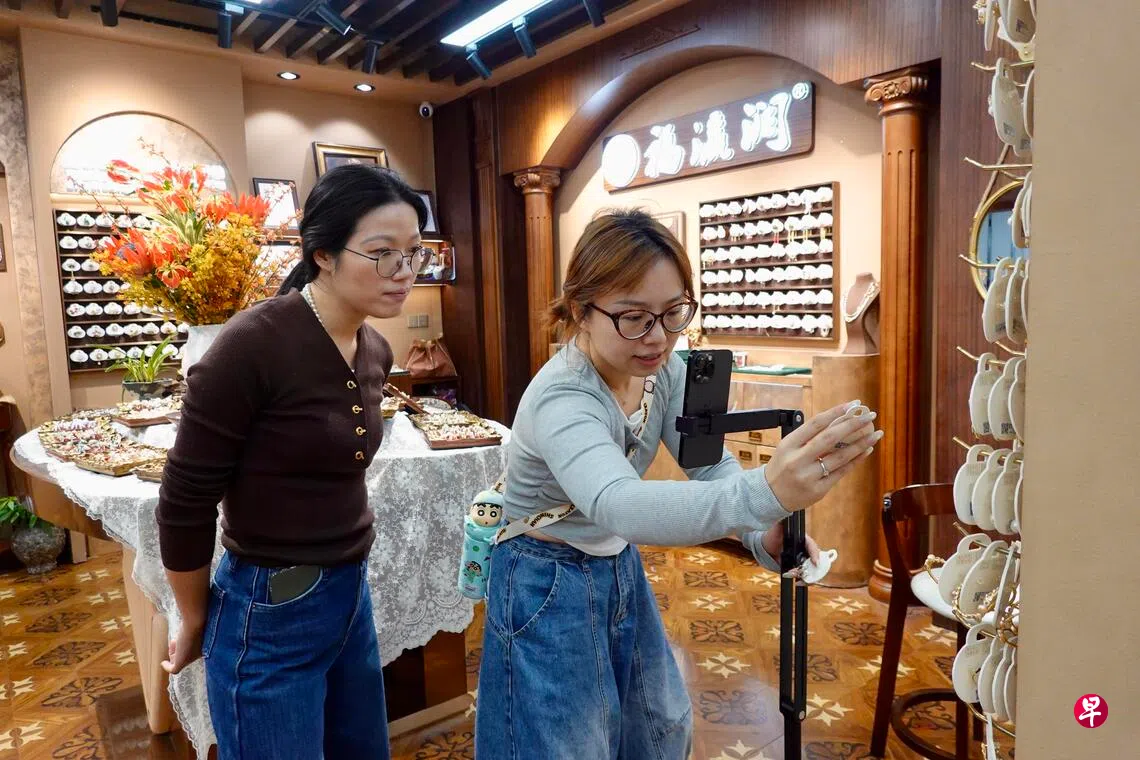
While social media feeds were flooded with talk of semiconductor giant Nvidia founder Jensen Huang’s alleged affair, the annual Singles’ Day shopping festival ended with barely a whimper — and many didn’t even notice.
When I was based in Shanghai a few years ago, enthusiasm for Singles’ Day was already waning. Even so, major e-commerce companies such as Alibaba and JD.com still invited the media to promotional events each year and teamed up with television stations to stage gala shows to encourage spending. On 11 November itself, platforms would race to publish their sales figures in competitive “battle reports”.
Now, the major platforms appear to share an unspoken agreement: no more high-profile publicity, no more lavish events, and no more disclosure of exact sales figures. According to retail data provider Syntun, total online sales during this year’s Singles’ Day reached 1.78 trillion RMB (S$343.4 billion), up 4.8% year on year. But that was far below last year’s growth of 14.2%.
Notably, those figures cover the period from 7 October to 11 November. A promotional campaign lasting more than a month may be one reason the festival has lost its novelty and consumers have become less enthusiastic. My friends in China no longer go out of their way to add items to their orders to qualify for discounts. The rules governing Singles’ Day deals, which drew ridicule from internet users in previous years, did not even make the trending lists on social media this year.
Yet the prolonged promotional period may be the least significant of the many factors at play. More fundamentally, an uncertain economic outlook, shaky expectations for jobs and incomes, falling property values and stock market volatility have combined to make people in China more inclined to save and avoid non-essential spending. In the first three quarters of this year, China’s total retail sales of consumer goods rose just 1.1% year on year, far below economic growth of 4.6% over the same period.
Against this backdrop of weak consumer confidence, big-ticket purchases such as cars and luxury goods have been particularly hard hit. According to the China Association of Automobile Manufacturers, domestic passenger car sales fell 25.2% year on year in the first 10 months of this year. Industry data also show that sales in China by the world’s 25 leading luxury brands, including Hermès, Cartier and Louis Vuitton, have remained sluggish in the second half of the year, even logging double-digit year-on-year declines in August and September.
The fading excitement around Singles’ Day reflects more than a change in how the e-commerce festival is marketed. It also shows that “consumption downgrading” has become a tacitly accepted reality for businesses and consumers alike.
Yet, in stark contrast to weak domestic demand, exports are growing rapidly.
The latest figures released this week by China’s General Administration of Customs show that the country’s goods trade surplus reached US$1.04 trillion (S$1.34 trillion) in the first 10 months of this year. It crossed the US$1 trillion mark a month earlier than last year and looks set to exceed last year’s full-year surplus of US$1.2 trillion.
Driven by the global boom in artificial intelligence (AI) investment, China’s exports rose 35.2% year on year in October, with high-tech products and semiconductors performing particularly well.
While the robust export performance undoubtedly highlights the competitiveness and resilience of Chinese manufacturing, a widening trade surplus also points to an over-reliance on foreign markets to drive economic growth. To some extent, this is because the domestic market cannot absorb such vast production capacity, prompting many Chinese companies to pivot overseas and compete with local businesses.
Not only does this expose China to the risk of structural economic imbalances, but also intensifies trade friction with other countries. At next week’s Asia-Pacific Economic Cooperation (APEC) leaders’ summit in Shenzhen, leaders from countries including the US and Canada are expected to raise trade issues with China.
Another event that concluded this week was the China International Import Expo, held to showcase China’s potential to “buy from the world”. According to official figures, the expo, now in its ninth year, recorded tentative deals worth US$85.45 billion for purchases over a year, up 2.3% from the previous edition, setting a record high.
In his opening address at the expo, Chinese vice premier Ding Xuexiang reiterated that China had never deliberately sought a trade surplus. He said: “There are many products that China wants to import but cannot buy or is not allowed to buy.” Normal trade in some high-tech products, in particular, had been disrupted and restricted, causing huge losses to all parties concerned, he added.
British and American media reports this week, however, revealed that Chinese companies and research institutions had obtained advanced chips subject to US export controls, and access to the associated computing power, through various channels. For example, AI company Moonshot AI rented a batch of servers equipped with Nvidia B300 graphics processing units in China at a premium of 350% above market rates. Northwestern Polytechnical University, which is on the US Entity List, also purchased two Nvidia H200 chips through a supplier in Shaanxi last month. According to a Reuters tally, computing projects worth more than US$3 billion in China use Nvidia processors subject to export controls.
Yet, even if the US relaxed its restrictions on high-tech exports, it would not change Chinese consumers’ reluctance to spend. And even if Chinese manufacturing continued to expand, it would be difficult to rely on overseas markets indefinitely to make up for insufficient domestic demand. The challenge for China’s economy is perhaps not just about getting the world to buy more Chinese goods, or getting China to buy more foreign goods — it is about realigning domestic willingness to spend with the country’s production capacity.
Seen in this light, the huge trade surplus is merely a symptom of China’s supply-demand imbalance. The muted Singles’ Day reflects a challenge the Chinese economy must confront: how to channel funds effectively from the supply side to the demand side, turn corporate profits into household incomes, and give people the confidence and motivation to spend again — and rediscover the pleasure of shopping.
