

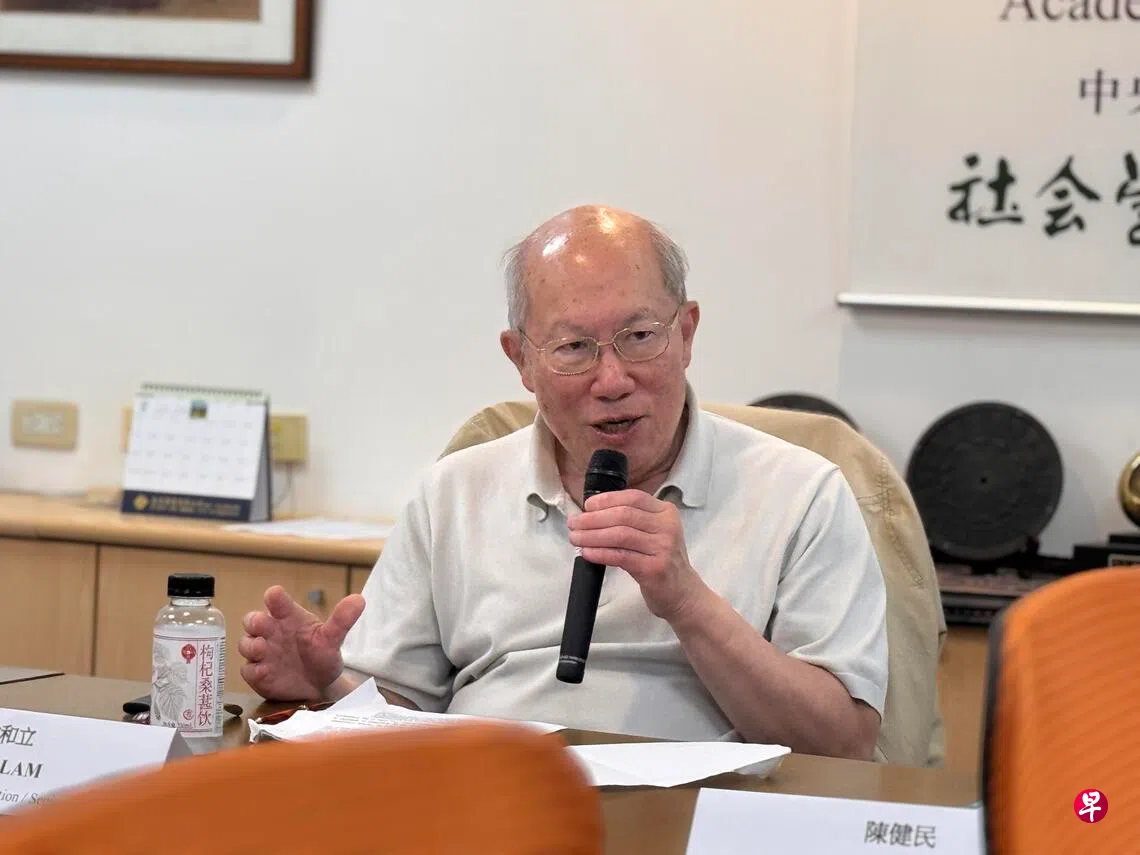
The Chinese Communist Party’s (CCP) fifth plenum will close on Thursday (29 October), with observers watching for possible appointments to the Central Military Commission. Veteran China scholar Willy Lam believes that, following sweeping purges in recent years, the People’s Liberation Army (PLA) will struggle to rebuild its command structure quickly. It is therefore unlikely to launch a full-scale military operation against Taiwan in 2027. However, mainland China could intensify grey-zone pressure to keep wearing down Taiwan’s ability to respond and influence public sentiment.
The fifth plenum of the CCP’s 20th Central Committee is scheduled to close on Thursday. Xinhua previously reported that the plenum will review a draft decision on continuing to advance full and rigorous Party self-governance. With the CCP holding its 21st Party Congress next year, when personnel changes will be made to the Central Committee, Politburo and Central Military Commission, the fifth plenum is widely expected to lay the groundwork for the congress.
Lam, who has long studied Chinese politics, diplomacy and military affairs, was formally an associate editor of the China section at Hong Kong’s South China Morning Post, and was based in Beijing from 1986 to 1989. He also worked at Asiaweek and CNN’s Asia-Pacific division. He is now a senior fellow at The Jamestown Foundation, a Washington-based think tank.
In an invited speech at the Institute of Sociology at Taiwan’s Academia Sinica on Wednesday (28 October), he said the number of full generals in the PLA had shrunk from more than 30 to just four or five. Of the seven members of the Central Military Commission appointed in 2022, only Xi Jinping and Zhang Shengmin remain publicly known to be serving.
Asia Society researchers estimate that 42 of the 44 military officers elected to the Central Committee in 2022 have been purged or have disappeared from public view. Lam therefore believes it will not be easy for Xi to fill the vacancies in the military commission and senior command before the 21st Party Congress.
Lam said: “I don’t think the PLA will use force against Taiwan in 2027.” A large-scale attack would require a fully functioning command structure, logistics and mobilisation of reservists, as well as support from across society. Amid the upheaval in military personnel, all this would be difficult to put in place in the short term.
However, he expects grey-zone operations to continue or even intensify.
A week earlier, Taiwan’s Ministry of Defence reported that it had detected 29 sorties by mainland military aircraft, six naval vessels and nine government vessels operating around Taiwan from 20 to 21 October. Of those aircraft sorties, 23 crossed the median line of the Taiwan Strait. Reuters also reported that mainland maritime militia fishing boats, coastguard vessels and research ships had stepped up coordinated operations in waters east of Taiwan, increasing the burden on Taiwan’s response capabilities.
At the Global Taiwan Institute’s annual symposium in Washington last year, Lam suggested that the mainland could blockade Taiwan with just four or five submarines, and said he believed Taiwanese people might not resist. Taiwan’s representative to the US, Alexander Yui, challenged him on the spot. Citing residents’ spontaneous disaster relief efforts in Hualien, Yui stressed that Taiwanese people were determined to defend their home.
Responding to a question from Lianhe Zaobao (LHZB) during Wednesday’s talkabout the latest trends in PLA operations against Taiwan, Lam said a distinction could be drawn between a full-scale attack and grey-zone pressure. He believes the latter is more likely to intensify. Changes in Taiwanese public sentiment will also affect Beijing’s assessment of how effective its pressure has been.
Taiwan’s nine-in-one local elections are scheduled for 28 November. Lam believes that, whatever the outcome, mainland media will interpret it in Beijing’s favour. However, the mainland’s increasingly fierce attacks on Puma Shen, the Democratic Progressive Party’s candidate for Taipei mayor, may not help the incumbent, Chiang Wan-an of the Kuomintang. “This could well backfire,” he said.
Shen was placed on a list of “diehard Taiwan independence separatists” by mainland China’s State Council Taiwan Affairs Office in 2024. Last year, Chongqing police opened an investigation into him on suspicion of secession.
Lam believes Beijing has yet to resolve the contradiction between its national security controls and maintaining Hong Kong’s status as an international financial centre. To claim at this point that it can punish opponents of unification beyond its borders would be “very dangerous”, he said.
He described Taiwanese attitudes towards Beijing as “currently at something of a stalemate”, adding that it remained difficult to judge whether the mainland’s united front strategy towards Taiwan would work.
