

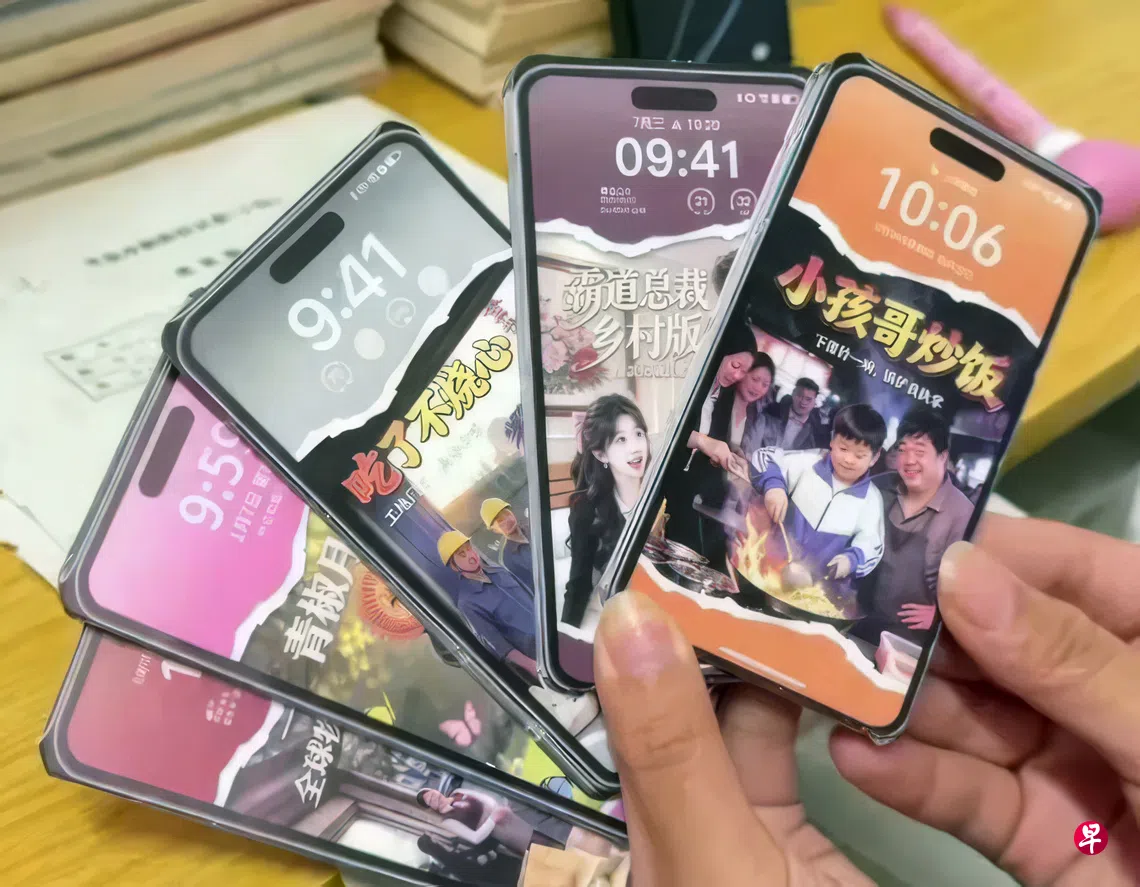
(Beijing) China’s short-drama craze has reached schools in printed form, with sellers turning screenshots and dialogue from the shows into booklets that appeal to primary and secondary school pupils whose mobile phone use is restricted. Adult themes in some of the dramas have raised concerns among parents.
According to reports by CCTV News, MyDrivers and other outlets, these “printed short dramas” are produced on stiff card that folds down to the size of a mobile phone but opens out to more than half a metre in length. They feature key plot points from popular short dramas, with a twist on every page and a complete story unfolding from beginning to end. Common themes include rebirth, reversals of fortune and domineering chief executives.
The booklets are sold at small shops and stationery stores near schools, as well as on e-commerce platforms, for one to two yuan (S$0.19 to S$0.39) each. Some sellers market them as “children’s tabletop games”, “booklets to relieve boredom” and “toys hugely popular with primary school pupils”.
Some parents say that because schools do not allow pupils to bring mobile phones, primary school children eager to follow the dramas have been buying these booklets, which require neither charging nor internet access. They slip them inside textbooks to read secretly and pass them around the classroom.
The popularity of “printed short dramas” has troubled many teachers and parents. One parent noted that these publications had not been vetted, and that some contained adult themes that could mislead primary school pupils who were not yet mature enough to assess them.
There are also suspicions that “printed short dramas” deliberately circumvent publishing regulations. Yang Kun, deputy director of the publishing law and copyright research institute at the Chinese Academy of Press and Publication, said the booklets had not obtained ISBNs issued by China’s National Press and Publication Administration and were not distributed through publishers, making them suspected breaches of publishing regulations.
As concerns over copyright infringement and inappropriate content draw attention, “printed short dramas” have gradually been removed from e-commerce platforms in recent days. They are now difficult to find through searches on platforms such as Taobao, Pinduoduo and Douyin’s online marketplace.
Zhang Xinhua, a professor and head of the digital publishing department at the Beijing Institute of Graphic Communication, said the freedom with which “printed short dramas” push the boundaries of acceptable content reflected not only failures in publishing oversight, but also content risks originating upstream in short-drama production. He said: “Short dramas operate under a filing system, with essentially no prior vetting. They are also often described as ‘feel-good dramas’, and there are potential issues with their scientific accuracy and truthfulness, among other things.”
