

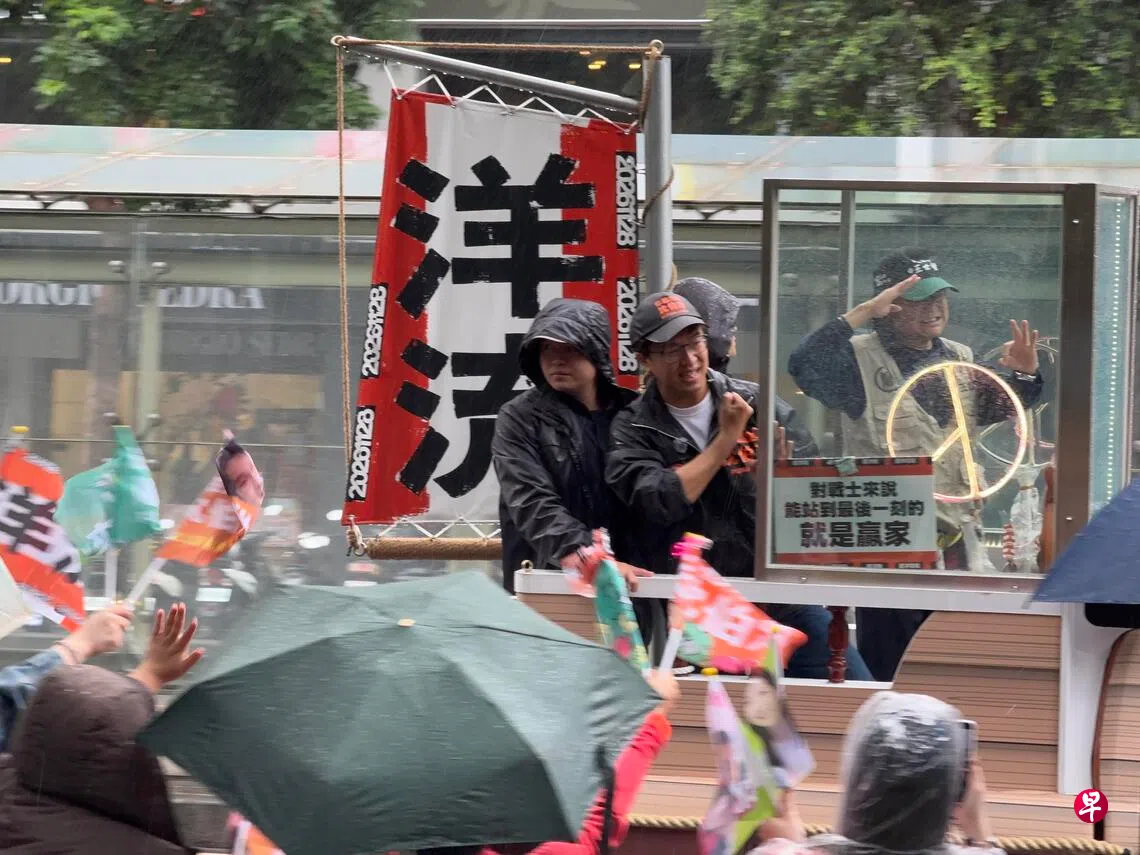
Democratic Progressive Party (DPP) Taipei mayoral candidate Puma Shen has moved his election-eve rally online after cancelling the in-person event because road closures for stage construction disrupted traffic. The ensuing row over road-use permits and event planning could hurt incumbent Chiang Wan-an’s re-election bid by creating a perception that Shen has been treated unfairly, an academic interviewed said, adding uncertainty to an already tight race.
Taiwan votes in its nine-in-one local elections on Saturday (28 November). Shen had planned to hold a “Citizens’ Night” rally on Section 4 of Ren’ai Road outside the Taipei City Council on Friday (27 November) evening. But stage construction and traffic restrictions that began on Wednesday (25 November) disrupted commuters’ journeys. Late that night, he announced the rally’s cancellation and had the stage dismantled overnight.
The campaign of Kuomintang (KMT) Taipei Mayor Chiang Wan-an secured a road-use permit for Ketagalan Boulevard in front of the Presidential Office for an election-eve rally on Friday. It also booked Shifu Road in front of Taipei City Hall to prepare for a vote-counting event on Saturday.
Although Shen secured a permit for Saturday to use Beiping East Road outside his campaign headquarters and the DPP’s central headquarters, others had booked the road for Wednesday and Thursday, preventing his team from setting up a stage and holding rehearsals in advance.
Applications for road-use permits open 30 days in advance. Official records show that applications to use Ketagalan Boulevard and Shifu Road on 27 November arrived 0.35 seconds and 0.38 seconds respectively after midnight on 28 October. Applications for Beiping East Road on 25 and 26 November arrived 0.4 seconds and 1.11 seconds respectively after applications opened, prompting questions about whether the bookings were intended to block others.
After Shen announced the cancellation, Taiwanese television host Kevin Tsai also posted on social media on Wednesday evening. Using an analogy of someone taking away both the food and the table, he wrote that “people who would not normally eat shit will end up eating shit”. His remarks were interpreted as a veiled criticism of the KMT camp for shutting out its opponent, sparking a heated debate.
He deleted the post early the next morning without explaining why.
Meanwhile, Chiang’s campaign director Lo Chih-chiang wrote early on Thursday that, on Chiang’s instructions, the team was willing to give up its road-use permit for Shifu Road on Friday. “If Puma Shen is willing, we can let his campaign have it.”
Lo also said the vote-counting event would move online, although Chiang said in an interview that afternoon that discussions were continuing. Shen’s campaign director Wu Szu-yao politely declined the offer, saying: “We appreciate Mayor Chiang’s kind gesture.”
Shen also said that morning that switching venues would not resolve the problems with traffic and safety preparations. “I still believe residents’ safety must come first.”
Wu confirmed that afternoon that the election-eve event on 27 November would move online. During an 8pm livestream with former president Tsai Ing-wen that evening, Shen added that, besides livestreaming the election-eve event, he would visit selected locations in Taipei on Friday morning to speak with residents.
Speaking to reporters that day, Chiang also questioned why Shen’s team had closed the road several days in advance, saying his own team would only begin setting up its stage in the early hours of the day of its election-eve rally.
Asked whether the KMT had applied to use Beiping East Road on 25 and 26 November, Chiang said that afternoon: “We are still looking into it. There are no further updates yet.” Responding to questions about applications submitted in less than a second, he stressed that applicants had always competed down to the second and should apply according to the rules.
The Taipei City Government’s New Construction Office said in a press release that applications to use Ketagalan Boulevard for election-eve events from 2020 to 2026 had all been submitted within one second of applications opening. It stressed that this year was no different from previous years and that there had been no unfair treatment.
“At the moment, the situation appears unfavourable to Chiang Wan-an,” Chen Shih-min, an associate professor of political science at National Taiwan University, told Lianhe Zaobao. He said that after Shen cancelled his event, public attention shifted to why the time slots needed for preparations outside his campaign headquarters had also been booked. This could easily create an impression that Shen had been treated unfairly.
Chen said the city government held the application records and should proactively explain what happened. If the applicants were members of Chiang’s campaign team or had links to it, this would reinforce suspicions that Shen was being deliberately obstructed. If Chiang continued to leave questions unanswered, people might also doubt his grasp of the situation and his ability to resolve problems.
He reckoned that if the controversy persisted, it would carry on into the day before the election, continuing to hurt Chiang. “If you keep failing to explain, I think this story will continue to dominate the news tomorrow.”
However, on the traffic disruption caused by Shen’s campaign closing the road early to build a stage, Chang Ching, a senior research fellow at the Society for Strategic Studies, said in an interview that, if an election campaign were likened to a military operation, choosing a location required assessing traffic, pedestrian flows and preparatory work. “Both traffic routes and the amount of space at the decisive battleground have to be considered,” he said.
He noted that campaign teams typically become the core governing staff after an election victory. Plans that angered residents even before a candidate took office raised concerns about how the team would govern once it held administrative power, he said.
