

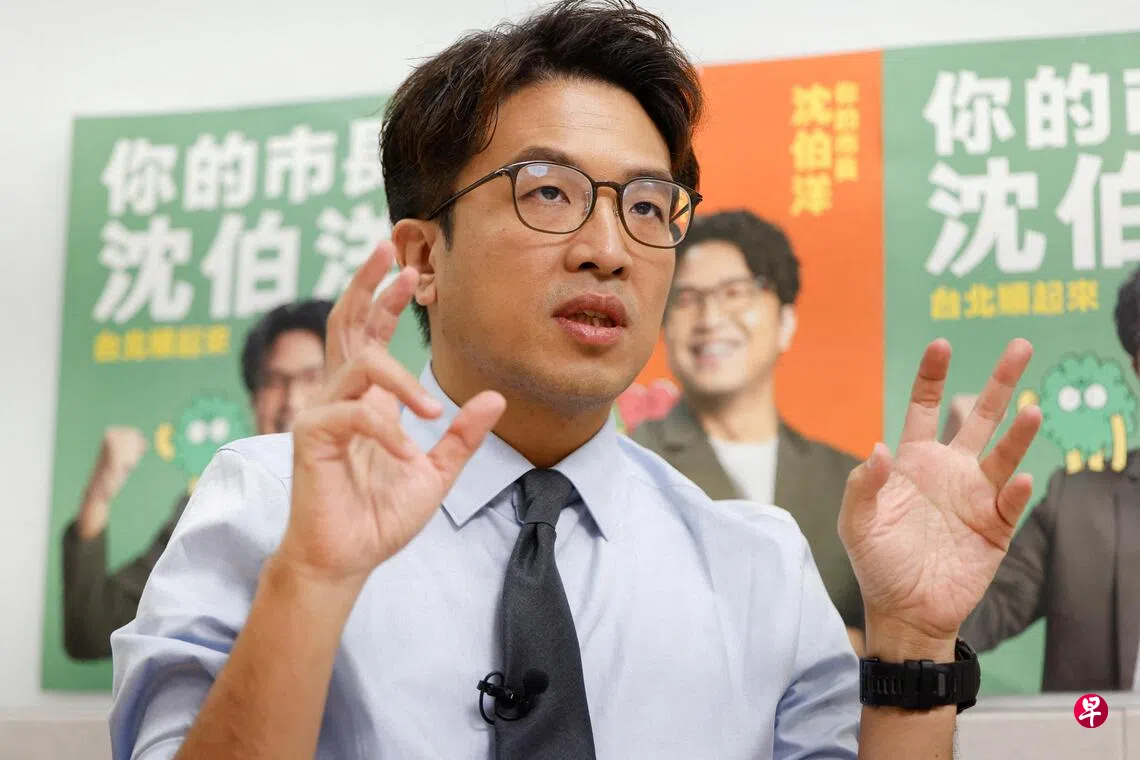
With Taiwan’s “nine-in-one” local elections approaching, Democratic Progressive Party (DPP) Taipei mayoral candidate Puma Shen has said the long-running Taipei-Shanghai Twin-City Forum has achieved little and proposed that Taipei consider holding a city exchange forum with Beijing instead.
US magazine Time (《时代》) published an interview with Shen on Wednesday (25 November). The 44-year-old will challenge incumbent Taipei Mayor Chiang Wan-an of the Kuomintang, who is seeking re-election in Saturday’s (28 November) local elections.
Shen said the Taipei-Shanghai forum had been held for more than a decade, but its activities often amounted to reading out documents and posing for photographs, with little substantive impact. Citing Taipei’s status as a “capital”, he said the city should consider engaging directly with Beijing if it were to hold such a forum.
He stressed, however, that city exchanges required proper risk management. Beijing poses a military threat to Taiwan, he said, and any cooperation involving sensitive information such as transport data would require careful risk assessment. Rather than cutting off exchanges altogether, he advocated making them effective, broadening participation and managing risks, while strengthening Taipei’s cooperation with other international cities.
On mainland China’s influence operations targeting Taiwan, Shen said the Taiwanese government should focus on prevention and protection, rather than treating everyone who frequently travels across the Taiwan Strait with suspicion. Businesspeople, singers and actors working on the mainland could come under pressure because of their business interests there and could themselves be victims of coercion, he said.
He said the government should provide the necessary assistance to people who might come into contact with mainland China’s united front departments, rather than labelling them spies when they return to Taiwan. Citing the pre-travel declaration system for public officials visiting the mainland, he said the government could help people prepare by advising them beforehand on whom to avoid and how to respond to threats.
Shen said such measures should be designed to protect the public, rather than to assign blame only after an incident. In a democratic society, managing risks in advance was the better approach.
On the lack of cross-strait dialogue, he said direct communication channels remained important, adding that Taiwan wanted to establish contact but Beijing had refused. With Beijing continuing to pose a military threat to Taiwan, he advocated strengthening Taiwan’s air defence systems and developing defence capabilities such as drones to preserve peace through strength.
