

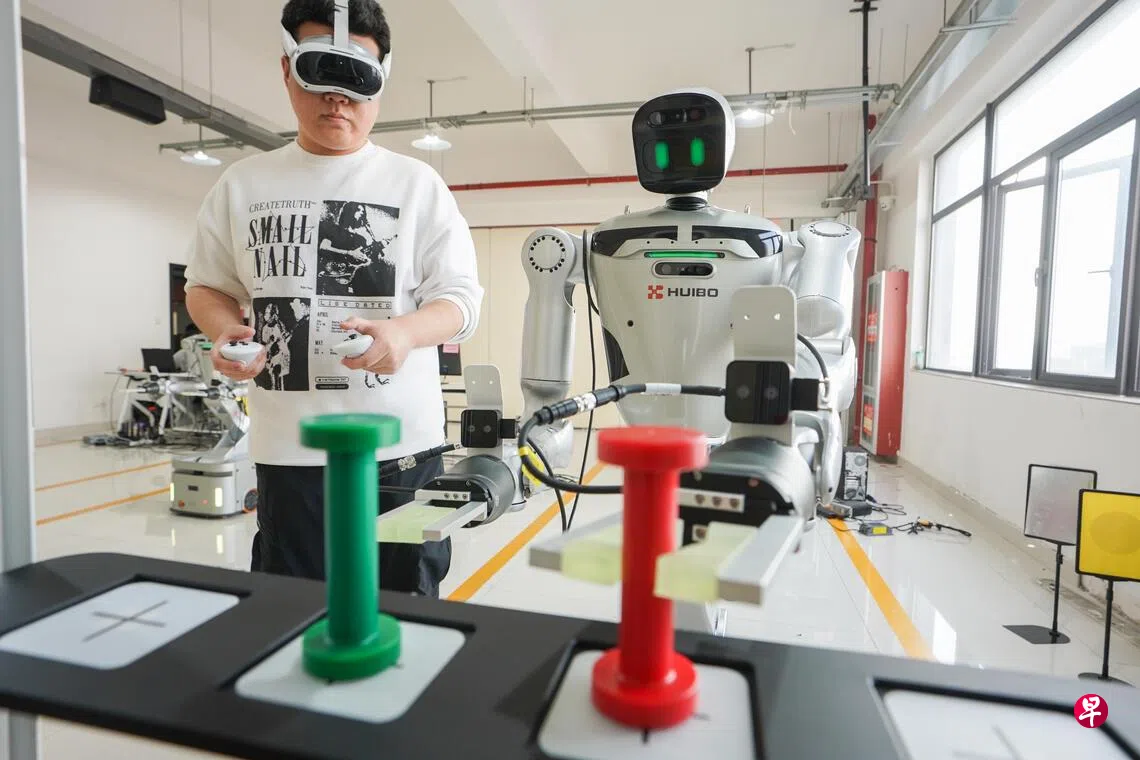
Chinese companies are accelerating the commercial deployment of humanoid robots, pouring resources into developing artificial intelligence (AI) to enable the robots to perform a broader range of jobs. This is fuelling growing investment and fundraising in embodied AI.
Reuters reported that, after years spent developing humanoid robots that can run, dance and perform backflips, Chinese companies are focusing on software that allows robots to perceive their surroundings, learn unfamiliar tasks and adapt without needing separate programming for each job.
The shift has sparked an investment boom in embodied AI. According to data research firm ITjuzi, Chinese embodied AI companies completed 322 funding rounds in the first half of 2026, raising a total of 93.5 billion yuan (about S$17.94 billion), five times the amount raised in the same period last year. Funding is increasingly flowing to companies specialising in intelligent systems for robots, rather than being confined to robot manufacturers.
According to company disclosures, three leading Chinese embodied AI start-ups — X Square, Galaxea and Spirit AI — have each reached valuations of about US$3 billion (S$3.83 billion).
As competition drives down hardware prices, robot manufacturers have "concluded that the margin won't come from the hardware but from the brain," according to Dermot McGrath, founder of Shanghai-based technology consultancy ZenGen Labs.
This emerging field is becoming a new battleground in the technology rivalry between China and the US. Those first to combine AI and robotics effectively stand to gain an advantage in factory automation and logistics, potentially reshaping industrial productivity and the global robotics market.
Analysts say US companies lead in some advanced robotic AI systems, with advantages in frontier AI research and access to high-performance computing chips. Chinese developers, meanwhile, can draw on their manufacturing strengths to work closely with robot manufacturers and industrial customers, testing and refining their systems in real-world settings.
However, Chinese companies also face multiple challenges. US export controls make high-end Nvidia chips difficult to obtain, while regulatory concerns over inflated valuations and an overcrowded industry are putting pressure on companies’ fundraising through initial public offerings (IPOs).
Chinese companies are trying to reduce their computing requirements by building more efficient models and using synthetic data and simulated environments. Domestic chipmakers such as Huawei are also actively developing alternatives to Nvidia hardware, but it remains unclear how far these efforts can make up for the shortfall.
Meta partners with Chinese company to develop humanoid robot
Separately, US technology news outlet The Information reported that US tech giant Meta is working with Chinese start-up Fourier to develop a humanoid robot prototype. An internal demonstration was held in late August, and development of a second-generation version began in September.
The robot, code-named “Max”, stands about 1.5 metres tall and weighs about 48 kilograms. It is equipped with Nvidia’s Jetson Thor chip, designed specifically for humanoid robots and physical AI. Meta said the collaboration is solely for internal research and experimentation, with no current plans for commercial sales.
The report said such partnerships not only generate product sales for Chinese robotics companies but also open a path for them to participate in overseas research and development projects. The ultimate significance of the collaboration will depend on subsequent progress and whether the robot can demonstrate reliable performance in its intended applications.
