

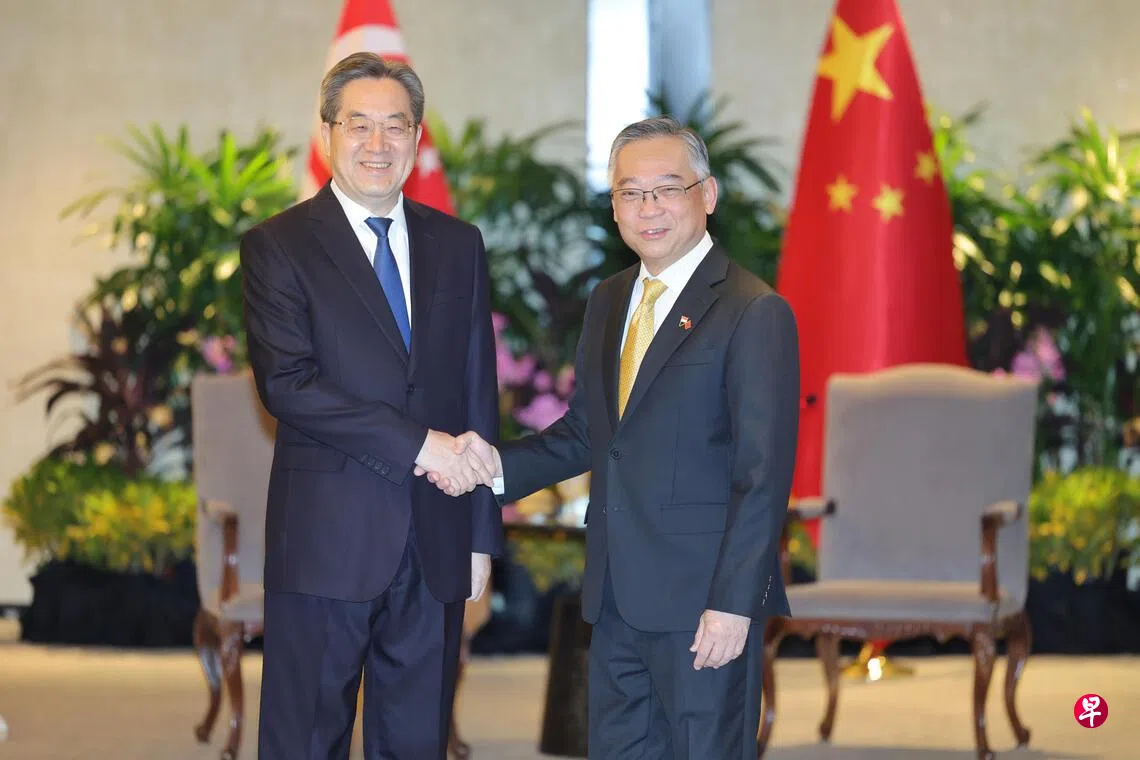
Singapore and China agreed on 29 cooperation outcomes at this year's Joint Council for Bilateral Cooperation (JCBC) meeting, the most in its history, spanning areas including trade and finance, science and technology, and public health.
The JCBC is the highest-level annual platform for bilateral cooperation between Singapore and China. Its 22nd meeting on Monday (23 November) was co-chaired by Deputy Prime Minister and Minister for Energy and Trade and Industry (Trade) Gan Kim Yong and Chinese Vice Premier Ding Xuexiang, a member of the Communist Party of China's Politburo Standing Committee.
According to a statement from the Prime Minister's Office, DPM Gan and Vice Premier Ding agreed that both sides should continue to collaborate and tap on opportunities in emerging areas to deliver high-quality outcomes that will benefit both countries and contribute to regional prosperity. They welcomed the strengthening of trade links and financial connectivity, particularly in enhancing Renminbi (RMB) cooperation and payment connectivity between Singapore and China to support real economy needs.
The two sides also strengthened food security cooperation this year, with livestock and poultry products from China's Hainan approved for import into Singapore. This broadens Singapore's food sources and strengthens its food resilience.
Speaking at the meeting, Gan stressed that bilateral cooperation is particularly salient given the increasingly complex and uncertain global environment. He noted that a key distinguishing trait of the Singapore-China relationship has always been the two countries' ability to stay relevant and forward-looking through different phases of their development. “Even as circumstances change, both sides have continued to adapt, build on our complementary strengths, and find new areas of practical cooperation.”
In his remarks, Ding said that amid a shifting international landscape, the China-Singapore All-Round High-Quality Future-Oriented Partnership had continued to deepen steadily, with the future of practical cooperation between the two countries gradually becoming a tangible reality. “These achievements have been extremely hard-won. There are many valuable lessons that deserve careful reflection and should be upheld over the long term.”
With breakthroughs in a new wave of technological revolution and industrial transformation accelerating, Ding urged both sides to continue expanding cooperation in emerging industries and achieve positive outcomes in areas such as the digital economy, green economy and artificial intelligence.
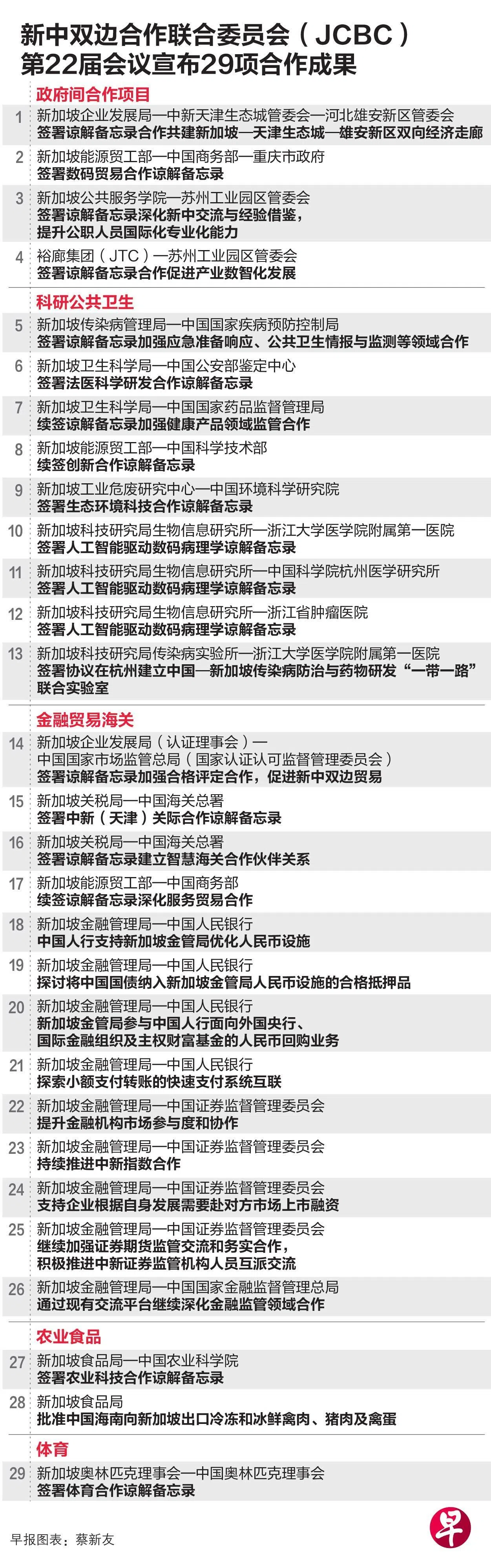
Singapore and China signed 29 memorandums of understanding and cooperation documents on Monday, surpassing last year's 27. These cover traditional areas such as trade and finance, as well as emerging areas such as technology and the digital economy.
Asked about the most important outcomes of this year's JCBC, Gan said at a press conference after the meeting that all the agreements were important, but highlighted a few that he felt would have a significant impact. The first was the China-Singapore Free Trade Agreement upgrade. “This is a major undertaking. It may take a year or two for us to finish it. And it is going to facilitate the trade between Singapore and China both ways – both exports and imports – and also to facilitate particularly digital trading. And it will also facilitate cross-border data flows.”
Ahead of the JCBC meeting, Singapore and China announced last Friday (20 November) the launch of negotiations on a 4.0 upgrade of the China-Singapore Free Trade Agreement, covering areas including the digital economy and government procurement. Gan said: “So these are very important for Singapore businesses operating in China and Chinese companies operating in Singapore. And this also will facilitate, strengthen the bilateral relationship between the two of us.”
Gan and Ding also held a bilateral meeting on Monday ahead of the JCBC meeting. The two deputy prime ministers welcomed the continued momentum of high-level exchanges following the commemoration of the 35th anniversary of diplomatic relations last year and Prime Minister Lawrence Wong’s visit to China last week.
Gan and Ding also chaired the Joint Steering Council meetings for the three Government-to-Government projects: the Suzhou Industrial Park, Tianjin Eco-City and China-Singapore (Chongqing) Demonstration Initiative on Strategic Connectivity. They agreed that Singapore and China should tap on their complementary strengths to adapt their Government-to-Government projects to evolving priorities.
The Prime Minister's Office statement also said that amidst an uncertain international environment, the two leaders reaffirmed Singapore’s and China’s shared commitment to upholding the principles of free trade, multilateralism, and a rules-based international order.
Ten Singapore political office-holders attended the JCBC meeting alongside Gan: three ministers, one second minister, five senior ministers of state and one minister of state. Members of the Chinese delegation included Ambassador to Singapore Cao Zhongming, Deputy Secretary-General of the State Council Wang Yang, Vice Minister of Foreign Affairs Hua Chunying, Vice Minister of Commerce Yan Dong and Vice Minister of Science and Technology Zhang Guangjun.
