

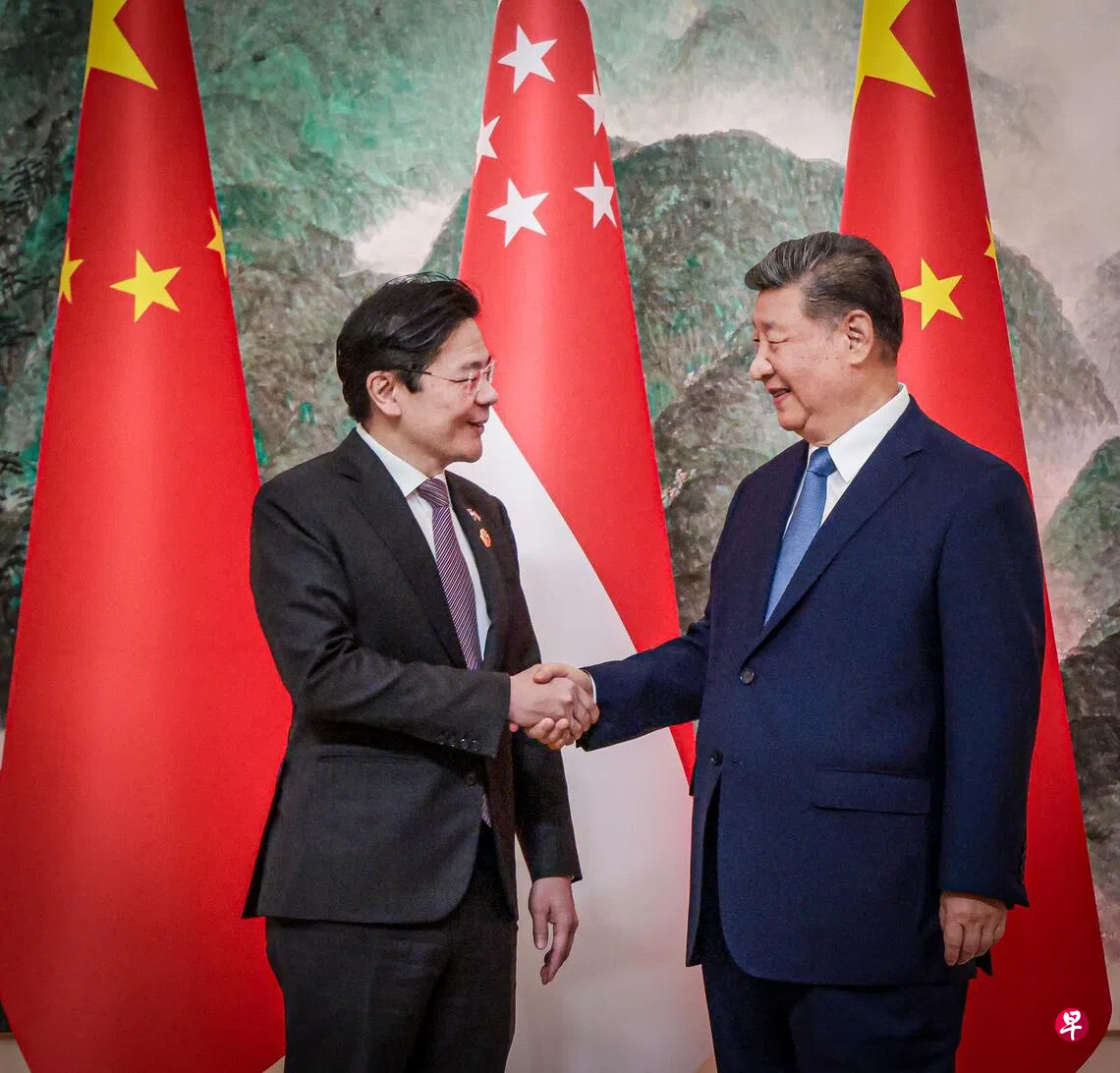
Singapore and China have launched talks to upgrade their free trade agreement and will strengthen cooperation in areas including the digital economy, artificial intelligence (AI) and innovation. Singapore will also join the Group of Friends of the Global Governance Initiative proposed by China.
Prime Minister Lawrence Wong is on a four-day visit to China, where he attended the Asia-Pacific Economic Cooperation (APEC) Economic Leaders’ Meeting in Shenzhen. He met Chinese President Xi Jinping for about 30 minutes at Kylin Villa in Shenzhen on Friday (20 November). Their previous meeting was in Beijing in June last year.
In his opening remarks, PM Wong congratulated China on successfully hosting the APEC meeting. He said the discussions between Singapore and China were timely as China emphasised openness, innovation and cooperation.
He also congratulated Xi on holding a historic trilateral summit with the leaders of the US and Russia, saying such dialogue helped foster mutual understanding and promote global peace and stability amid rising geopolitical tensions.
On Singapore-China relations, PM Wong said the two countries shared a longstanding friendship and close partnership. “The relationship has deepened even as the international environment has become more complex.”
Recalling his meeting with PM Wong last year, Xi said he was very pleased to meet him again. He said he was glad that exchanges and cooperation across various fields over the past year or so had yielded fruitful results and brought tangible benefits to the people of both countries.
Xi also said that changes unseen in a century were unfolding more rapidly across the world, alongside accelerating breakthroughs in a new wave of technological revolution and industrial transformation. As friendly neighbours and important development partners, China and Singapore should keep pace with the times, strengthen strategic cooperation, and enhance solidarity and collaboration. This would take their All-Round High-Quality Future-Oriented Partnership to new heights and better support their respective modernisation efforts.
He said: “We can make positive contributions to the prosperity and stability of the region and beyond.”
According to a statement from Singapore’s Ministry of Foreign Affairs, PM Wong and Xi reaffirmed the strong bilateral ties built by successive generations of leaders. They agreed to continue deepening cooperation under the existing All-Round High-Quality Future-Oriented Partnership, and stressed the need to expand into new areas of cooperation to meet both countries’ evolving development needs.
The two leaders also welcomed the launch of negotiations to upgrade the China-Singapore Free Trade Agreement (CSFTA). The statement said the upgrade would cover areas such as the digital economy and government procurement, creating more opportunities to strengthen cooperation in AI and innovation, open up new market opportunities, further improve the business environment and make it easier to do business.
In a Facebook post, PM Wong said the upgraded free trade agreement would help facilitate cross-border data flows and open up more opportunities for businesses in both countries. The two sides also discussed how to deepen cooperation in emerging technologies, particularly AI. Both countries are investing in AI development and have much to learn from each other, including how to help businesses innovate and improve productivity, and prepare workers for the jobs of the future.
The Ministry of Energy, Trade and Industry said Deputy Prime Minister and Minister for Energy, Trade and Industry (Trade) Gan Kim Yong and China’s Minister of Commerce Wang Wentao signed a memorandum of understanding to formally launch the CSFTA 4.0 upgrade negotiations. The CSFTA took effect on 1 January 2009 and was China’s first comprehensive bilateral free trade agreement with an Asian country. Singapore and China subsequently upgraded the agreement in 2011 and 2019, and began further negotiations in 2020. The resulting upgrade protocol took effect in 2024.
China has been one of Singapore’s major trading partners for more than a decade, while Singapore has been China’s largest source of foreign investment since 2013.
According to the Ministry of Foreign Affairs statement, PM Wong also acknowledged China’s contributions to addressing global challenges and expressed support for its vision of building a community with a shared future for humanity. He said Singapore supported China’s various global initiatives where they aligned with Singapore’s interests and principles. Singapore is currently a member of the Group of Friends of the Global Development Initiative and will also join the Group of Friends of the Global Governance Initiative.
Singapore will assume the ASEAN chairmanship next year. PM Wong briefed Xi on its priorities, including supporting regional integration and strengthening supply chain resilience. PM Wong said he looked forward to further deepening ASEAN-China cooperation next year to address regional challenges together, including strengthening regional energy security through the development of the ASEAN Power Grid.
The two leaders also discussed the situation in the Taiwan Strait. PM Wong reaffirmed Singapore’s consistent and longstanding one China policy, and its opposition to Taiwan independence and any unilateral change to the status quo. He said Singapore would continue to support the peaceful development of cross-strait relations.
Separately, according to China’s Ministry of Foreign Affairs website, Xi outlined four imperatives for China-Singapore relations. The two countries should be sincere friends who trust each other and consolidate political mutual trust; development partners who lead innovation, continuing high-quality Belt and Road cooperation, launching negotiations on version 4.0 of their free trade agreement and delivering flagship cooperation outcomes in areas such as the digital economy, green development and AI; friendly neighbours who learn from each other, deepening exchanges on governance experience and inter-party cooperation while expanding people-to-people exchanges; and a progressive force upholding international fairness and justice, strengthening multilateral coordination and cooperation and safeguarding regional peace and stability.
According to China’s Ministry of Foreign Affairs, those who attended the meeting included Chinese Communist Party Politburo Standing Committee member Cai Qi, Foreign Minister Wang Yi and Guangdong party secretary Huang Kunming.
PM Wong left Shenzhen for Beijing on Friday. That evening, he met Chinese Communist Party Politburo member and Beijing party secretary Yin Li over dinner. On Saturday (21 November) morning, PM Wong will meet Chinese Premier Li Qiang, followed by lunch.
