

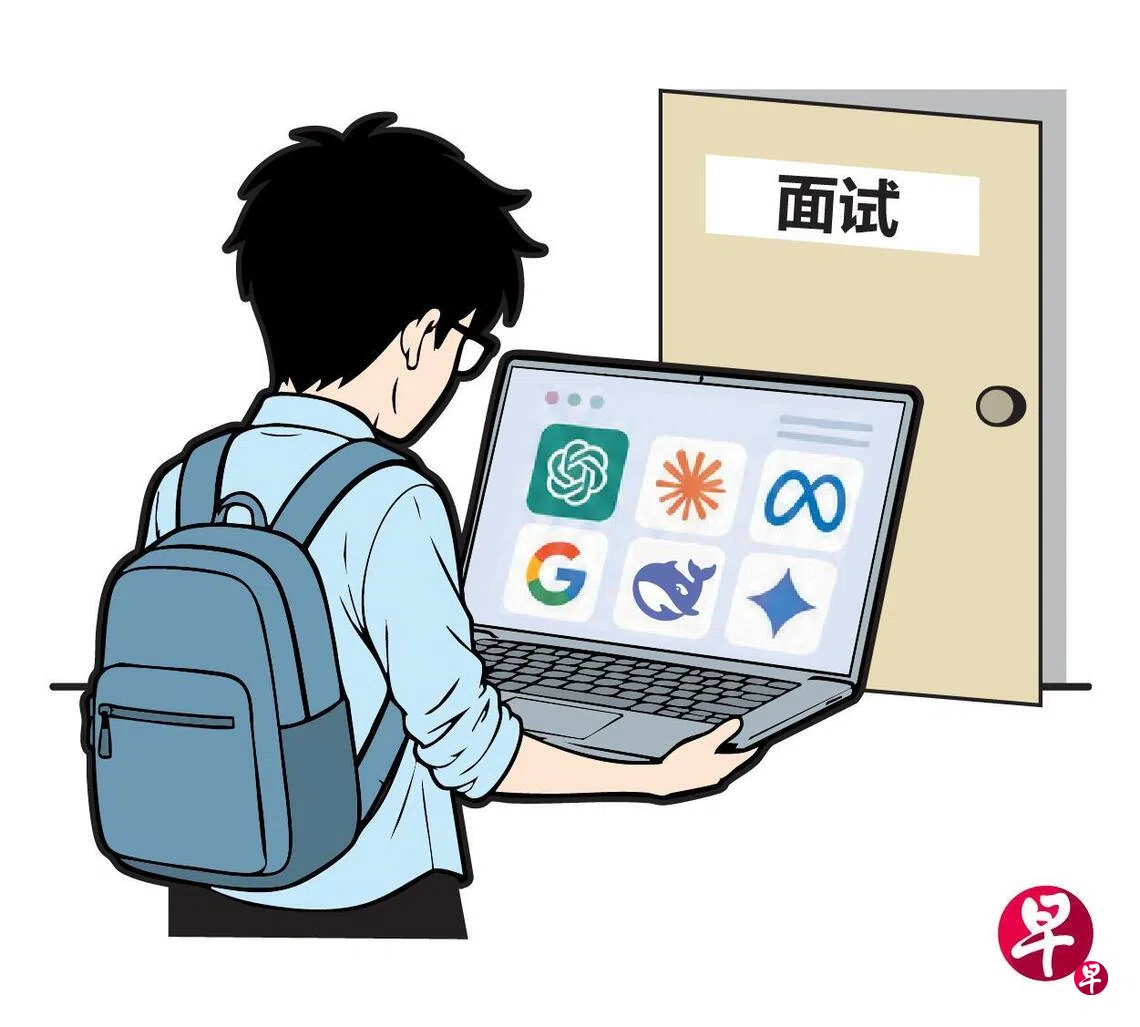
A 10,000-character article titled “The Model Generation” has been sweeping through the social media feeds of young Chinese born after 2000.
Published on Wednesday (18 November) in “Zhengmian AI”, a new section of Chinese non-fiction outlet Zhengmian Lianjie, the article explores how artificial intelligence (AI) is reshaping universities and the choices young people make as they come of age. Its author, Jiang Yifan, who graduated from Tsinghua University last year, spent five months interviewing more than 30 people, including AI company employees, entrepreneurs and university lecturers.
Jiang begins with those around him. At university, he and several friends studying science and engineering attended classes and skipped them together; there was little to distinguish them. But after they entered the AI industry, one had an “expected annual income 10 times mine”, while another was earning US$1 million a year (about S$1,289,400), “100 times my expected annual income”.
“In their early 20s, they no longer need to spend long years earning money and recognition,” the article observes. One graduate of Tsinghua’s Yao Class identified their academic background on social media and received unsolicited private messages from nearly 20 venture capitalists. Yet fortunes can differ even within the same elite circles. Another graduate, once the top-scoring science student in their province, gave up a route to postgraduate admission without an entrance examination to look for work directly, but has so far found nothing because they lack an AI internship.
The article notes that AI has also changed the humanities, social sciences and university classrooms: “No one writes papers themselves any more, and not many even read papers themselves.” A doctoral student in Marxist studies submitted an assignment that AI had written in a day. She felt she was cheating, but her teacher recommended submitting it for publication. A master’s student in comparative literature who insisted on not using AI was told by a senior student that they were “turning back the clock”.
Jiang’s own feelings are conflicted. His quiet confidence that reading and writing could not be replaced gave way to shock and envy as he watched his peers gain money, conviction and a sense of mission. He regrets not taking up AI internships sooner, but also regrets having skimmed too many books hastily and arrogantly.
At the end of the article, he recalls reading The Iliad in his second year at university. Years later, the phrase “winged words” still stays with him, revealing his attachment to learning experiences that cannot be measured in efficiency or income.
As the article went viral, many readers recognised that unease. If even Tsinghua students feel adrift in the technological tide, what of ordinary young people already under pressure from the job market and the economy?
Others, however, criticised the article as a form of “AI angst literature” that magnifies elite university students’ sense of loss and anxiety. A blogger who goes by “Yikezhong” and studies in Tsinghua’s Chinese language and literature department rejected the “model generation” label. She said she had once felt the sadness of being “born at the wrong time”, but still believed AI could help bring many ideas to life.
On elite university students’ employment anxiety, she asked: “Who told you that getting into a top-two university automatically makes you a member of the social elite with status and a high salary?” Rather than cling to the prestige of an elite university, she argued, it would be better to lower expectations and build a good life.
Others refused to sympathise with such “elite bewilderment”. The Tsinghua classrooms and close readings of Homer’s epics that Jiang describes are themselves educational experiences not every young person has the chance to enjoy. While some lament the loss of humanistic values, others may still be worrying about whether their qualifications will get them even a call for an interview.
Writing on Zhihu, young Chinese physicist Cai Jiaqi criticised the article for dividing young people into two groups: those who have secured passage into a new era, and those who have yet to realise they have been left behind. This division, he argued, reduces the rich diversity of human creativity to a single career track centred on the AI industry, then measures the meaning of life by one’s proximity to that track. “It is a sophisticated way of peddling anxiety, earning rapid and widespread circulation, but it ultimately falls back on the same old formula.”
But can abandoning proximity to AI as a measure of worth really dispel the anxiety of finding a job?
Wang Tianfu, a professor in Tsinghua University’s sociology department, noted that young people are the most likely to lose out from AI’s disruptive impact. Many commentators have tried to point them towards a way forward, but most focus on the individual, such as adjusting one’s mindset or learning new skills. He asked: “Can structural problems really all be resolved at the individual level?”
“The Model Generation” may not capture an entire generation. Some see structural constraints; others believe in individual choice. Either way, young people must ultimately navigate that narrow passage.
