

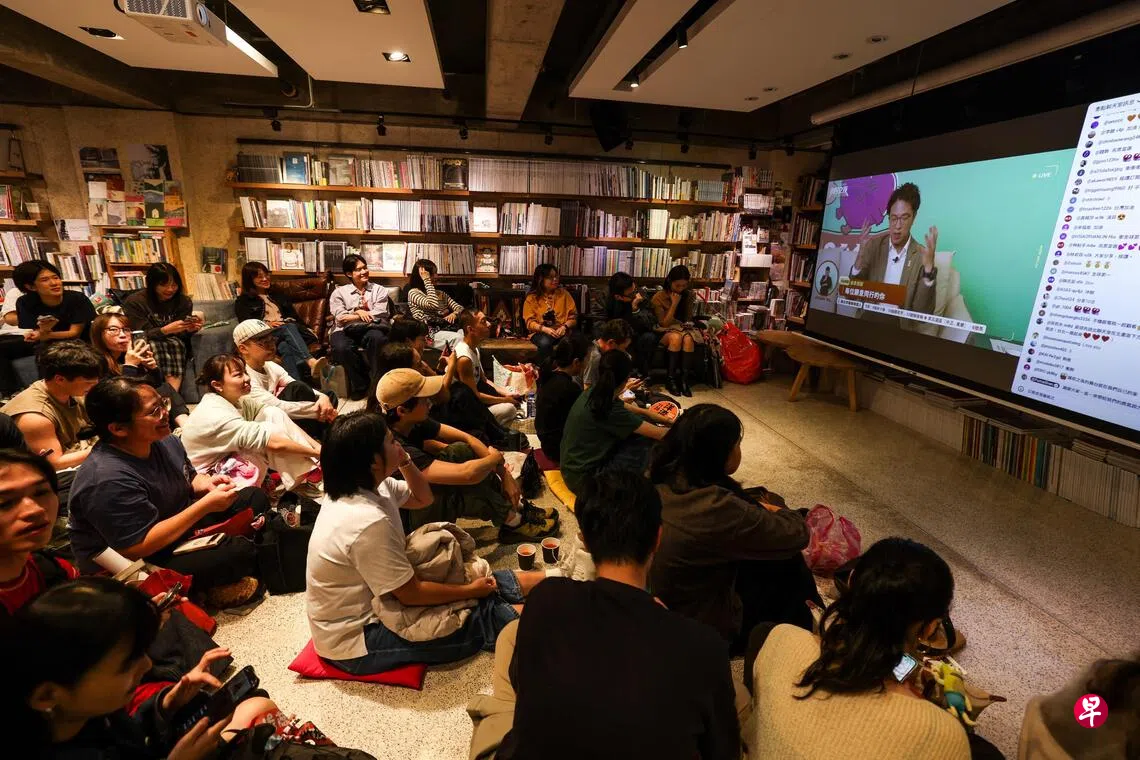
On the eve of Taiwan’s nine-in-one local elections, candidates from all parties made a final push to get out the vote. The Taipei mayoral race was particularly intense, with Kuomintang (KMT) candidate Chiang Wan-an holding a rally on Ketagalan Boulevard and Democratic Progressive Party (DPP) candidate Puma Shen making his final appeal through a livestream.
Taipei Mayor Chiang Wan-an, who is seeking re-election, held an election-eve rally under the slogan “Glory for Taipei, Forward Together” on Ketagalan Boulevard on Friday (27 November) evening. Taichung Mayor Lu Shiow-yen, New Taipei Mayor Hou Yu-ih and Legislative Yuan Speaker Han Kuo-yu took turns on stage to urge supporters to vote. Before the rally ended, organisers announced that 150,000 people were present.
Lu, who chairs Chiang’s campaign, said a video she filmed a week earlier, “The Sound of Silence” (《沉默之声》), had drawn more than two million views. Opinion polls might not reflect everyone’s views, she said, but ballot papers could. “As long as we turn out to vote, we will win!”
Han was greeted by thunderous cheers as he took the stage. He called it the dirtiest Taipei mayoral election he had seen in 40 years of observing Taiwanese politics, accusing the media and online commentators of smearing Chiang — turning “White toothpaste into Darlie toothpaste”, as he put it. He criticised judicial intervention, media bias and the weaponisation of opinion polls, saying the DPP government “has already moved towards dictatorship” and urging voters to use their ballot papers to keep it in check.
Chiang said plainly that he could not afford any complacency in this race, with his opponent’s camp mobilising on all fronts. “The race is extremely tight right now.” Every additional vote would strengthen Taipei’s stability, he said, while every lost vote would put the work of the past four years at greater risk. He urged people to turn out to vote for their shared home, the values they held dear and the next generation’s future.
Chiang’s campaign also announced that if he won re-election by a large margin, he would adopt a new look, appearing with silver-white hair.
A message purportedly from a Chiang fan group circulated online the day before polling, apparently inciting others to attack Shen. Chiang’s campaign office said on Friday that it had reported the matter to the police and asked them to swiftly establish the message’s source and the identity of its author. The campaign also strongly condemned threats of violence and remarks inciting violence, stressing that no one should face intimidation or threats because of differing political views, and that the safety of both candidates and residents should be protected.
Shen had planned to hold an in-person rally called “Citizens’ Night”, but road closures for the stage set-up caused traffic congestion and public complaints. He decided to cancel it and switch to a livestream, calling on supporters to gather at businesses in various locations for watch parties. A map of the watch parties showed more than 380 participating locations and over 50,000 supporters taking part. Towards the end of the livestream, concurrent viewers exceeded 500,000.
Xia Mi, a restaurant on Taipei’s Chongqing South Road that specialises in local ingredients, was among the first businesses to respond to Shen’s call for watch parties. When the livestream hosts led chants, supporters in the restaurant joined in, shouting “Dong suan!” — a call for electoral victory.
Mr Lin, 49, who had originally planned to attend the in-person election-eve rally, went to Xia Mi with his wife and their son, a first-time voter, to watch the livestream over a meal. He told Lianhe Zaobao that he had bought a book by former Taipei mayor Ko Wen-je and had voted for him before. This time, however, he was supporting Shen, whose campaign focused on municipal issues. In his view, Shen was an “unconventional candidate”.
Asked whether Shen could win, Lin said he was unsure. Although Shen had a strong online presence, the KMT had still secured substantial numbers of votes in several previous elections despite attracting less attention online.
Concurrent viewers quickly surpassed 400,000 when Shen’s wife, Tseng Hsin-hui, and their daughter, nicknamed “Little Mochi”, appeared on the livestream. Tseng recalled that her husband had spent a great deal of time studying policies since entering the race, sometimes even talking about municipal affairs in his sleep. She briefly choked up as she spoke about the strain of his campaign.
Taiwanese President Lai Ching-te made the final guest appearance, bringing kumquat tea, bear-shaped biscuits and an album of photographs of Shen interacting with voters. He also invited Taipei 101 chairwoman Janet Chia to join him. Chia said Lai had recruited both her and Shen, and that neither had initially inspired much confidence. Lai joked that he had since received plenty of positive feedback, and that their performance further vindicated his original decisions.
In his final appeal at the end of the livestream, Shen said Taipei should start planning early for its development over the next 20 years and do better in areas such as childcare, support for young entrepreneurs and improvements to urban spaces. The campaign had shown him residents’ desire for change, he said. “I carry that hope on my shoulders. I can do this.” He urged supporters to turn those hopes into votes.
