

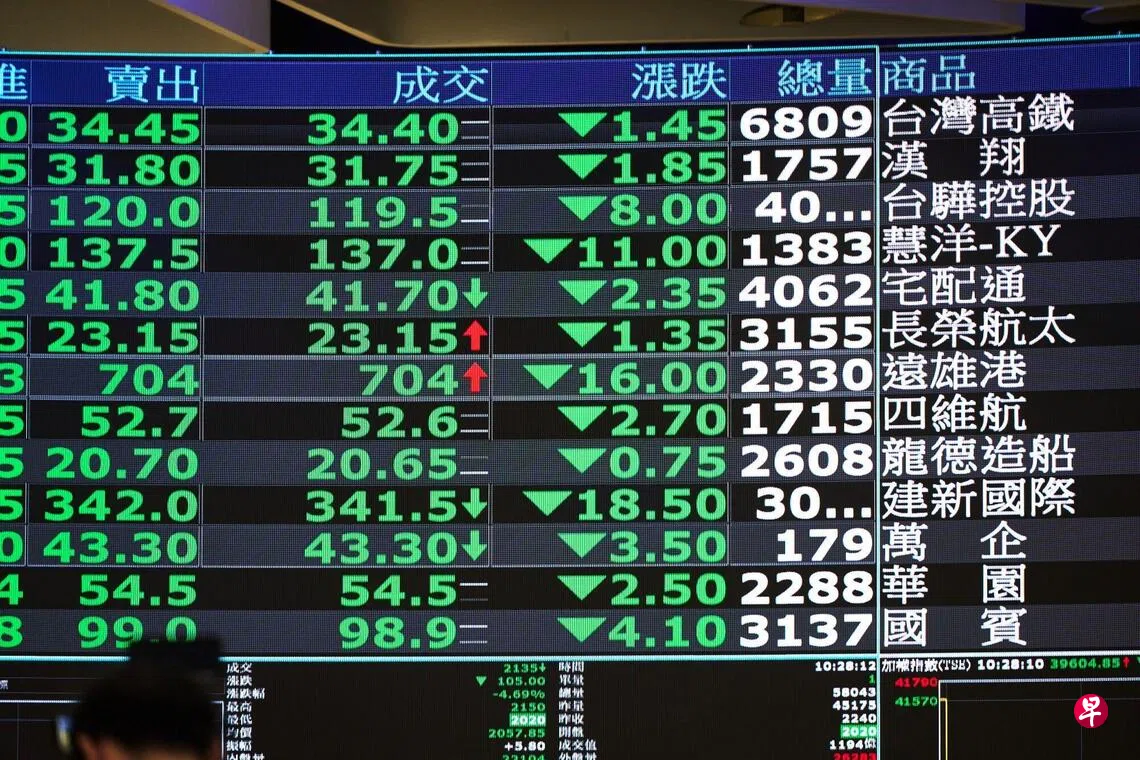
Taiwan’s technology-heavy stock market suffered another sell-off on Friday as global artificial intelligence (AI) stocks came under renewed pressure, leaving its benchmark index with its worst weekly performance since 1991.
Bloomberg reported that the Taiwan Stock Exchange Weighted Index slumped 6.2% on Friday (20 November), taking its losses for the week to nearly 18%. Taiwan’s financial regulator has tightened short-selling restrictions twice this month to stabilise the market, but has failed to halt the index’s slide.
Asian technology stocks came under broad pressure on Friday after Anthropic’s blockbuster listing failed to dispel widespread doubts about the AI industry’s prospects. Investors remained cautious about whether massive capital expenditure on the underlying technology infrastructure and debt financing would generate commensurate investment returns.
Shares in Anthropic, the developer of the Claude chatbot, fell 4.7% in US after-hours trading. Technology stocks account for more than 70% of the Taiwan benchmark index, making it highly sensitive to swings in sentiment towards the global semiconductor and AI supply chains.
Taiwan’s Financial Supervisory Commission (FSC) announced further tightening of short-selling rules on Thursday (19 November) in a bid to stabilise the island’s equity market.
In a statement, the FSC said that from Friday, the daily limit on intraday orders to sell borrowed shares would be lowered further, from the 3% set earlier this month to 1% of each stock’s average daily trading volume over the preceding 30 trading days. Certain hedging and market-making activities would be exempt.
Following the US midterm elections, concerns that the Democrats might tighten regulation of the AI industry triggered a sell-off in chip stocks on Wall Street that spilled over into Asian markets. Taiwan’s benchmark index plunged as much as 3,737.67 points on 6 November, hitting an intraday low of 37,837 points before paring its losses.
The FSC announced that day that, from 9 November, it would raise the cost of short selling and curb selling pressure, primarily by increasing margin requirements for short sales and lowering the daily limit on intraday orders to sell borrowed shares to 3% of average daily trading volume over the preceding 30 trading days.
