

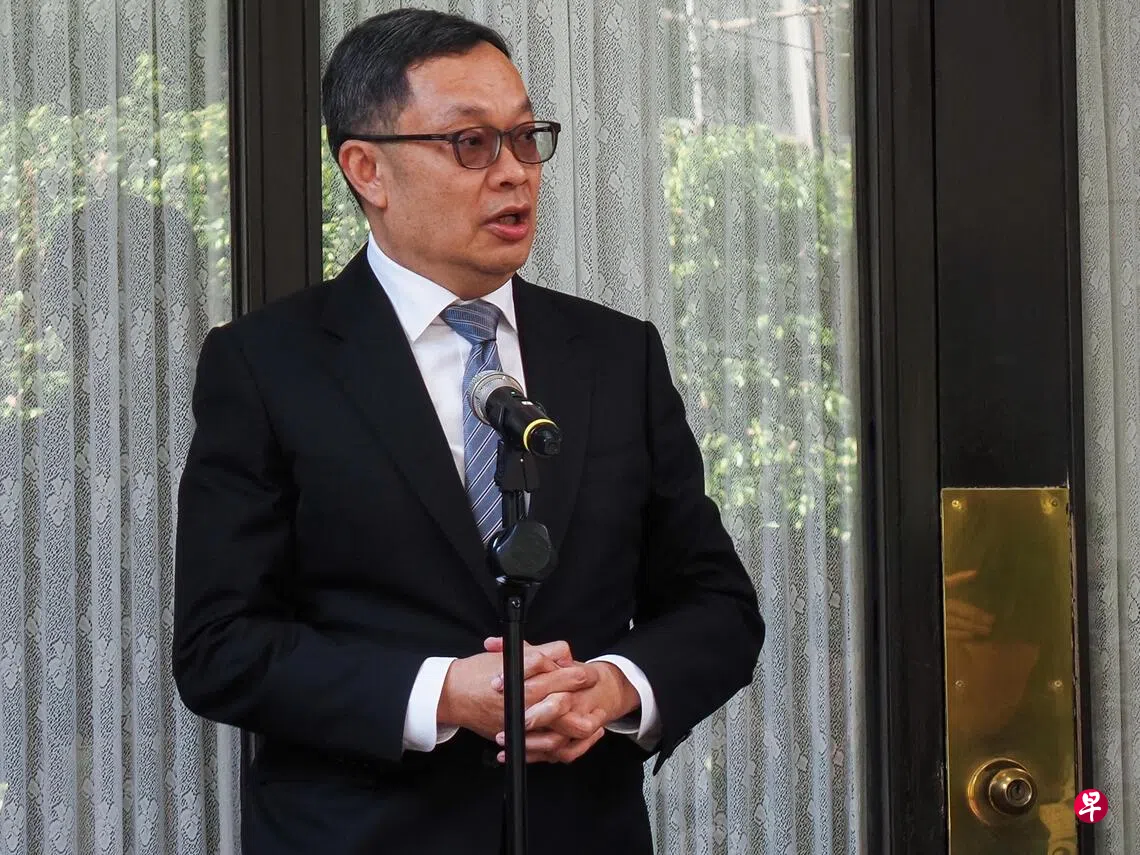
Taiwan’s Deputy Foreign Minister Chen Ming-chi said the timing of US approval for a US$14 billion (about S$18 billion) arms sale to Taiwan depends largely on US President Trump and will not be affected by the outcome of the US midterm elections.
AFP reported on Tuesday that Chen Ming-chi said Taiwan has long enjoyed “very strong bipartisan support” in the US Congress, so even if the Democratic Party wins control of both the Senate and the House of Representatives in this month’s midterm elections, it will not affect the timing of approval for the arms sale.
“When it comes to time, I think it's very much up to... President Trump,” he said.
Chen said the Trump administration has to weigh several factors, including the war in the Middle East, when considering arms sales to Taiwan. Taiwan respects US considerations but has also made clear its urgent need for the military equipment to strengthen its defence capabilities.
Taiwan has been waiting for months for Trump to approve the US$14 billion arms sale, which includes Patriot missiles, automated command-and-control systems and 360-degree air defence radar systems.
After meeting Chinese President Xi Jinping in May this year, Trump said he had temporarily put the arms sale on hold, describing it as a bargaining chip in negotiations with Beijing.
Chen stressed that Taiwan maintains good direct communication with the Trump administration and believes this will not change. In his view: This could be just a matter of time before the sale is approved, either as one package or in smaller parcels.
Trump is expected to meet Xi again during the Asia-Pacific Economic Cooperation (APEC) summit in Shenzhen this week and at the Group of 20 (G20) summit in the US in December.
Although Taiwan was among the issues discussed at their previous talks, Chen was not concerned about the upcoming meetings, stressing: “We are very confident and very comfortable with our relationship with the US and with other like-minded partners.”
He said: “We are structurally important, and our people (are) committed to our own defence. I think this (is) what matters the most.”
Chen also noted that Taiwan is at the heart of the global AI revolution and holds an important position in the advanced semiconductor supply chain. He believes almost all world leaders now understand Taiwan’s importance.
