

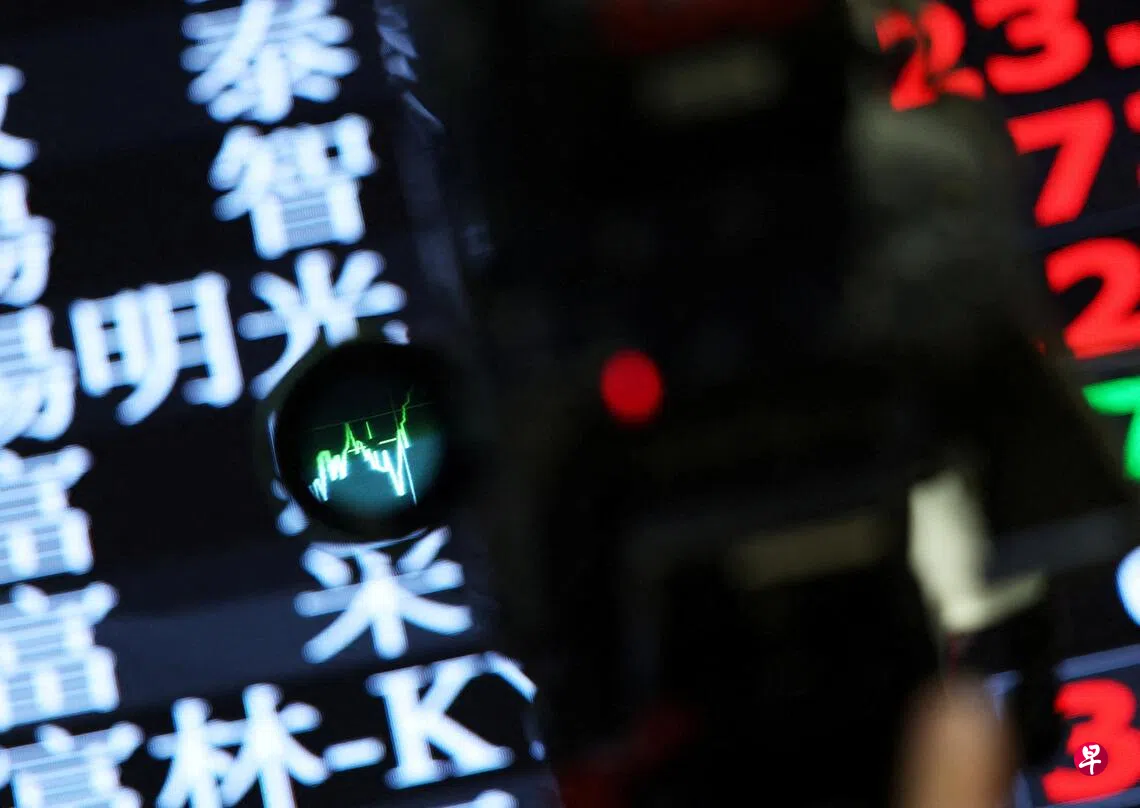
Taiwan’s stock market recorded its largest-ever weekly points loss in the run-up to the nine-in-one local elections, prompting emergency government measures to stabilise the market and intervention by the National Financial Stabilisation Fund.
Academics interviewed said the sharp short-term losses could sway economically minded swing voters, putting the ruling party at a relative disadvantage. However, the electoral impact could ease if stocks halt their slide and recover this week.
Fuelled by the artificial intelligence (AI) boom, Taiwan’s technology-heavy stock market had continued to climb this year, briefly becoming the world’s fourth-largest by market capitalisation. But growing doubts about the outlook for AI investment triggered a sell-off in technology stocks. Taiwan’s stock market shed 7,641.83 points last week, a decline of 17.5%, wiping nearly NT$25 trillion (S$980 billion) off the market value of listed companies.
Taiwan’s National Financial Stabilisation Fund was authorised on 6 November to carry out market stabilisation operations and confirmed last Saturday (21 November) that it had intervened. That same day, Premier Cho Jung-tai convened an emergency meeting of financial and economic officials. The Financial Supervisory Commission subsequently announced a third round of short-selling restrictions, including a blanket ban on short-selling below the previous closing price and higher margin requirements for short sales. The measures took effect on Monday (23 November).
Taiwan stocks rebounded on Monday, gaining 778.6 points to close at 36,811.89. The Taiwan Stock Exchange announced that day that it would lower the collateral maintenance ratio for margin financing from 130% to 120%, effective Tuesday (24 November).
At a meeting with representatives from the financial sector and industry on Monday, Cho stressed that the fund, together with other government resources, still had “capacity to spare” to stabilise the market. Nevertheless, the government was willing to actively consider expanding the fund. The fund is legally permitted to raise up to NT$500 billion, and the government is studying legislative amendments to double that ceiling to NT$1 trillion.
Speaking after the meeting, Taiwan’s Economic Affairs Minister Kung Ming-hsin relayed Cho’s remarks that Taiwan’s economic fundamentals remained sound, with some industries’ order books stretching into 2029. The government would also continue to expand investment in the AI industry.
Wang Chih-sheng, secretary-general of the Chinese Asia-Pacific Elite Exchange Association, told Lianhe Zaobao that some economically minded voters might direct their anger over recent stock market losses at the government, questioning why it had not intervened sooner. People who had not planned to vote might also turn out to cast “anger votes”, putting the ruling party at a relative disadvantage.
He said voters might feel their recent losses more keenly than they remembered the stock market’s gains over the past year. “They won’t think about how much stocks have risen over the year, only how much they have lost this week.”
Wang said middle-class stock investors were relatively concentrated in metropolitan areas, so the elections in Taipei and New Taipei could be more noticeably affected, particularly the fiercely contested Taipei mayoral race.
But he stressed that voters might still vote according to their existing political allegiances, even if they were unhappy that the government had not intervened sooner. Investors’ discontent could also ease if the stock market halted its decline and recovered this week.
Chang Teng-chi, a professor in the Department of Political Science at National Taiwan University, said investors among both pan-blue and pan-green supporters had benefited from the earlier stock market rally, but the ruling party was more likely to receive credit for revitalising the economy. The recent sharp correction could damage perceptions of the government’s economic record, prompting the relevant agencies to take active steps to stabilise the market.
Chang assessed that stock market volatility had “limited capacity to directly influence the elections”. The ruling party could also use former Nvidia chief executive Jensen Huang’s involvement in an industrial espionage controversy linked to mainland China to stress the need to strengthen societal resilience and “resist China and protect Taiwan”, easing the political pressure from the stock market rout.
Jensen Huang was reported last month to have had an intimate relationship with a woman suspected of conducting intelligence activities for mainland China. Nvidia launched an internal investigation, and Huang resigned to take responsibility. The controversy raised market concerns about Nvidia’s business prospects, intensifying selling pressure on technology stocks and affecting related supply chains.
