

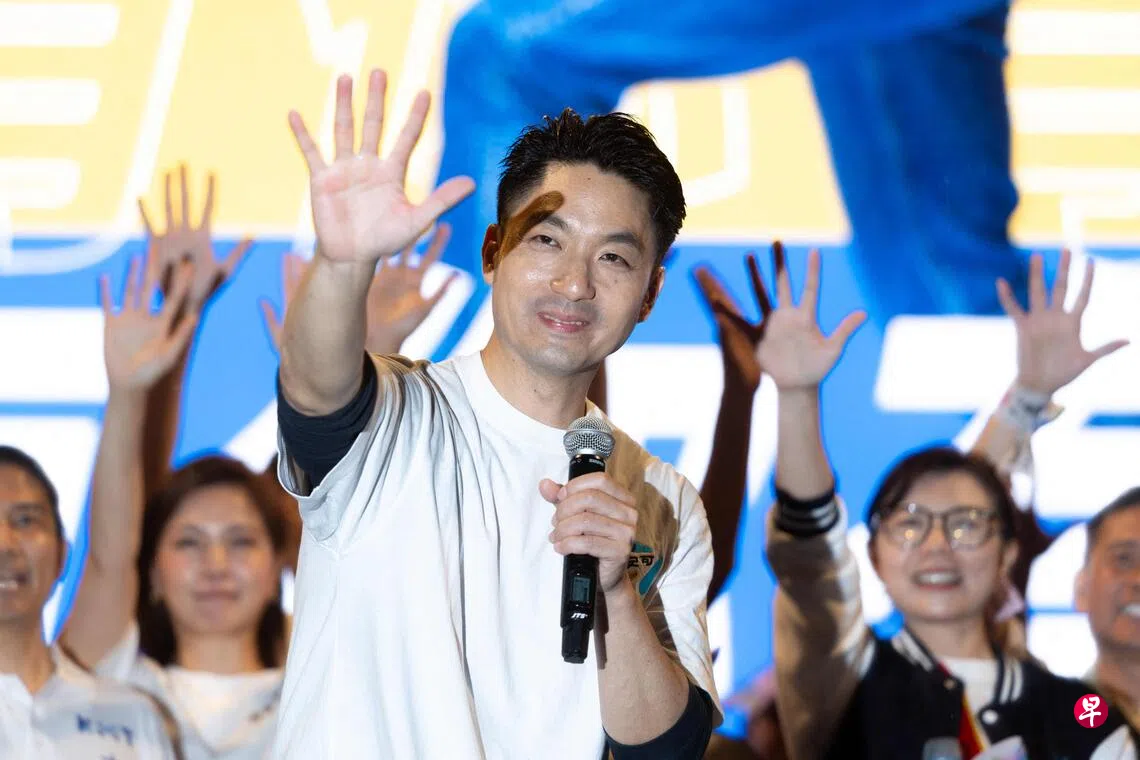
Taiwan’s nine-in-one local elections have entered the final stretch, with the Taipei mayoral race growing increasingly heated. Incumbent Kuomintang (KMT) Mayor Chiang Wan-an and Democratic Progressive Party (DPP) candidate Puma Shen both held major campaign events on the penultimate weekend before polling day, testing their popularity and ability to mobilise supporters.
Chiang held his “Taipei Peace of Mind March” on Saturday (14 November), drawing more than 80,000 people, according to organisers. Shen held his final major motorcade canvassing event in Shilin and Beitou on Sunday (15 November). Supporters independently organised a flotilla of yachts, dragon boats and stand-up paddleboards on the Tamsui River to converge with the motorcade. With livestreaming added to the mix, the campaign event unfolded on land, on water and online. Organisers said more than 100,000 people attended, with another 42 “Ocean Current” vessels gathering on the river.
At the junction of Zhongzheng Road and Wenlin Road in Shilin district on Sunday, Lianhe Zaobao’s correspondent saw many Shen supporters wearing “Ocean Current” ribbons and carrying homemade fans, flags and 3D-printed accessories. Some had spontaneously formed a running group to cheer on the motorcade. From time to time, supporters in passing cars wound down their windows and waved “Ocean Current” flags, drawing cheers from the roadside crowd.
Ms Huang, who is in her 40s and attended with two friends, told Lianhe Zaobao that she had accompanied her parents to Chen Shui-bian’s campaign rallies when she was young. “The atmosphere was much like this in the Ah Bian days. Taipei hasn’t seen anything like it for a long time.”
Huang described this election as the one in which she had felt most involved. But she acknowledged that many supporters of the KMT-led blue camp remained unwilling to declare their allegiance publicly, leaving her less than certain that Shen could win. “I’ll cry whether or not he gets elected,” she said.
After the motorcade passed, Huang and her two friends planned to head to the gathering point at Guandu Temple to continue taking part in the joint land-and-water rally. Shen urged supporters to turn out and ensure that “every vote goes into the ballot box”. President Lai Ching-te and Kaohsiung Mayor Chen Chi-mai also spoke at the event. Lai described its scale as “historic, surpassing any presidential election rally”.
Chiang’s mass march on Saturday afternoon followed two routes, one from the south and the other from the north. One contingent was led by Legislative Yuan Speaker Han Kuo-yu and Chiang’s wife, Shih Fang-ken; the other by Chiang and Taichung Mayor Lu Shiow-yen, who chairs his campaign headquarters. They converged in front of Taipei City Hall.
Despite rain during the march, supporters took part with umbrellas or raincoats. Many wore heart-shaped stickers on their faces and ribbons around their wrists, waving campaign flags and chanting “An encore for Taipei” and “Elect Chiang Wan-an” along the way.
Ms Chen, who had recently retired, walked all the way to Taipei City Hall with several friends. “Chiang Wan-an has done a good job! He’s practical and down to earth!” she said in an interview.
Chen and her friends were dismissive of the “Ocean Current” movement generated by Shen, but acknowledged that many Chiang supporters they knew were unwilling to state their views publicly. “They don’t want to come out and be targeted, but they will vote. We also need to come out and rally support for him.”
A 22-year-old university student who declined to be named said that despite Shen’s strong online presence, Chiang was more pragmatic, which was why he supported him. He observed that the DPP was more adept at using social media, and that winning young voters was a major challenge for Chiang.
In his speech, Chiang criticised what he described as a recent proliferation of rumours and smear campaigns. He stressed that the election concerned not only Taipei’s future, but also the choice of Taiwan’s future path and direction.
Scholar: “Ocean Current” unleashes green camp supporters’ “30 years of frustration”
Japanese scholar Yoshiyuki Ogasawara, dubbed the “god of elections” by Taiwanese media, travelled from Hsinchu to Taipei on Saturday specifically to observe the march. In a Facebook post on Sunday, he said the rain had affected turnout and the atmosphere. While supporters near the front of the stage were enthusiastic, those further back were relatively subdued. Attendance at City Hall Square may have fallen short of the organisers’ expectations.
Ogasawara drew comparisons with major marches during Lien Chan’s 2000 presidential campaign and Hau Lung-bin’s 2010 bid for re-election as Taipei mayor. Lien’s supporters had left in droves when rain fell during the march, while Hau had successfully rallied blue camp supporters and strengthened his re-election momentum. Chiang’s march, he said, “fell roughly between the two”.
Chuang Po-chung, a former director of the KMT’s Culture and Communications Committee and party spokesman who is now a journalism professor at Chinese Culture University, said in an interview that few candidates in past Taipei mayoral elections had extended their campaign events onto the Tamsui River. The joint land-and-water rally was indeed a refreshing approach, he said.
Chuang said the DPP had not won a Taipei mayoral election in nearly 30 years, since Chen Shui-bian’s failed re-election bid in 1998, leaving supporters of the DPP-led green camp with “30 years of frustration”. Shen’s “Ocean Current” movement had now given them hope of competing with the KMT, unleashing their long-suppressed enthusiasm. But he stressed: “Creativity is one thing; whether it brings in more votes is another.”
Chen Shih-min, a political science professor at National Taiwan University, said Shen’s “Ocean Current” movement had already built considerable momentum, and Sunday’s joint land-and-water rally was mainly intended to sustain it. The more important question was how the blue and green camps would win over Taiwan People’s Party (TPP) supporters.
Chen said Chiang hoped to use cooperation between the blue and white camps to attract voters who remained firmly behind Ko Wen-je and the TPP. Shen, meanwhile, was targeting swing voters who had supported Ko two years ago but were now disappointed with the TPP and had yet to decide whom to vote for.
As campaigning enters its final stretch, the coming weekend will mark the start of the crucial final week before polling day. The TPP is scheduled to hold a major rally in front of Taipei City Hall on Saturday (21 November), with Chiang invited to attend. TPP founding chairman Ko Wen-je is also expected to be there. Whether the two share a stage and interact will be closely watched.
