

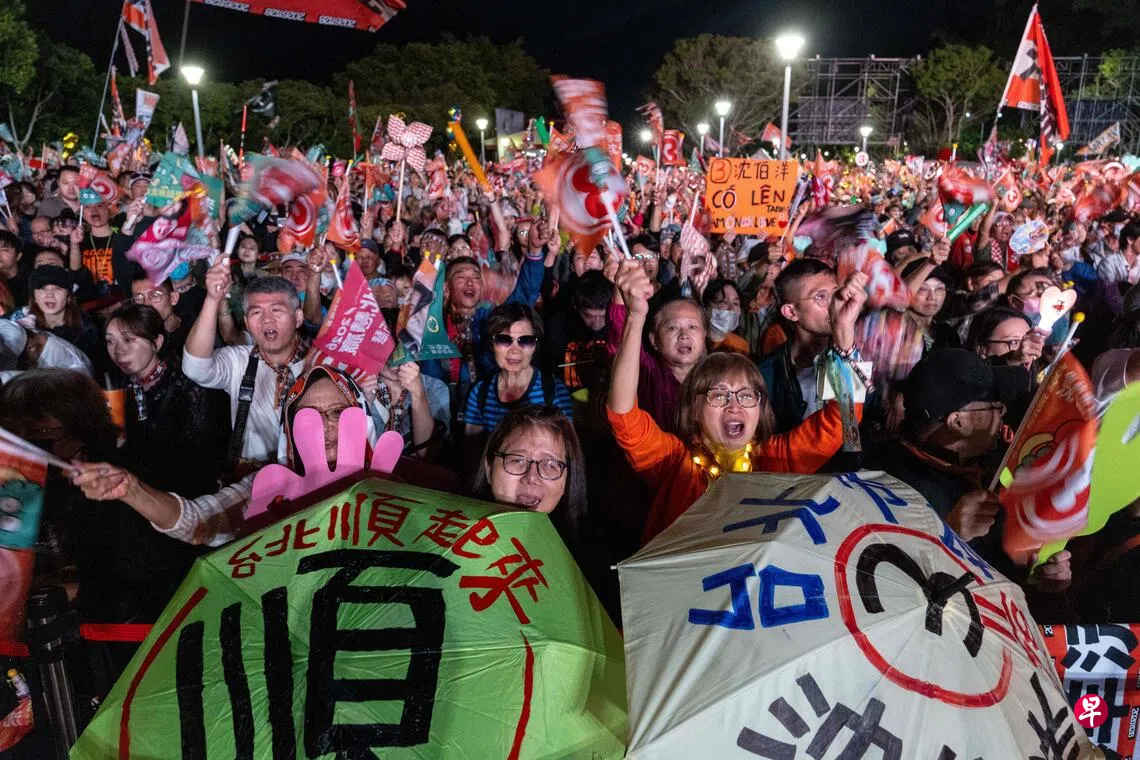
Taiwan votes in its nine-in-one local elections this Saturday (28 November). The Democratic Progressive Party (DPP) believes it has its best chance yet of winning the mayoral races in Taipei and New Taipei, and hopes to expand its control of local governments. But a recent plunge in Taiwan’s stock market, coupled with sustained Kuomintang (KMT) attacks over proposed solar installations at Feitsui Reservoir and controversies surrounding the central government’s policies, has raised concerns in the DPP camp that the races could take a turn.
According to reports on Monday (23 November) by Taiwan’s United Daily News (《联合报》) and China Times (《中国时报》), the DPP suffered a crushing defeat in the 2022 local elections, winning just five county magistrate and mayoral posts — its worst result since its founding. This year, it has nominated 19 candidates for these posts, hoping to retain the five counties and cities it governs while expanding its local foothold, potentially even doubling the number under its control.
The DPP sees its Taipei mayoral candidate Puma Shen and New Taipei mayoral candidate Su Chiao-hui as the mainstays of its campaign. It hopes the momentum generated by their “Yang and Hui join forces” campaign in the two cities will boost its prospects in central Taiwan and other counties and cities.
Beyond Taipei and New Taipei, the DPP camp has identified Yilan, Changhua, Chiayi City and Hsinchu County as key targets to wrest from its opponents. It remains in close pursuit in Keelung and Taitung, while its position in Pingtung and Chiayi County is relatively stable.
However, as campaigning enters its final stage, the recent stock market plunge and the KMT’s repeated efforts to highlight controversies have fuelled anxiety among the DPP’s grassroots supporters. These include solar installations at Feitsui Reservoir, a universal cash handout of NT$20,000 (about S$780), and the Executive Yuan’s refusal to countersign legislative amendments raising allowances for elderly farmers.
The Feitsui Reservoir controversy stems from letters sent by Taiwan’s Ministry of Economic Affairs’ Water Resources Agency in each of the three years from 2022 to 2024 to explore the possibility of adding solar power facilities. KMT Taipei mayoral candidate Chiang Wan-an and New Taipei mayoral candidate Li Ssu-chuan held a press conference on 19 November opposing the installation of solar panels at the reservoir, warning that this could threaten drinking water safety in the Greater Taipei area.
Some DPP and government figures believe the KMT is using these issues to mobilise supporters, stoking hostility to turn out its core vote and divert attention from controversies over Chiang Wan-an’s administration, but that the actual impact will be limited. Others, however, note with concern that President Lai Ching-te has often cited stock market performance as an achievement of his administration. If stocks continue to fall this week, they fear it could undermine voters’ confidence in the central government and even spur opposition supporters to vote, becoming the biggest uncertainty ahead of polling day.
The KMT, meanwhile, is fighting to retain the 15 counties and cities it governs. Its camp believes it still has a chance of holding Taipei and New Taipei despite intense competition. Its position in Taipei is gradually stabilising, while New Taipei remains closely contested. With tight races in Yilan, Hsinchu County, Changhua and Chiayi City, the party will focus its final-stage efforts on consolidating its core support and winning over undecided centrist voters.
The Taiwan People’s Party has nominated 64 candidates for county and city council seats across Taiwan this year, aiming to double its number of councillors. The party expects a modest increase in council seats from the previous election, but believes it still needs to strengthen grassroots mobilisation in the final stretch of its races for local government leadership posts.
