

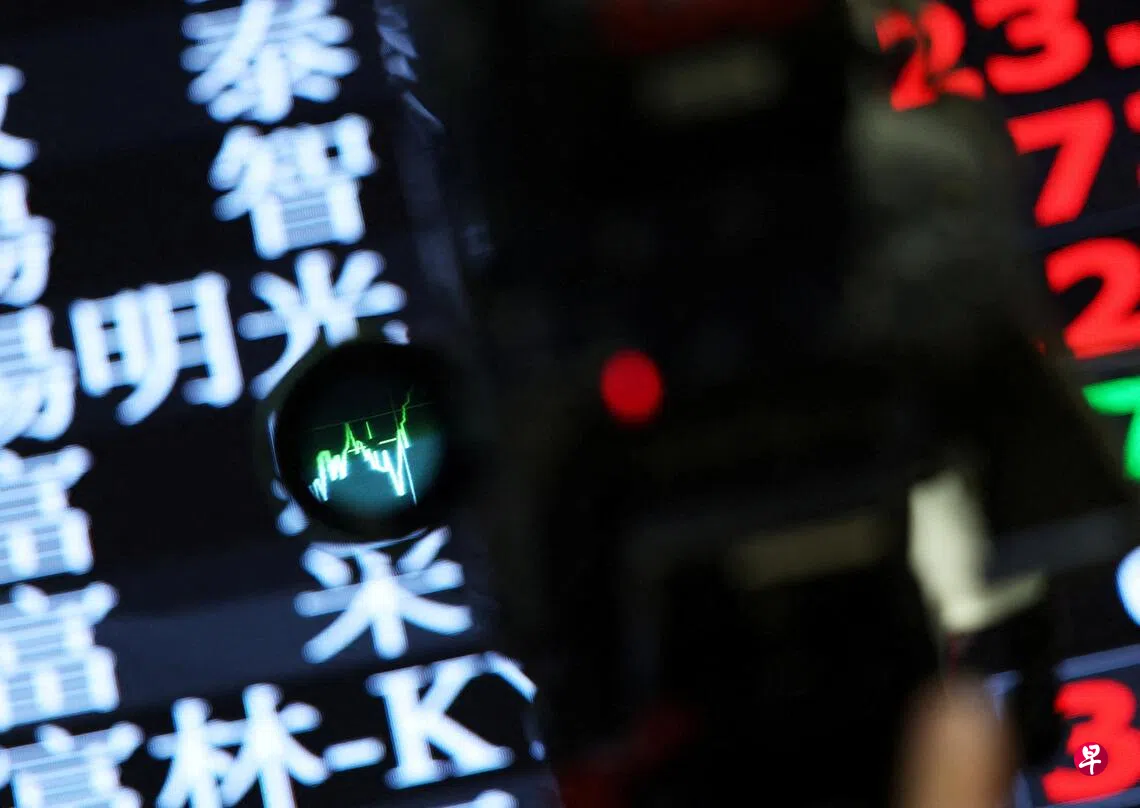
Taiwan’s stock market plunged more than 7,600 points last week, its largest weekly point loss on record, wiping out nearly NT$25 trillion (S$980 billion) in market value. After convening economic and financial officials over the weekend to discuss measures to shore up the market, Premier Cho Jung-tai will invite representatives from the financial sector and industry to a meeting on Monday (23 November) to rally support for stabilising stocks.
According to Taiwan’s United Daily News (《联合报》) and Liberty Times (《自由时报》), the Taiwan Weighted Index tumbled 7,641.83 points, or 17.5%, last week. It was the largest weekly percentage decline in 35 years and the biggest weekly point loss on record. Taiwan Stock Exchange figures showed that the total market capitalisation of listed companies shrank by NT$24.97 trillion, the largest weekly loss on record.
With stocks continuing to slump, Cho convened a special meeting of economic and financial officials on Saturday (21 November) morning. He instructed the relevant agencies to step up measures to stabilise capital markets and issued four directives.
According to Executive Yuan spokeswoman Li Hui-chih, Cho instructed the Ministry of Finance to strengthen corporate financing and credit guarantee support, and bolster the National Financial Stabilisation Fund’s efforts to steady the stock market. The Financial Supervisory Commission (FSC) was told to continue monitoring trading to ensure an orderly market and propose appropriate stabilisation measures. The Ministry of Economic Affairs was tasked with helping industries maintain stable operations and expand into international markets, while the central bank was instructed to closely monitor exchange rates and foreign exchange market developments.
Cho will also convene a large economic and financial meeting at 3pm on Monday with representatives from financial, technology, business and industry associations. It is understood that the heads of the Ministry of Finance, Ministry of Economic Affairs and National Development Council, among other agencies, have been invited, along with senior executives from several private financial holding groups that own major life insurers.
United Daily News described it as the largest meeting Cho has ever convened to support the stock market.
People familiar with the matter said Cho hoped to enlist the financial sector and industry in efforts to shore up the market. In particular, purchases of shares by cash-rich life insurers could provide support for stocks. Encouraging listed companies to buy back their own shares will also be a key topic of discussion.
Taiwan’s National Financial Stabilisation Fund announced on 6 November that it was launching its 10th market intervention. The FSC has also introduced a series of measures, including restrictions on short selling, but these have failed to halt the slide. On Saturday (21 November), the FSC announced further measures effective from Monday: a blanket ban on short selling below the previous closing price and an increase in the margin requirement for short selling to 150%.
Despite the sharp market swings, the Executive Yuan stressed that Taiwan’s economic fundamentals remained sound and the long-term outlook for its technology and semiconductor industries was unchanged. It said the recent stock market decline was mainly driven by volatility in international financial markets, rather than long-term structural problems in the economy.
United Daily News on Monday quoted Democratic Progressive Party and government figures as saying that President Lai Ching-te had often cited stock market performance as a measure of his administration’s achievements. If stocks continued to fall this week, it could erode voters’ confidence in the central government and even spur opposition supporters to turn out to vote, becoming the biggest source of uncertainty ahead of the nine-in-one local elections.
