

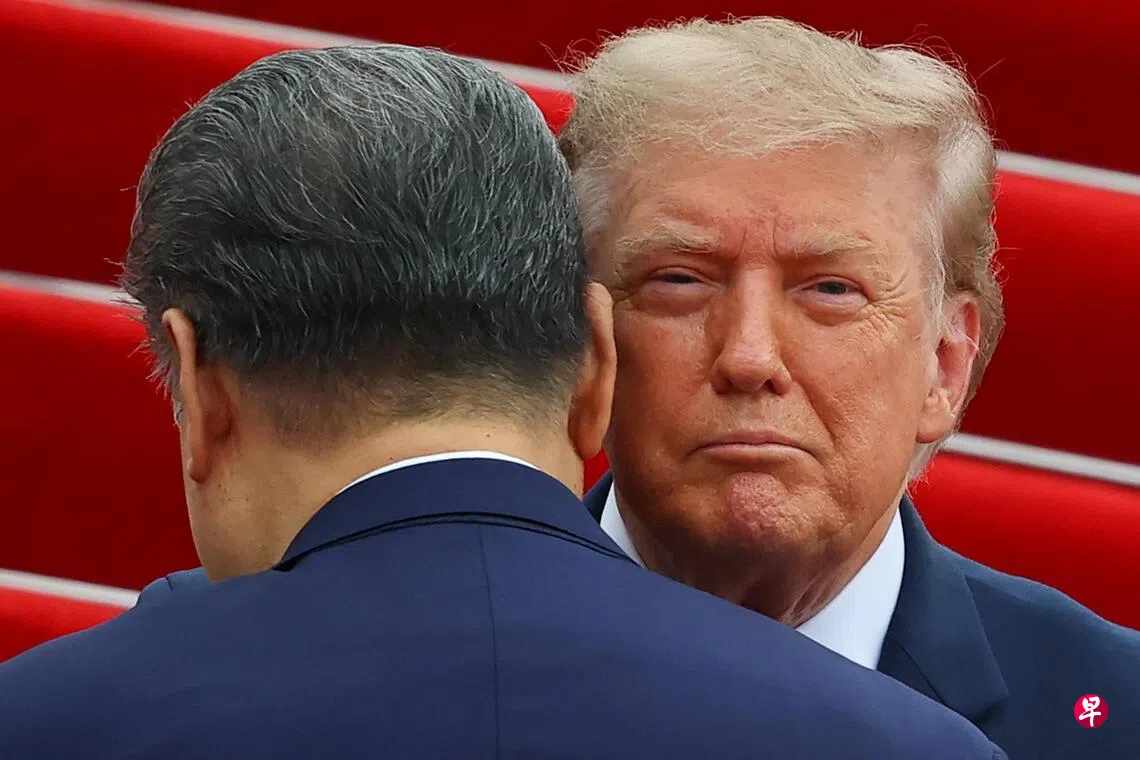
US President Donald J. Trump is attending the Asia-Pacific Economic Cooperation (APEC) summit in Shenzhen after the Republicans lost their majorities in both houses of Congress in the midterm elections, while a controversy involving Nvidia founder Jensen Huang has reignited debate in the US over technology and national security in dealings with China.
Academics interviewed said the risks for Taiwan extend beyond whether it is discussed directly at the summit. They also hinge on whether Washington changes its China policy, whether US arms sales to Taiwan are affected by US-China relations, and how chip controls reshape Taiwan-US technology supply chains. Semiconductor competition could mark a turning point for Taiwan’s future.
The APEC Economic Leaders’ Meeting begins on Wednesday (18 November) in Shenzhen, in China’s Guangdong province. Trump will hold talks with Chinese President Xi Jinping on Thursday (19 November), followed by a trilateral meeting with Xi and Russian President Vladimir Putin.
The summit comes just after Trump suffered a setback in the midterm elections, with the Republicans losing their majorities in both houses of Congress. Newly elected Democratic lawmakers will take office in January next year, giving the party control of the Senate and the House of Representatives.
Meanwhile, the controversy over Huang’s extramarital affair and his relationship with Chinese business figure Huang Le has drawn public attention in the US to the flow of advanced chips to China. Congress is more concerned about whether corporate or personal ties could allow dual-use technologies, such as artificial intelligence (AI), to circumvent export restrictions. Beijing has denied allegations that Huang Le is a Chinese spy.
Before attending the APEC summit, Trump attended the Quadrilateral Security Dialogue (Quad) summit in Manila, the Philippines, on Tuesday (17 November). He announced stronger cooperation with Japan, Australia and India on critical mineral supply chains and AI. The four countries will commit more than US$85 million (S$110 million) to a “Superintelligence” initiative and pursue maritime security cooperation. He said the US would work to match China’s rare earth output within 10 months.
Although the Quad statement did not name any country, it expressed concern over economic coercion and arbitrary export restrictions, and opposed unilateral changes to the regional status quo. This signals that critical minerals, AI and maritime routes have become part of the agenda for Indo-Pacific competition. For Taiwan, technology, resource security and the order in the Taiwan Strait will become more closely intertwined.
Tan Wei-en, a professor at the Graduate Institute of International Politics at Taiwan’s National Chung Hsing University, told Lianhe Zaobao (LHZB) that trade and high-tech competition were likely to dominate Trump’s talks with Xi. The Huang controversy could also prompt the US to treat AI chips increasingly as a national security issue. “What really affects Taiwan is not the incident involving Huang himself, but the way it has led the US to treat AI as a national security issue.” If this trend translates into laws and export rules, Taiwan’s affected industries will also have to adjust.
Tan said Congress could advance legislation including the AI Overwatch Act, the Chip Security Act and the MATCH Act. These bills cover reviews of advanced chip exports, tracking where chips end up, and requiring allies to cooperate in restricting exports of chipmaking equipment to China. If such measures are incorporated into the National Defense Authorization Act, Taiwanese companies may have to strengthen compliance checks, adjust their operations and bear the costs of supply chain changes. Beijing could also accelerate the development of home-grown AI chips or respond with rare earth export controls.
He said that if chip issues again heightened tensions between mainland China and the US, existing trade arrangements could also be affected, putting pressure on Taiwanese industries over their choices of customers, investments and markets.
Tan therefore believes semiconductors will determine whether this summit marks a turning point for Taiwan. “The decisive impact will not be in the military sphere, but in semiconductors.”
Asked on Tuesday whether Taiwan would come up during the APEC summit, Trump said he was certain Xi would raise the issue at their Shenzhen meeting, but did not elaborate. US officials had previously said Trump did not intend to raise Taiwan himself.
Li Da-jung, director of the Graduate Institute of International Affairs and Strategic Studies at Tamkang University, told LHZB that, in the trilateral talks, Russia would be focused on the war in Ukraine. The US might hope for Beijing’s help in dealing with Iran and seek to bring China into strategic arms reduction talks, although Beijing has reservations about the latter. With each side pursuing its own objectives, the meeting may not produce substantive results.
“At present, this US-China-Russia meeting looks likely to be more symbolic than substantive,” Li said. However, if the talks touch on the war in Ukraine, Taiwan should take note of Ukraine’s absence. “If this summit of the three countries addresses the Russia-Ukraine war and how to end it, the key point is that Ukraine is not at the table.” How major powers handle the security concerns of an absent party offers Taiwan one way to assess the risks of the talks.
Li said Trump still regarded stable relations with China as a foreign policy priority, but the Huang controversy reflected a struggle within the US over its approach to China. “What concerns me more is whether the fundamentals of Trump’s China policy will shift,” he said.
He added that once the Democrats take control of the new Congress, they will gain greater control over committees and scrutinise Trump’s policies towards partners such as Ukraine and Taiwan. However, the president retains considerable latitude in foreign policy, and congressional oversight does not necessarily mean an immediate change in the White House’s approach.
Tan, meanwhile, said Xi might use the meeting to test Trump’s position on arms sales. If the US adjusts its arms sales, it is more likely to split packages into smaller amounts, proceed in stages or choose less sensitive moments. He said incoming US lawmakers did not share a uniform position on Taiwan Strait issues, leaving the direction of arms sales uncertain. Existing US-China arrangements could also come under renewed scrutiny after the new Congress takes office in January next year.
