

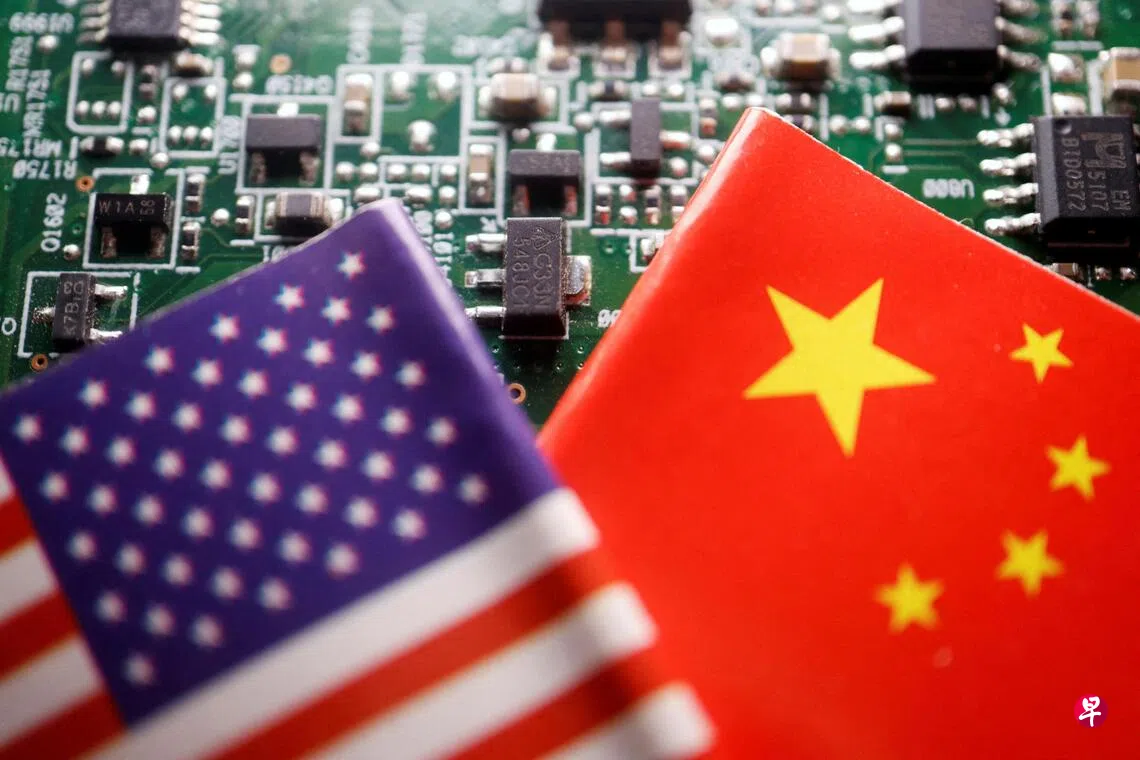
US President Donald J. Trump’s administration has announced tighter export controls on advanced artificial intelligence (AI) chips, designating Singapore, Malaysia, Thailand, Indonesia and Brazil as countries at high risk of chip transshipment. Exports of advanced AI chips to these countries will require US government licences to prevent Chinese companies from using overseas data centres to circumvent US restrictions on chip exports to China.
According to Bloomberg and Reuters reports, the US Commerce Department announced new rules on Monday (16 November) restricting exports of advanced AI chips made by US companies such as Nvidia to data centres in the five countries. Chinese companies have been accessing computing power remotely through these data centres to train AI models.
Under the new rules, overseas data centres providing substantial computing power to companies headquartered in China must obtain US export licences within 90 days to continue offering these services, or face further export restrictions. Licence applications will be reviewed on a case-by-case basis.
However, the rules allow companies headquartered in the US to continue importing the chips into the five countries without applying for licences, provided they meet specific reporting requirements. Computing services used exclusively for commercial recommendation systems by online retailers and social media platforms may also be exempted from the restrictions.
The US Commerce Department said in a statement: The rule is designed to ensure that existing restrictions on access to sensitive American technology cannot be circumvented through remote computing arrangements involving data centers in third countries.
Southeast Asia has emerged as a data centre hub in recent years. Demand for AI computing power from Chinese technology companies such as Alibaba and ByteDance has driven rapid expansion of related infrastructure in the region, with Malaysia and Thailand becoming major investment hotspots.
The new rules come as Nvidia is embroiled in a scandal involving alleged export control violations. Its former chief executive Jensen Huang resigned last week after admitting to an extramarital affair with a former executive of Singapore cloud computing company Megaspeed International.
Megaspeed International, an Nvidia partner, is under US investigation for allegedly transshipping advanced AI chips illegally to China. The company denies any wrongdoing and stresses that it has always complied with applicable laws, including US export controls.
The episode has also increased pressure on US Commerce Secretary Howard Lutnick. Treasury Secretary Scott Bessent recently criticised the Commerce Department for failing to fully enforce export controls. He also revealed that four government agencies had already backed adding Megaspeed International to a trade blacklist, but the Commerce Department, which is responsible for the matter, had yet to act.
In announcing the new rules, the US Commerce Department specifically noted that the rule was “written by and at the direction” of the Treasury Department and the National Security Council, suggesting that other government bodies may have played an important role in pushing for the rules.
Former senior Commerce Department official Nazak Nikakhtar said: “The rule is long overdue, and the question that stands out is about enforcement. If Commerce is distancing itself from this rule, which US government entity will take the lead in enforcement?”
Despite this, Trump publicly expressed confidence in Lutnick before departing for Asia on Monday, saying he had no intention of replacing him. Trump said Lutnick may have slowed work on export controls to avoid angering Beijing during sensitive US-China trade negotiations.
The measures were announced as Trump prepared to meet Chinese President Xi Jinping on Thursday (19 November) on the sidelines of the Asia-Pacific Economic Cooperation (APEC) summit in Shenzhen. The further tightening of US restrictions on advanced technology exports could add uncertainty to the talks.
Former Commerce Department official Kate Koren said the rule announced on Monday would have a much bigger impact on China than adding a single entity to the Commerce Department's trade blacklist. She said: “Nvidia and Jensen (Huang) himself were key drivers of the argument for selling chips to China as a strategy. The revelations last week put that argument into question, and the pendulum is swinging in the other direction — towards tighter export controls.”
The new rules also formally repeal Biden-era rules imposing licensing restrictions on global exports of advanced AI chips. The measures are expected to take effect after their official publication in the US Federal Register on Thursday.
