

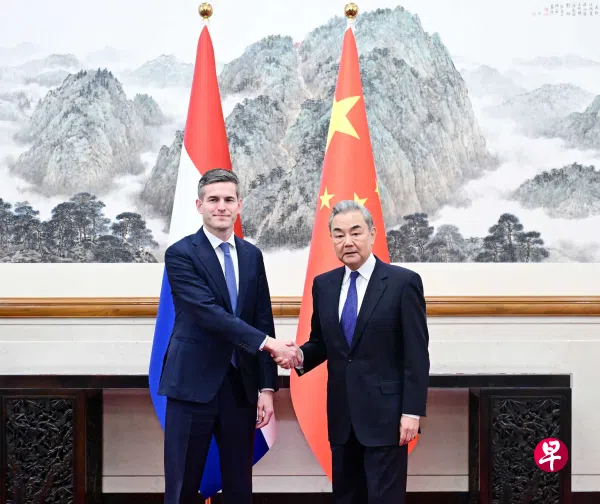
Chinese Foreign Minister Wang Yi told his Dutch counterpart Tom Berendsen that China was willing to work with the Netherlands to advance mutually beneficial outcomes through cooperation and deepen understanding through dialogue. Stressing that the Taiwan issue was a core interest of China, he said he hoped and trusted that the Netherlands would uphold the one-China principle through concrete action and safeguard the political foundation of bilateral relations.
According to a statement on the Chinese Ministry of Foreign Affairs website, Wang held talks with Berendsen in Beijing on Wednesday (25 November). Berendsen visited China from Monday (23 November) to Wednesday at Wang’s invitation, in his first visit to the country since taking office.
Wang said China and the Netherlands were both open economies and important partners to each other, with openness and pragmatism the defining features of their relationship. Amid an international landscape marked by turmoil and change, particularly the spread of economic fragmentation, China was willing to work with the Netherlands and other like-minded countries in a spirit of openness and pragmatism.
Wang stressed that the Taiwan issue concerned China’s sovereignty and territorial integrity and was a core interest of China. He said he hoped and trusted that the Netherlands would uphold the one-China principle through concrete action and safeguard the political foundation of bilateral relations.
Wang also briefed Berendsen on the main features of Chinese modernisation and the key outcomes of last week’s 33rd APEC Economic Leaders’ Meeting. He said China supported businesses from both countries in expanding two-way investment and welcomed more Dutch companies to invest and operate in China. He expressed hope that the Netherlands would provide a fair, transparent and predictable business environment for Chinese companies operating there.
Wang also said China attached great importance to the Netherlands’ role as a “gateway” for China-Europe cooperation and hoped it would play a constructive role in the healthy and stable development of China-EU relations.
Amid the US-China technology rivalry, the Netherlands faces pressure from Washington over controls on semiconductor exports to China. Reuters reported on Wednesday that Berendsen made clear in Beijing that the Dutch government was working to block the US MATCH Act, which could further restrict Dutch semiconductor equipment giant ASML’s business in China.
The Netherlands has already aligned with the US on export controls for advanced semiconductor equipment. However, it lobbied Washington over the MATCH Act in June this year, stressing its right to determine its own export control policy.
China and the Netherlands also have an unresolved dispute over Nexperia, a subsidiary of China’s Wingtech Technology, as well as friction over the Taiwan issue.
In September last year, the Dutch government intervened in the management of Nexperia, triggering trade and economic friction between China and the Netherlands and affecting the global automotive chip supply chain. The Dutch foreign trade minister visited China in July this year, signalling a desire to end the friction. But on 12 November this year, a Dutch court ordered additional measures to limit Wingtech’s intervention in Nexperia. The parties involved remain engaged in multiple lawsuits in China and the Netherlands.
In June this year, the People’s Liberation Army’s Eastern Theatre Command said that, since 27 May, a helicopter operating from the Dutch frigate De Ruyter had illegally entered the airspace over the Xisha Islands, and that the frigate had subsequently transited the Taiwan Strait. The command said it had deployed naval and air forces to track and monitor the Dutch vessel throughout its transit, maintain vigilance and respond effectively. When asked, the Dutch side maintained that the warship had been sailing in international waters in accordance with international law.
