

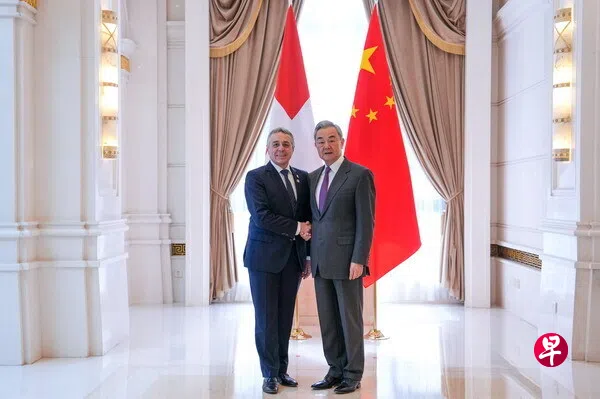
Chinese Foreign Minister Wang Yi told Swiss Vice-President and Foreign Minister Ignazio Cassis that he hoped Switzerland would take concrete action to oppose Taiwan independence and play a positive role in helping China and the EU resolve their economic and trade differences smoothly.
According to China’s Ministry of Foreign Affairs website, Wang co-chaired the fifth round of the China-Switzerland foreign ministers’ strategic dialogue with Cassis on Monday (23 November). Wang said progress in bilateral relations reflected the principles underpinning Chinese diplomacy: equality among all countries, large and small; opposition to power politics; respect for countries’ independent choice of development path; non-interference in internal affairs; and drawing on complementary strengths for mutual benefit.
He said China was willing to work with Switzerland to implement the consensus reached by their heads of state, strengthen exchanges across sectors and at all levels, and consolidate high-level political trust. Respect for each other’s core interests was the political foundation of bilateral relations, he said, expressing hope that Switzerland would take concrete action to oppose “Taiwan independence” and support China’s cause of reunification.
Wang also said free trade cooperation would provide a strong internal impetus for bilateral relations. Both sides should work towards bringing the protocol to upgrade their free trade agreement into force at an early date. He welcomed more Swiss companies to tap the extensive business opportunities offered by China’s development and pursue common development.
He noted that Switzerland was China’s first strategic partner with a focus on innovation. Both sides should strengthen coordination and planning on scientific and technological cooperation, and pursue dialogue and cooperation on artificial intelligence at bilateral and multilateral levels, jointly promoting its positive development for the benefit of humanity.
Wang said the success of China-Switzerland cooperation had once again shown that protectionism was no panacea and that intertwined interests were by no means a security risk. Openness and cooperation were the right way to move beyond the zero-sum trap towards a mutually beneficial future. China and the EU should move beyond the so-called “trade imbalance” narrative, properly manage differences through dialogue and consultation, and expand cooperation for mutual benefit, he said. He expressed hope that Switzerland would play a positive role in helping China and the EU resolve their economic and trade differences smoothly.
He also said China was willing to strengthen strategic communication with Switzerland, practise genuine multilateralism, reform and improve global governance, and uphold international fairness and justice, bringing greater stability and certainty to a turbulent world.
According to the Chinese readout, both sides agreed to make full use of their dialogue mechanisms across sectors, accelerate their respective domestic ratification procedures for the protocol to upgrade the free trade agreement, and deepen mutually beneficial cooperation in finance, science and technology, intellectual property, artificial intelligence, communications technology and education. They would also advance their innovative strategic partnership. Both sides would jointly uphold the international system with the UN at its core and the international order underpinned by international law, contributing to world peace, stability, prosperity and progress.
The two sides also held in-depth exchanges on international and regional issues, including the Ukraine crisis.
