

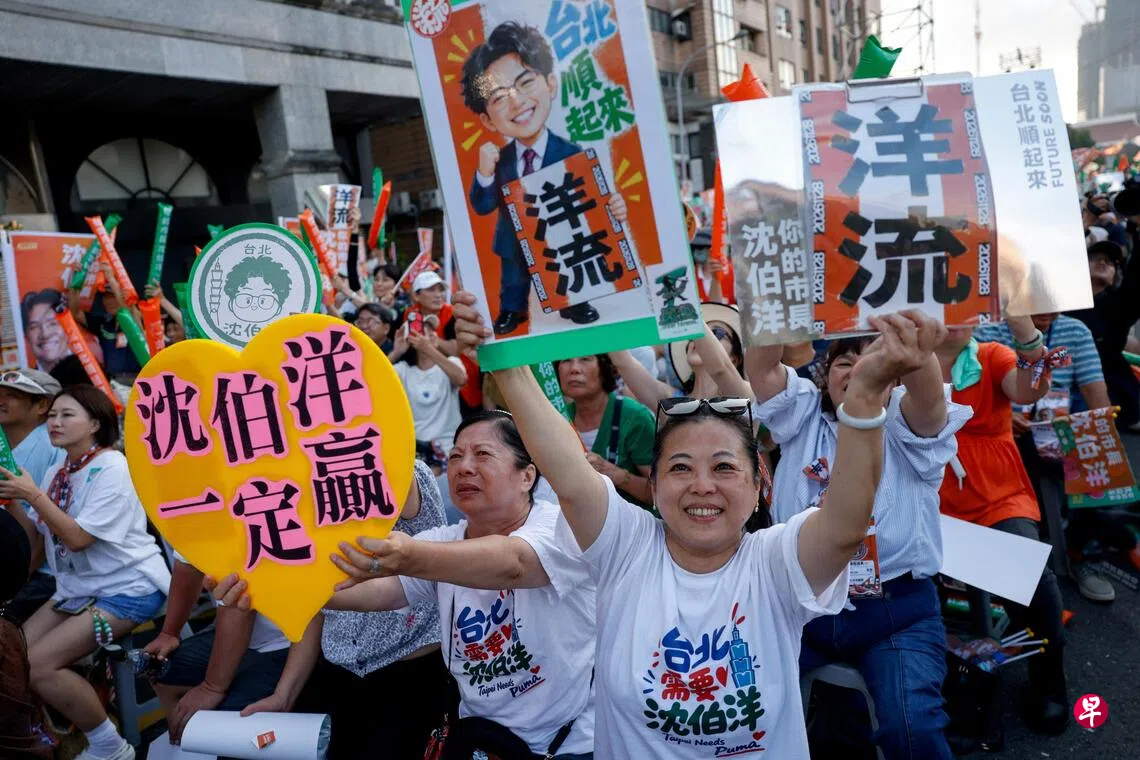
Taiwan will vote in its 2026 “nine-in-one” local elections on 28 November, with the results set to have a major bearing on the presidential election 13 months later. The ruling Democratic Progressive Party (DPP) has thrown its full weight behind Taipei mayoral candidate Puma Shen, building a “Puma O’Shen wave” that has gained considerable momentum recently. This has sharply increased the pressure on incumbent Taipei Mayor Chiang Wan-an of the opposition Kuomintang (KMT) as he seeks re-election. The KMT’s hold on New Taipei City, which it has governed for more than 20 years, is also under threat.
Academics interviewed said that if Taiwan’s longstanding political divide — a KMT-leaning “Blue” north and a DPP-leaning “Green” south — begins to shift, a DPP victory in New Taipei, Taiwan’s most populous city, would give a major boost to Lai Ching-te’s bid for re-election in 2028. Cheng Li-wun, who took over as KMT chair late last year, would face pressure to step down. Whether the KMT can unite and work together in the final stretch will be crucial.
The “nine-in-one” local elections combine elections for nine categories of local public office on a single day. These cover mayors and councillors of special municipalities; county magistrates and city mayors; county and city councillors; township chiefs and county-administered city mayors; township and county-administered city representatives; chiefs and representatives of mountain indigenous districts in special municipalities; and village and neighbourhood chiefs. A total of 19,695 people have registered to contest 11,051 posts.
Across Taiwan’s 22 counties and cities, as many as 13 local government leaders are certain to hand over power this time. Who the parties field to succeed them, and whether established local power bases will be reshuffled, are central questions in this year’s contest.
The KMT won 15 county and city leadership posts in the 2018 local elections and 14 in 2022, establishing a strong local power base around the DPP-led central government. Yet it lost the subsequent presidential elections amid domestic and external factors, including the US-China confrontation. This time, nine KMT county and city leaders who won in 2018 and secured re-election in 2022 must hand over power. Whether their successors can hold these seats will be a major test.
Voters will also cast ballots on Polling Day in a referendum asking: “Do you support the government using nuclear power to revitalise the economy, thereby abolishing the ‘nuclear-free homeland’ energy policy?” Under the rules, valid votes in favour must amount to at least a quarter of all eligible voters and outnumber votes against for the proposal to pass. Based on the 19,548,531 eligible voters in the 2024 presidential election, it would need at least 4,887,133 votes in favour.
Liu Jia-wei, a professor in the Department of Public Administration and Policy at National Taipei University, told Lianhe Zaobao (LHZB): “This referendum is a good card for the Blue and White camps, but they have not picked it up.” It touches on fundamental differences over energy policy between the Blue and Green camps and challenges what was once a core tenet of the DPP. But the KMT’s county and city leadership candidates have failed to take the lead in incorporating it into their campaigns, missing an opportunity to build electoral momentum.
DPP targets New Taipei
Among the six closely watched special municipalities, the KMT currently controls Taipei, New Taipei, Taoyuan and Taichung, while the DPP holds Tainan and Kaohsiung. The KMT hopes to retain its four cities while trying to capture Tainan and Kaohsiung, fielding legislators-at-large Hsieh Lung-chieh and Ko Chih-en respectively for another attempt. The DPP has nominated Chen Ting-fei and Lai Jui-lung to defend its two southern strongholds, while making New Taipei, governed by the KMT for more than 20 years, its top target to flip.
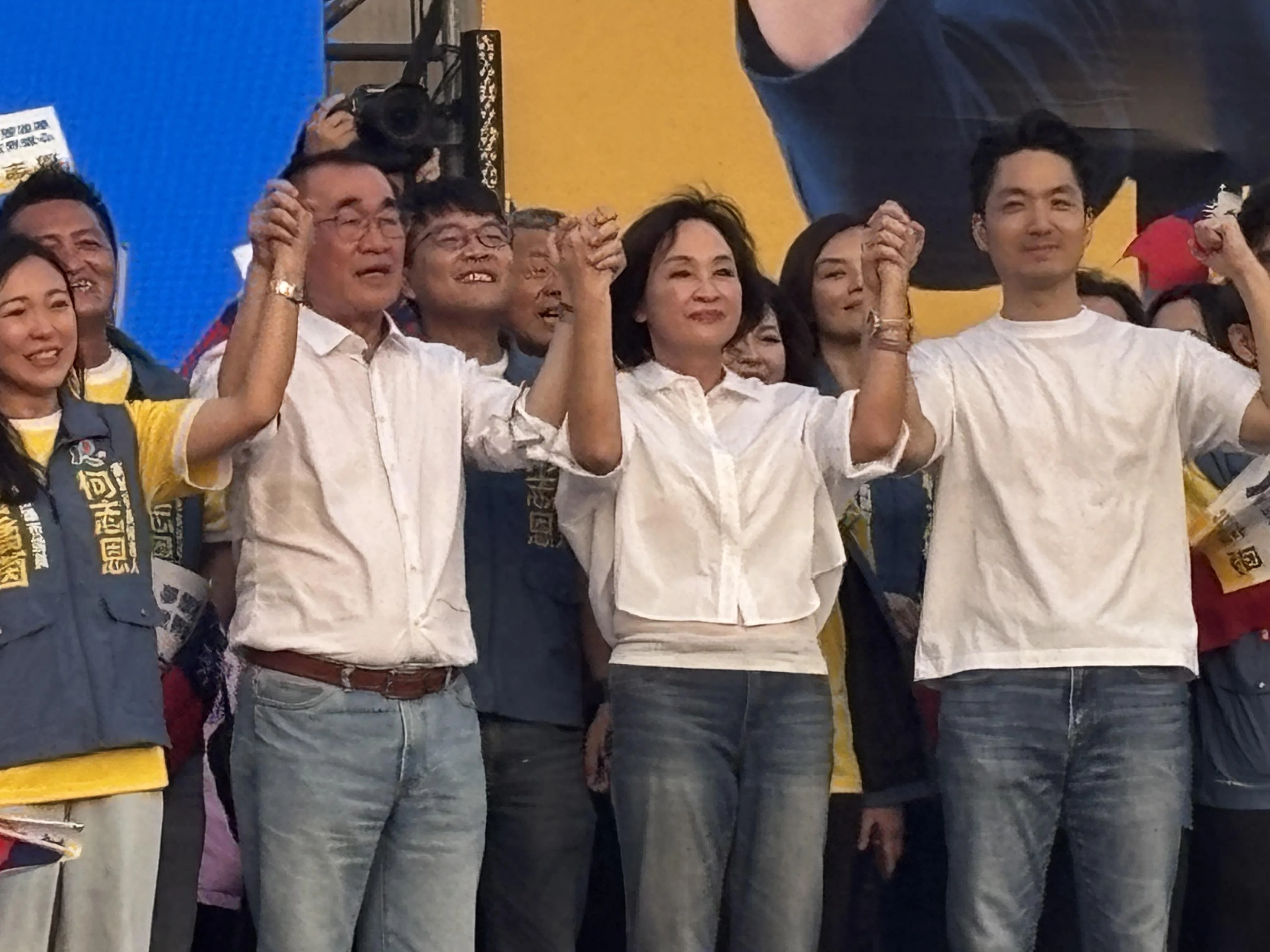
Outside the six special municipalities, Chiayi City, Changhua County and Yilan County are generally seen as places the DPP could win. The outlook is less promising for the KMT in Hsinchu County, where it had been favoured to win, after factional infighting during its primary led to the collapse of cooperation between the Blue and White camps. Support for Lai and the DPP has gradually recovered from the low following last year’s failed mass recall campaign. In counties and cities where it is weaker, the DPP has nominated candidates with less pronounced partisan profiles and stronger local ties, including Lin Kuo-chang in Yilan County and Wen Shih-cheng in Nantou County. It has a chance of increasing its tally from five posts in 2022 to eight or nine, or even more.
While the KMT’s strength lies in its deep local governing roots, it is hampered by a weak central leadership, belated local electoral preparations and local power brokers operating in silos. The DPP, by contrast, has extensive resources as the party in central government and a strong ability to set the agenda, giving it a clear advantage. Cheng Li-wun acknowledged that “the KMT is in a very dangerous electoral position”, urging party members and supporters to unite.
Chiang had initially appeared assured of victory and is the KMT’s leading figure in this election. But having underestimated his opponent and started too late, he now risks being overwhelmed by the “Puma O’Shen wave”. He has hurriedly brought in Taichung Mayor Lu Shiow-yen as chair of his campaign headquarters to steady the campaign, shifting into an all-out electoral battle.
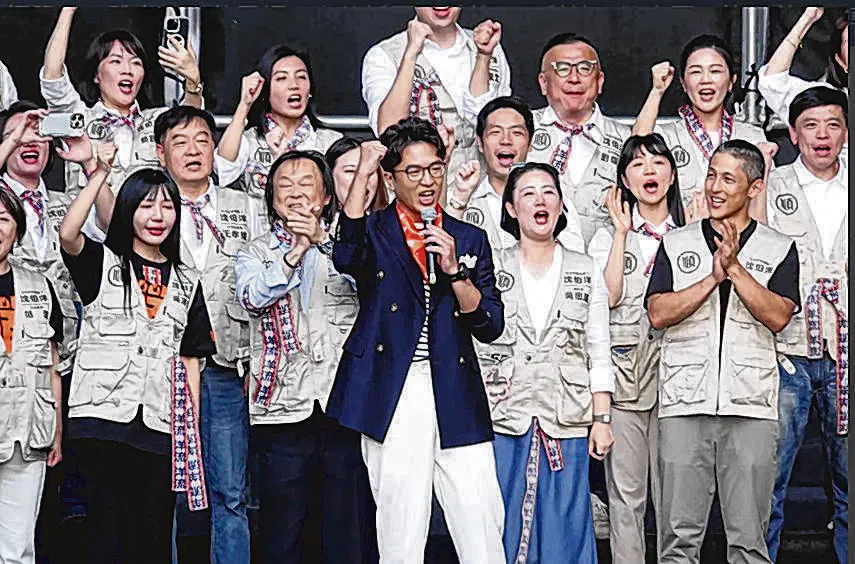
Wang Chih-sheng, secretary-general of the Taiwan Asia-Pacific Elite Interchange Association, said: “When Puma Shen first entered the race, everyone thought it would be enough if he did not fall below the party’s ‘vote-share floor’. Now, people are asking where his ‘ceiling’ is. He might even win.”
In the 2002 Taipei mayoral election, the DPP fielded Lee Ying-yuan against the hugely popular KMT incumbent Ma Ying-jeou. Lee secured 35.89% of the vote, a result described as the DPP’s “vote-share floor” in a head-to-head Taipei mayoral contest. When Chen Shui-bian sought re-election in 1998, he secured 45.9%, the DPP’s highest-ever vote share in a Taipei mayoral election, but still lost to Ma. That result has been seen as the party’s “vote-share ceiling”.
However, polls in Taipei diverge sharply. A poll released on 20 October by the Green-leaning Taipei Trust in Democracy Association (TTDA) put Shen’s support at 50.3%, a commanding 17 percentage points ahead of Chiang’s 33.3%. But a poll released by Blue-leaning TVBS on 8 October showed Chiang leading Shen by eight percentage points with 49%. In a poll released by the Blue-leaning United Daily News on 28 October, Shen led with 45% to Chiang’s 41%.
DPP New Media Centre director Juan Chun-ta highlighted two concerns behind the “Puma O’Shen wave”. Although the TTDA poll showed Shen ahead by 17 percentage points, pan-Green voters were eager to express their views while Blue- and White-camp voters were less forthcoming, producing a picture far removed from Taipei’s familiar political balance among the three camps. Meanwhile, positive coverage of Shen had remained at around 26% to 28% for four consecutive weeks but “could not rise further”. Negative coverage had exceeded 40% for two consecutive weeks, while Chiang’s share of negative coverage had fallen to 50.1%.
Lai, who also chairs the Democratic Progressive Party (DPP), and former president Tsai Ing-wen have repeatedly reminded party members to remain vigilant and cautious, stressing that “we are not actually ahead in Taipei yet; we are still a little short”. They have urged vigilance against cognitive warfare by mainland China targeting Taiwan, and called for calm and reason to avoid escalating conflict.
Wang said the DPP wanted to “cool things down” because “the higher the turnout, the worse it is for Shen”. A gap in the polls could spur Blue-camp voters to turn out, while Shen had probably already mobilised most of his potential supporters. The party needed to guard against overconfidence leading to defeat.
Chiu Chao-hsiang, an adjunct professor at Chinese Culture University’s Graduate Institute of National Development and Mainland China Studies, said bluntly that the DPP wanted to keep Chiang Wan-an, a potential vote-winner for other KMT candidates, confined to Taipei. “They believe that [Legislative Yuan Speaker] Han Kuo-yu has already been defeated and Lu Shiow-yen is no longer a threat. Chiang is the last major opponent within the KMT, so they are throwing the full weight of the party into attacking him. They must find a way to force him out at second base. If Chiang wins re-election and goes on to become a presidential candidate, he will have reached third base.”
Lo Shih-hung, head of the Department of Communication at National Chung Cheng University, wrote on Facebook that Shen’s “Puma O’Shen wave” used a carefully crafted narrative and electoral strategy to make the race highly entertaining, thereby achieving a dramatic transformation of his public persona — from cognitive warfare expert to a gentle, supportive presence.
Liu also said Shen was indeed reshaping his image, toning down his previously more combative and confrontational legislative persona and presenting himself as a “rational, caring man”, successfully reversing negative impressions.
She said the “Puma O’Shen wave” had generated a degree of “coattail effect”, while a “spiral of silence” was also at work. The former could lead people who paid little attention to elections to make their choice based on the dominant opinion conveyed through the media. The latter meant that people whose views differed from prevailing public opinion might remain silent for now but would ultimately still vote for their preferred candidate. “At the moment, I think there appear to be quite a lot of people staying silent.”
Will the “Puma O’Shen wave” spill over into New Taipei?
New Taipei is the biggest uncertainty in this election. With a population of four million, it is Taiwan’s largest special municipality and has been governed by the KMT since its elevation to that status in 2010.
The momentum of the “Puma O’Shen wave” has also encouraged DPP candidates in New Taipei, Keelung and other counties and cities. DPP New Taipei mayoral candidate Su Chiao-hui has fought her way from trailing in the polls to running neck and neck with the KMT’s Lee Shu-chuan. The Green camp believes she has a chance of capturing the city.
Wang said that winning New Taipei, alongside expected gains in counties and cities such as Changhua and Chiayi, would be a major victory for the DPP and a boost to Lai’s 2028 re-election bid. If the KMT lost New Taipei, Cheng would face immense pressure to resign.
Blue-White cooperation and the third force
The opposition Taiwan People’s Party (TPP) is cooperating with the Kuomintang (KMT) in this election, with Chiayi and Yilan serving as key test cases for the “Blue-White cooperation”. Yet their chances of victory in both places currently appear slim. In Hsinchu County, the collapse of Blue-White cooperation has also driven some TPP supporters towards the Green camp.
Whether the TPP can retain control of Hsinchu City and expand its presence among city councillors and at township and county-administered city level will also test whether it can remain a “third force” in Taiwanese politics.
The DPP’s strategy of playing down its Green identity
Another interesting development is the DPP’s deliberate downplaying of its “Green” identity in Taipei and New Taipei, where it is electorally weaker. Shen has framed his campaign around “happiness and hope”, adopting orange to convey warmth and gentleness. Su has chosen pink, emphasising warmth, innovation and the ability to get things done, in an effort to attract swing voters weary of partisan confrontation. Whether this less overtly partisan branding translates into votes will be another key point to watch.
Liu said: “The entire DPP is helping Shen, while Chiang looks as though he is fighting the election alone. The role of the KMT’s has disappeared.” With Lu recently joining Chiang’s team and figures such as Han Kuo-yu also appearing at his rallies, the KMT is only now beginning to project a sense of unity.
Many KMT supporters have retreated into a “spiral of silence” out of anxiety, and the party is now actively rallying them for a fightback. The DPP, meanwhile, fears that the “Puma O’Shen wave” could peak too early and instead galvanise Blue-camp voters. Ultimately, which side can get its supporters and swing voters to the polling stations will be crucial in closely contested constituencies.
