

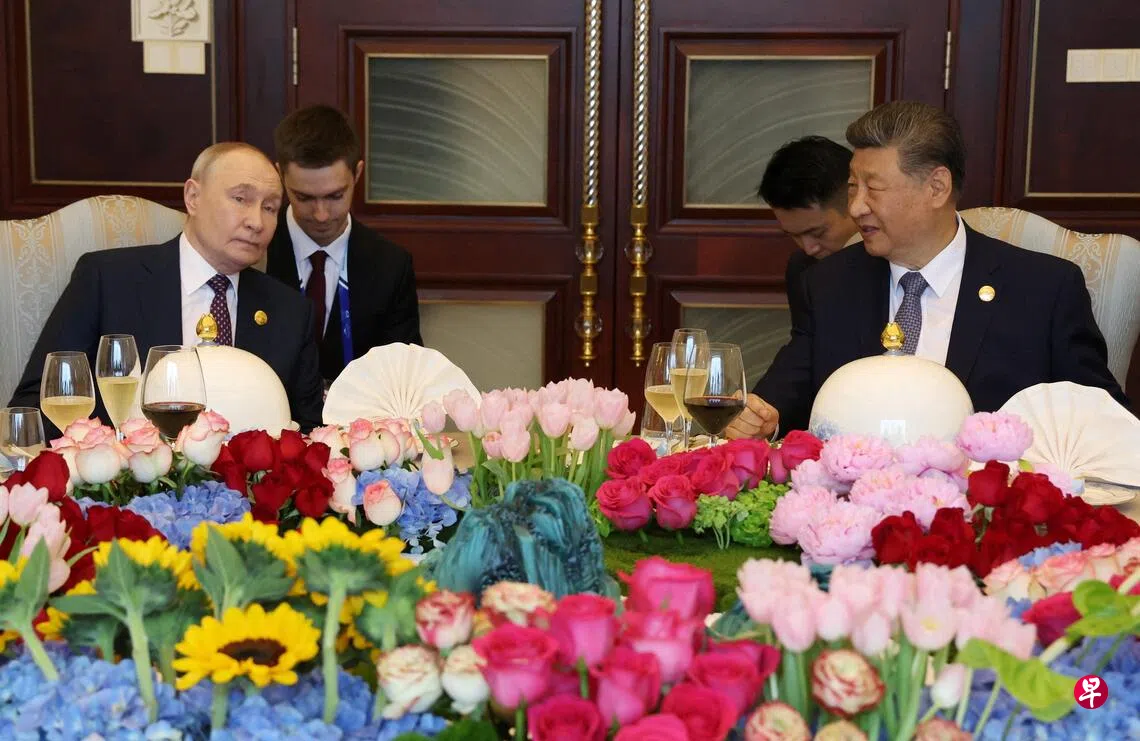
Chinese President Xi Jinping met Russian President Vladimir Putin, ahead of the closely watched summit of the Chinese, US and Russian leaders, and the third meeting between Xi and US President Donald J. Trump.
Xi and Putin both stressed the need to advance a multipolar order in a world beset by turmoil and change. Analysts interviewed differed on whether the Chinese and Russian leaders were first coordinating their positions ahead of the trilateral meeting, but expected no “two against one” scenario when the “Big Three” gather.
Putin arrived in Shenzhen early on Wednesday (18 November) to attend the Asia-Pacific Economic Cooperation (APEC) Economic Leaders’ Meeting. This is his first appearance at the multilateral summit in the nearly five years since the war in Ukraine broke out. Cai Qi, a member of the Communist Party of China’s Politburo Standing Committee and the Secretariat of its Central Committee, received him at the airport.
Xi met Putin in Shenzhen at midday on Wednesday. It was their fifth meeting this year and their second in China.
According to Xinhua, Xi quoted verses by Mao Zedong, the founding leader of communist China, to describe China-Russia relations as requiring “a broad, long-term perspective” while remaining “unshaken by wind and rain, as firm as a mountain”. He said the relationship had brought greater stability and certainty to a world beset by turmoil and change.
Looking ahead, Xi called on both sides to deepen cooperation across all areas; shoulder their responsibilities as major powers and lead efforts to advance a multipolar world; and make use of exchanges between their party, government, military and legislative bodies to ensure that the consensus reached by the two leaders is effectively implemented.
Separately, Russia’s Sputnik news agency reported that Putin addressed Xi as “dear friend” and noted that they had held several fruitful talks this year.
Putin stressed that safeguarding peace and prosperity in the Asia-Pacific was a shared goal. “Russia-China diplomatic coordination remains steady and active. Amid a complex geopolitical situation, we maintain a constructive approach and are committed to building a fairer multipolar world order.”
Putin will hold a historic first trilateral meeting with Xi and Trump on Thursday (19 November). Speaking at the opening of the APEC CEO Summit on Wednesday, he said he looked forward to the potentially immense benefits the trilateral meeting could bring.
Zhu Feng, a distinguished professor at Nanjing University and former dean of its School of International Studies, told Lianhe Zaobao (LHZB) that China-Russia ties were clearly stronger than either China-US or Russia-US relations in terms of bilateral closeness and strategic security. He said it was “highly likely” that the Chinese and Russian leaders were using Wednesday’s meeting to coordinate their positions ahead of the trilateral talks. “Before the three leaders meet, they need to brief each other on their views.”
Zhang Xin, deputy director of the Centre for Russian Studies at East China Normal University in Shanghai, took a different view. He said the meeting appeared more like a routine bilateral engagement. “They may not carry out the most important coordination and communication [for the trilateral meeting] when the two meet face to face.”
Both analysts expected that a “two against one” scenario was unlikely at the trilateral meeting. Zhang said, “China is not really interested in pushing too hard to create a ‘two against one’ situation, especially when it is the host.”
Zhu said such a scenario could not be ruled out, depending on the agenda, if discussions touched on major core strategic interests of concern to China and Russia. “But in both form and substance, I do not think the trilateral summit is structured entirely as China and Russia against the US. If that were the case, its strategic significance and value would be greatly diminished.”
Zhu added, “The trilateral summit is an innovative format for cooperation among major powers. At its heart, it is about demonstrating their respective strategic vision and finding ways to advance cooperation with greater sincerity.”
Zhang said China, the US and Russia currently differed markedly in how they ranked issues of shared interest. He expected the trilateral meeting to struggle to reach clear agreement on specific issues such as Russia-Ukraine relations, US-Iran relations and nuclear weapons. However, he did not rule out “some statements of principle” on matters such as ensuring stable global energy transport, supplies of critical raw materials and shared market needs.
