

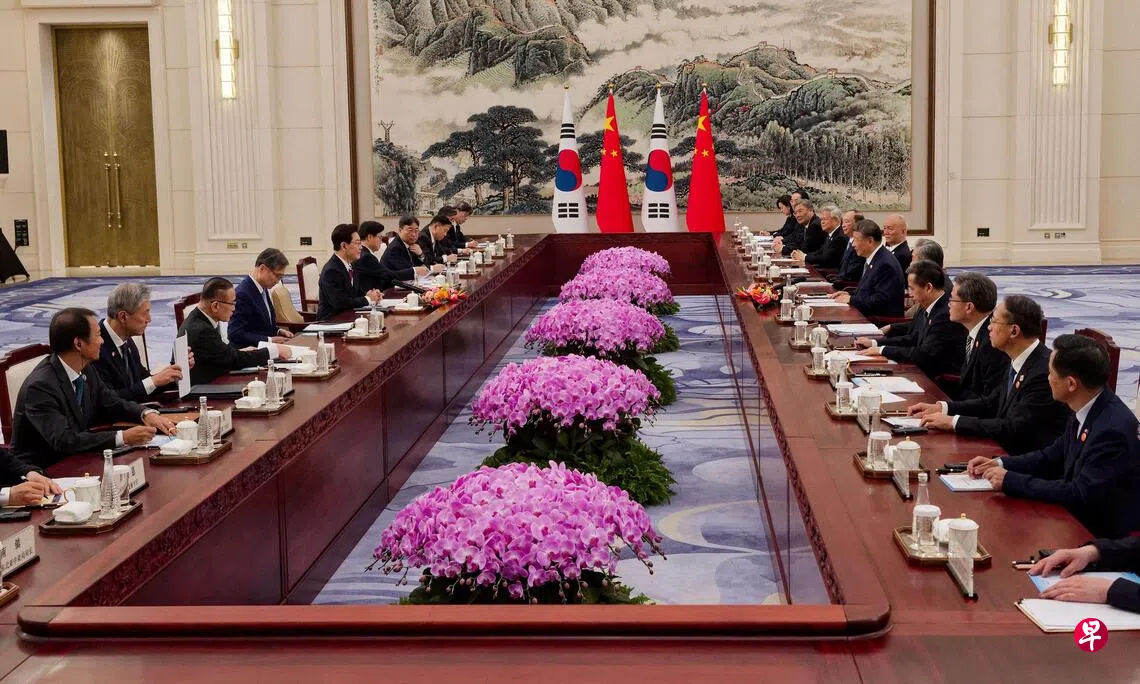
Chinese President Xi Jinping called for “healthy and beneficial cultural exchanges in a gradual manner” during talks with South Korean President Lee Jae Myung. China also pledged to grant South Korea “most-favoured-nation treatment” in sectors including film and gaming, raising the prospect of a substantive easing of its decade-long restrictions on Korean cultural content.
According to Xinhua and Yonhap news agency, Xi and Lee held their third face-to-face meeting in just over a year in Shenzhen on Wednesday (18 November), on the sidelines of the Asia-Pacific Economic Cooperation (APEC) summit.
Xi said China and South Korea had substantially concluded the second phase of negotiations on their free trade agreement (FTA). He urged both sides to make full use of this institutional framework, strengthen macroeconomic policy coordination, foster an ecosystem for cooperation in emerging technology industries such as artificial intelligence, and share development opportunities.
“China is willing to work with South Korea to continue promoting people-to-people exchanges between the two countries and pursue healthy and beneficial cultural exchanges in a gradual manner.”
Lee proposed that the two countries use the conclusion of the second phase of FTA negotiations to encourage more companies to enter each other’s markets. He also expressed hope that both sides would expand exchanges in culture and creative content in stages.
South Korea’s Ministry of Trade, Industry and Resources said China had pledged during the FTA negotiations to grant South Korea most-favoured-nation treatment in sectors including film and gaming, and to apply the principle of non-discrimination to the pre-screening of creative content such as online games and films.
On audiovisual co-productions, the two countries agreed to expand their scope beyond films to include television dramas, animation, variety shows and documentaries. South Korean travel agencies operating in China will also be allowed to conduct outbound tourism business, offering overseas travel services to Chinese citizens and foreigners living in China.
Reuters reported that the agreements could signal an easing of China’s decade-long restrictions on Korean cultural content. Shares in major South Korean entertainment companies surged on Wednesday following the news.
Relations between China and South Korea deteriorated sharply in 2016 after Seoul decided to deploy the US Terminal High Altitude Area Defense (THAAD) anti-missile system. China subsequently imposed years of informal restrictions on South Korean cultural products, although Beijing has never acknowledged their existence.
Separately, Lee told Xi on Wednesday that peace and stability on the Korean peninsula must underpin the development of a mature strategic cooperative partnership between South Korea and China. He said peace and stability on the peninsula served both countries’ interests, and expressed hope that they would work together to usher in a new era of peaceful coexistence there.
The Chinese statement did not mention Xi’s remarks on the Korean peninsula. South Korean media reported that Xi responded by saying China would continue to play a constructive role in resolving issues on the peninsula. Xi also outlined recent developments in China-North Korea relations, saying China supported efforts by all parties to ease tensions on the peninsula, including dialogue between North Korea and the US.
