

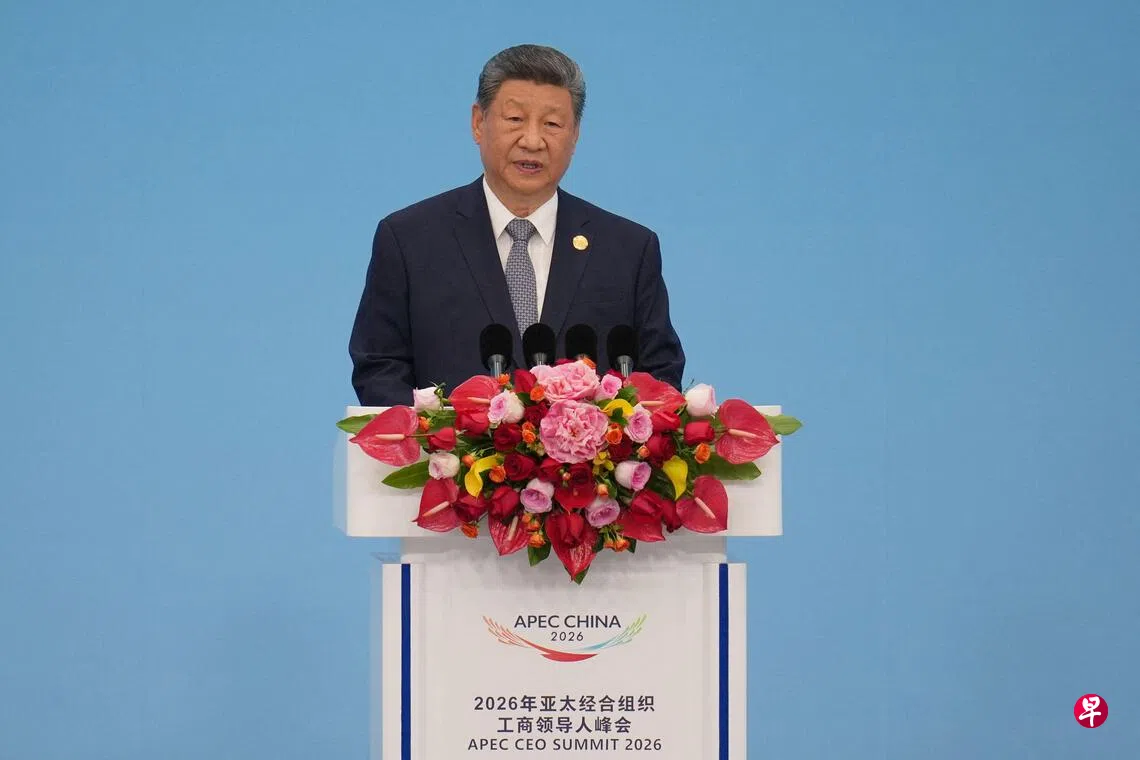
Chinese President Xi Jinping said China's commitment to mutually beneficial cooperation with countries around the world would not change in the face of unilateral trade measures. China would lower tariffs, expand market access and steadily open up its services sector, providing a more stable and predictable environment for global businesses to invest and operate in the country.
Xi delivered a keynote address at the opening ceremony of the Asia-Pacific Economic Cooperation (APEC) CEO Summit in Shenzhen on Wednesday (18 November).
He said the international situation was marked by intertwined changes and global economic growth lacked momentum, while unilateralism and protectionism were on the rise. Yet global trade continued to grow against the headwinds, and accelerating breakthroughs in emerging technologies were profoundly reshaping global development. “Openness or isolation, cooperation or division, reform or resistance to change” were questions of the times that all parties had to answer.
Xi recalled that China first hosted the APEC Economic Leaders' Meeting in 2001, the same year it joined the World Trade Organization (WTO). Over the past 25 years, China had fully honoured its WTO accession commitments, sharing opportunities and promoting development with countries around the world while pursuing its own development. In the face of unilateral trade measures, China had consistently practised true multilateralism, upheld the multilateral trading system and global trade rules, and promoted WTO reform, bringing stability and certainty to global economic growth and international economic and trade cooperation.
“No matter how the international situation changes, China's commitment to mutually beneficial cooperation with countries around the world will not change,” he said, welcoming businesses from the Asia-Pacific region to participate actively in high-quality Belt and Road cooperation.
Xi also said China would lower tariffs and expand market access, while exploring deeper reforms in areas such as rules, administration and standards. It would fully ensure that access to the manufacturing sector translated into permission to operate, and steadily expand the opening-up of its services sector.
He said China’s 15th Five-Year Plan was not only a blueprint for its own development, but also a list of opportunities for economic growth in the Asia-Pacific and beyond, and an invitation from China to the global business community to cooperate. China would offer global businesses a vast, open market, broad development prospects and an environment for cooperation that enabled all parties to advance together.
Xi said China was the world’s second-largest consumer market, with the largest middle-income population and enormous investment and consumption potential. From new energy vehicles and smart homes to the silver economy and winter tourism, every new sector offered fresh opportunities for global businesses.
He said China was accelerating the development of a vast, open market and expanding imports of quality products and services, continually generating diverse new demand. Following the ninth China International Import Expo, held in Shanghai a few days earlier, China would continue to hold a series of events, including “Export to China”, to create efficient channels for quality goods from other countries to enter its market.
On innovation-driven development, Xi cited robots working in factories, robotic dogs farming in rural areas, autonomous driving and drone food deliveries. He said China's vast testing ground for innovation allowed cutting-edge technologies to be tested and refined in real-world settings, continually translating them into fresh impetus for high-quality development.
He said China would accelerate the development of a modern industrial system, promote closer integration of technological and industrial innovation, support the transformation and upgrading of traditional industries and the growth of emerging industries, and plan ahead for industries of the future. This would provide impetus for technological innovation and growth among global businesses.
Xi said the Asia-Pacific economy had become an important engine of global economic growth thanks to the region's long-term stability. The more complex the external environment became, the more firmly all parties should uphold the post-war international order, advance an equal and orderly multipolar world and universally beneficial and inclusive economic globalisation, resolve differences through dialogue and consultation, and address challenges through solidarity and cooperation.
On economic and trade cooperation, he said openness brought progress, while isolation inevitably led to backwardness. All parties should uphold the rules-based multilateral trading system with the WTO at its core, support free and open trade and investment, maintain stable and smoothly functioning global industrial and supply chains, and steadily advance the process towards a Free Trade Area of the Asia-Pacific.
Xi also called for a comprehensive connectivity network, stronger cooperation in areas such as trade digitalisation, cross-border e-commerce and smart customs, and deeper international cooperation on industrial and supply chains to pave the way for Asia-Pacific economic integration.
He also proposed actively building partnerships for technological innovation, deepening cooperation in the digital economy and artificial intelligence, and promoting the green and low-carbon transition to turn strengths in innovation into drivers of growth.
On cooperation among bay areas, Xi said the Asia-Pacific region was home to the world's most important bay areas, whose economies were characterised by openness, collaboration and spillover effects. China supported the establishment of an alliance for economic cooperation among the world's bay areas, deeper exchanges and interaction among them, and the exploration of new avenues for Asia-Pacific economic cooperation.
He noted that Asia-Pacific economies differed in their histories, cultures and stages of development, saying that “cooperation must not be advanced through power politics or hegemony”. All parties should remove trade and investment barriers, promote broadly beneficial and balanced development, and give due consideration to both efficiency and fairness. They should also strengthen economic and technical cooperation with developing countries and deepen cooperation in transport, public health, energy, food security and anti-corruption efforts, so that the benefits of development reached all economies and different social groups.
Xi also called on the Asia-Pacific business community to embrace an entrepreneurial spirit of bold innovation and the pursuit of excellence, expand opportunities for business cooperation and make a greater contribution to advancing Asia-Pacific economic integration.
