

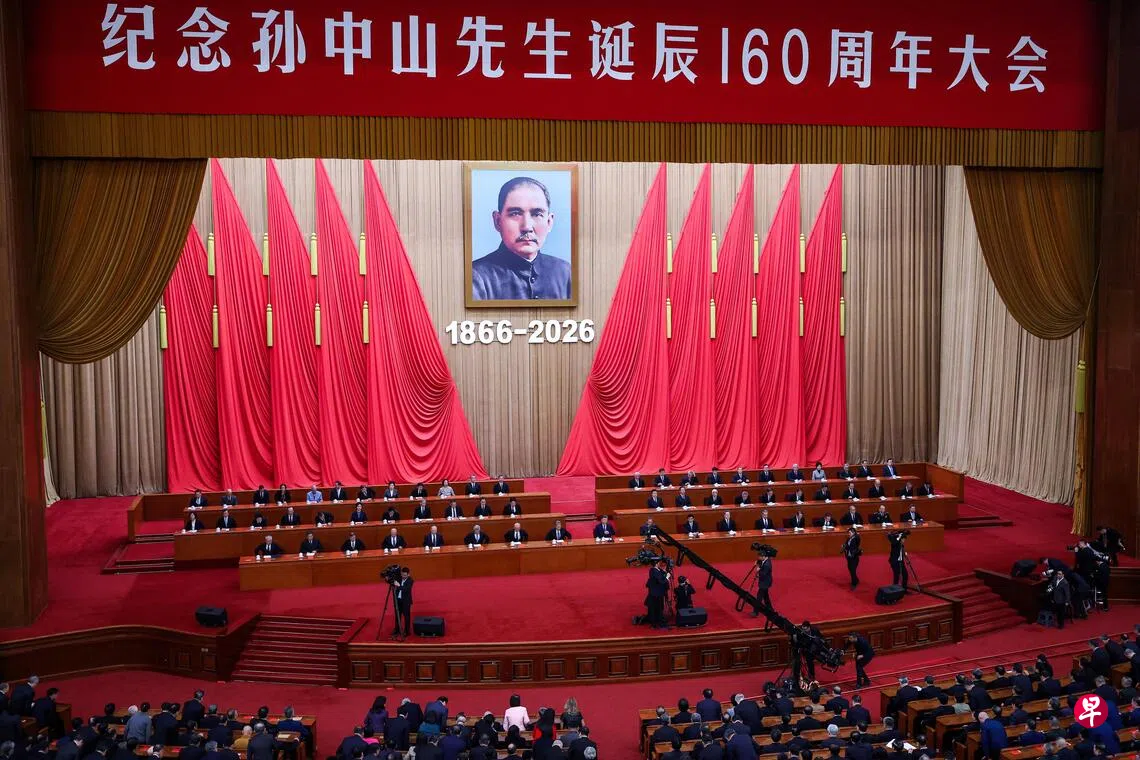
Chinese Communist Party (CCP) General Secretary Xi Jinping has stressed that resolving the Taiwan question and achieving complete national reunification is the party’s “unwavering historical mission” and an “essential requirement for achieving the great rejuvenation of the Chinese nation”. Speaking at a ceremony in Beijing marking the 160th anniversary of Sun Yat-sen’s birth, he drew a red line against “Taiwan independence” while pledging to “fully consider Taiwan’s realities and fully accommodate the interests and sentiments of Taiwan compatriots”.
Mainland Chinese scholars interviewed said this was one of Xi’s more comprehensive statements on Taiwan policy since his speech on 2 January 2019 marking the 40th anniversary of the “Message to Compatriots in Taiwan”. It reaffirmed the mainland’s leading role in pursuing reunification while also signalling goodwill towards Taiwan.
The ceremony was held at Beijing’s Great Hall of the People on Thursday (12 November), chaired by Wang Huning, chairman of the Chinese People’s Political Consultative Conference National Committee. Those present included CCP Politburo Standing Committee members Li Qiang, Zhao Leji, Cai Qi, Ding Xuexiang and Li Xi, as well as Politburo members based in Beijing. Central Military Commission Vice-Chairman Zhang Shengmin, who was added to the Politburo at the fifth plenary session of the 20th CCP Central Committee in late October, sat in the front row on the podium. About 3,000 people attended, including representatives of Sun’s family and guests from Hong Kong, Macau, Taiwan and overseas.
In his speech, Xi presented the CCP’s achievements over the past century as a continuation and development of Sun’s revolutionary cause. He identified six aspects of Sun’s spirit: patriotism and saving the nation, concern for the people, pursuit of truth, perseverance, advocacy of unity and a global outlook. He linked these respectively to political tasks in the new era: upholding the CCP’s overall leadership, putting the people first, advancing theoretical innovation, fostering a fighting spirit, maintaining the united front and building a community with a shared future for humanity.
Turning to cross-strait relations, Xi placed the Taiwan question within the historical framework of the continuity of Chinese civilisation and national rejuvenation. Declaring that “our territory must not be divided, our country must not descend into chaos, our nation must not be split, and our civilisation must not be interrupted”, he stressed that complete national reunification was the “shared aspiration of all sons and daughters of the Chinese nation”.
Xi described people on both sides of the Taiwan Strait as “one family”, saying they were “bound by blood ties, and blood is thicker than water”. He added: “Within a family, as long as we talk things through calmly and consult one another, there are no differences or disagreements that cannot be resolved.” Reaffirming that people on both sides belong to one family, he pledged to continue deepening cross-strait exchanges and integration and improving their well-being.
He also reiterated the policy of “peaceful reunification and one country, two systems”. On the basis of upholding the one-China principle and the “1992 Consensus”, he said, “we are willing to engage in dialogue and consultation with people of vision from all sectors in Taiwan on cross-strait relations and national reunification”. At the same time, he stressed that “we will never leave any room for separatist activities seeking ‘Taiwan independence’ in any form”.
Xi said Taiwan’s future lay in national reunification and that “the interests and well-being of our Taiwan compatriots are tied to the great rejuvenation of the Chinese nation”. He called on Chinese people at home and abroad to jointly oppose separatist forces seeking “Taiwan independence”, stressing that complete national reunification “must and will be achieved”.
A mainland scholar who declined to be named told Lianhe Zaobao (LHZB) that the speech covered all aspects of the issue, including the goal of reunification, the policy of peaceful reunification, the red line against independence, and cross-strait exchanges and integration. It emphasised the mainland’s leading role in pursuing reunification while also signalling goodwill through dialogue and consultation and the message that people on both sides belong to one family.
The scholar added that the speech came on the eve of the Chinese and US leaders’ meeting in Shenzhen and was intended to explain to the US the historical and national considerations behind Beijing’s handling of the Taiwan question. “This is not simply about vying for geopolitical supremacy or pursuing hegemonic interests. It is about the imperatives of national reunification and the nation’s history.”
Comparing Xi’s latest speech commemorating Sun’s birth with the one he delivered in 2016, Qi Dongtao, a senior research fellow at the National University of Singapore’s East Asian Institute, said Xi’s language on Taiwan was more moderate than it had been a decade ago. There was greater emphasis on political persuasion, peaceful reunification, dialogue and consultation, with less forceful warnings and language opposing external interference. The approach, he said, was what Chinese people often describe as “appealing to emotion and reason”.
Qi noted that the 2016 speech came after former Taiwan President Tsai Ing-wen took office and did not accept the “1992 Consensus” as Beijing had hoped. At the time, Xi issued stern warnings, repeatedly using the phrase “will never allow”. This time, he instead said that “we will never leave any room for separatist activities seeking ‘Taiwan independence’ in any form”.
In Qi’s view, the latest speech continued the approach set out in Xi’s 2019 address marking the 40th anniversary of the “Message to Compatriots in Taiwan”: pursuing peaceful reunification through political dialogue and consultation. The change in tone could be linked to US President Donald J. Trump’s relatively restrained remarks on Taiwan and the forthcoming Xi-Trump meeting during the Asia-Pacific Economic Cooperation (APEC) summit. It could also reflect Beijing’s desire not to inflame electoral sentiment as Taiwan’s local elections approach.
Qi also said that, by linking the six aspects of Sun’s spirit to the CCP’s six current political tasks, Xi had directed much of his speech at a mainland audience. The aim was to emphasise that the CCP had inherited Sun’s spirit — not only as the party that had best carried it forward, but also as one that continued to put it into practice.
He said the speech placed greater emphasis on showcasing the CCP’s achievements in governance and its ability to realise the ideal of national rejuvenation. Its overall argument was more confident than in 2016, reflecting Beijing’s belief that it had successfully weathered the Trump administration’s maximum pressure campaign, trade war and technology war.
