

Chinese Communist Party (CCP) General Secretary Xi Jinping said on Thursday (12 November) that he was willing to hold dialogue and consultations with people of insight from all sectors of Taiwanese society on cross-strait relations and national reunification, on the basis of upholding the one-China principle and the “1992 Consensus”. Figures from Taiwan’s Blue camp launched a cross-strait peace initiative the same day, proposing that civil society lead the way in consultations to create conditions for official communication to resume.
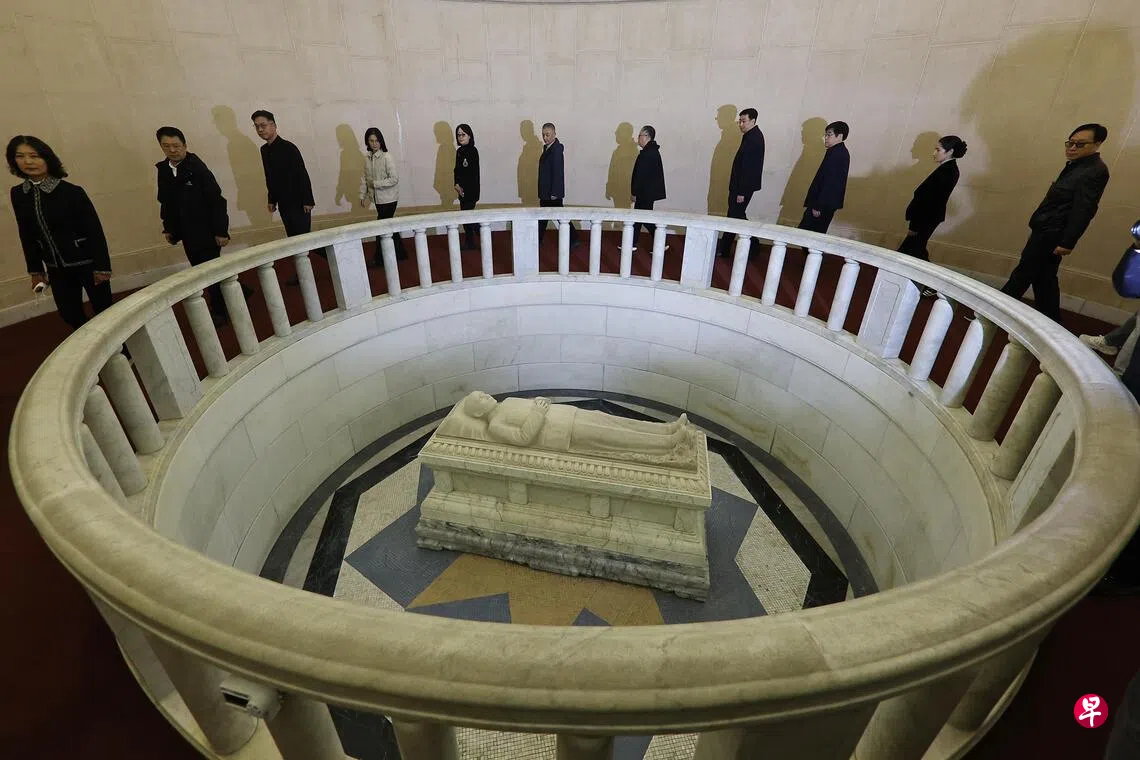
Mainland China held a ceremony on Thursday to commemorate the 160th anniversary of Sun Yat-sen’s birth. In his speech, Xi stressed that resolving the Taiwan question and achieving cross-strait reunification were “essential to realising the great rejuvenation of the Chinese nation”. He also said that, on the basis of “upholding the one-China principle and the ‘1992 Consensus’, we are willing to engage in dialogue and consultation with people of vision from all sectors in Taiwan on cross-strait relations and national reunification”.
The Democracy Foundation, a private Taiwanese think tank with pan-Blue leanings, also held a ceremony in Taipei that morning to commemorate Sun’s birth. Blue camp veterans attending included former Kuomintang (KMT) vice-chairman John Kuan, former Legislative Yuan president Wang Jin-pyng, former premier Sean Chen and former National Security Council secretary-general Su Chi.
The gathering also announced a “Cross-Strait Peace Initiative”, jointly launched by more than 280 experts and academics. It put forward four proposals: prioritising peace, restoring cross-strait dialogue, deepening cooperation and advancing political consultations.
Former KMT legislator Ting Shou-chung, chairman of the Bridge Across the Strait Foundation, told the gathering that the initiative aimed to oppose war, restore cross-strait dialogue, deepen cooperation and promote political consultations, in the hope of reducing cross-strait hostility and the risk of conflict.
He said more than 10 meetings had been held since the initiative’s first discussion among academics and experts in May this year. Five working groups would be set up to focus on Taiwan Strait security, economic, trade and technological cooperation, cultural and youth exchanges, governance and livelihoods, and peaceful integration and development.
He added that the two sides should negotiate a final political arrangement on the basis of peace, equality and mutual respect. “We can start Track II consultations at the civil level first, creating conditions for official communication to resume in future.”
Kuan stressed that Taiwan should avoid being drawn into war, and that the initiative does not address unification or independence, or involve party politics. Urging support for peace, he said: “Only peace can protect Taiwan; war means sacrificing Taiwan.”
Asked about the successive proposals for cross-strait political consultations from the mainland and the Blue camp, Taiwan’s Mainland Affairs Council Minister Chiu Chui-cheng told reporters at the Legislative Yuan that day: “The greatest threat to peace in the Taiwan Strait today is the CCP’s policy towards Taiwan, which still seeks to eliminate the Republic of China and annex Taiwan, without renouncing the use of force against Taiwan.”
He stressed that Taiwan “cherishes peace but will not give up freedom; is willing to engage in dialogue but will not accept being demeaned”. It was willing to communicate on the principles of parity and dignity, he said, adding that the government’s policy was to maintain the status quo with neither subservience nor arrogance.
Chang Hung-yuan, a professor in the Department of International Trade at Chihlee University of Technology and former deputy director of the KMT’s mainland affairs department, told Lianhe Zaobao (LHZB) that he expected the KMT to resume contact with the mainland after Taiwan’s nine-in-one local elections. Party-to-party interactions could restart, he said. “The KMT will make such moves after the elections. That is certain.”
He said KMT chair Cheng Li-wun hoped to secure tangible results through exchanges similar to the KMT-CCP forum, building political capital for the KMT. The peace initiative put forward by Ting and others, meanwhile, was a civil society effort. If it could bring the two sides to the negotiating table, Beijing might regard that as progress.
However, Chang said cross-strait issues were “not an electoral asset” in Taiwan. The KMT would not make them the centrepiece of its 2028 election campaign and was more likely to keep interactions low-key. The form and extent of future exchanges would still depend on the political situation in 2027 and 2028.
Wang Hung-jen, a political science professor at National Cheng Kung University who has close ties with the Green camp, said in an interview that Xi’s offer of dialogue and consultations was a step in Beijing’s efforts to advance talks on unification. But at present, “substantive progress would be fairly difficult”.
Wang assessed that, besides engaging the KMT, Beijing also hoped to expand its interactions with the Taiwan People’s Party. Direct contact with the Democratic Progressive Party was “of course impossible”, he said. One possible route was for the US to help bring the two sides to the table, but “that also depends on whether the Americans are willing to do it”.
Taiwan’s official institutions, which calculate birth anniversaries using the traditional Chinese age reckoning system, held events marking the 160th anniversary of Sun’s birth last year.
