

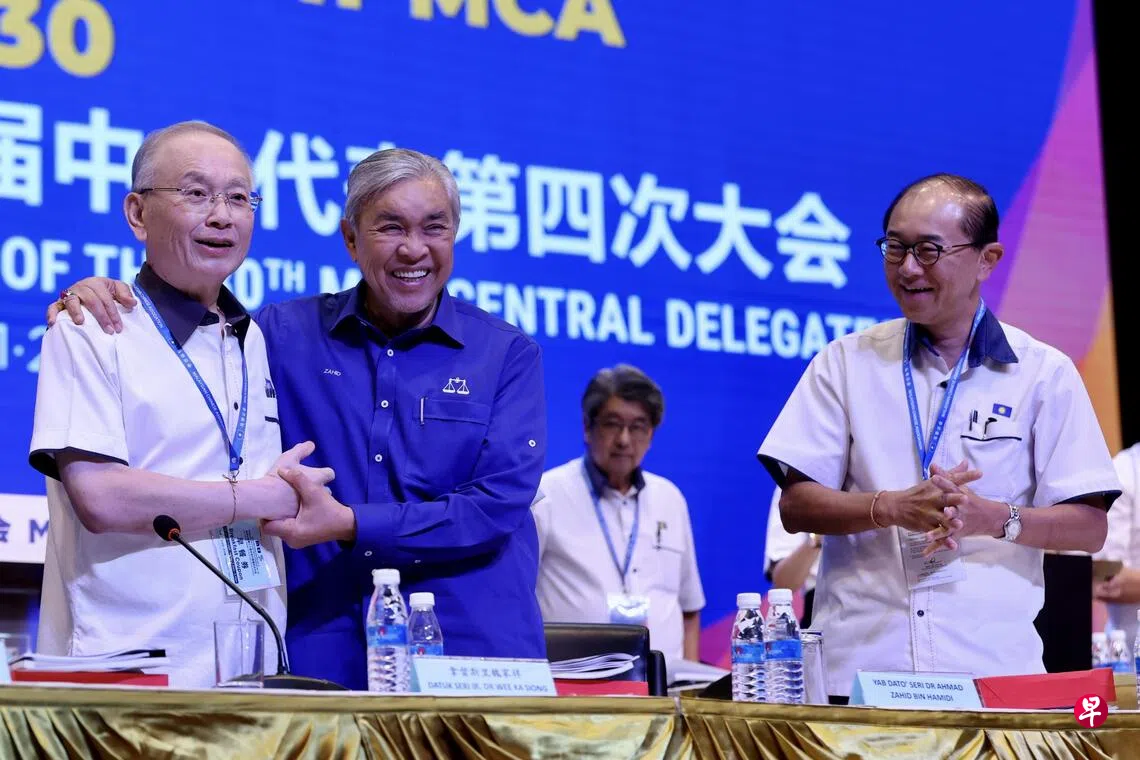
(Kuala Lumpur) Malaysia’s Barisan Nasional (BN) chairman Ahmad Zahid Hamidi has hinted that the coalition’s cooperation with Perikatan Nasional (PN), particularly Parti Islam SeMalaysia (PAS), will continue into the 16th general election. BN and PN previously cooperated in state elections in Johor, Negeri Sembilan and Melaka, securing sweeping victories in all three.
Ahmad Zahid, who is also Malaysia’s deputy prime minister and Umno president, was opening the 30th central delegates assembly of the Malaysian Chinese Association (MCA), a key BN component party, on Sunday (22 November). Explaining Umno’s call for “Muslim unity” to MCA delegates, he used the imagery of blue skies and green grass, saying that bringing the two together would make Malaysia’s blue skies even more expansive, and that the people also hoped to see a blue wave sweep the country.
According to Malaysian media reports, including Sin Chew Daily, The Star and online news outlet Free Malaysia Today, Ahmad Zahid used blue and green as a metaphor for bringing together different political forces. Blue is BN’s colour, while green represents PAS.
He stressed that even with this blue-green alliance, BN would retain its identity and represent the voices of all Malaysians. He therefore hoped MCA would engage its grassroots members to explain why BN had decided to cooperate with PN.
He acknowledged that MCA members might have differing views on cooperating with the PAS-led PN, saying this was normal. “This (cooperation) was decided by the top (BN) leadership… I want MCA to help its grassroots members understand why BN has taken this approach.”
Ahmad Zahid also said that if BN returned to power at the federal level, it would reintroduce the Goods and Services Tax (GST) to replace the current Sales and Services Tax (SST).
He said: “I am very much in agreement that GST must be brought back. This is not about saying SST is bad, but that GST is fairer and more focused.”
He added that more than 170 countries worldwide had implemented GST, and that only Malaysia had taken a backward step by introducing SST.
MCA also supports bringing back GST. In his policy address at the party’s delegates assembly that day, MCA president Wee Ka Siong said reintroducing GST would help plug tax loopholes and curb the underground economy. It would also prevent the double taxation and cascading effects that could arise under the current SST system.
Former Malaysian prime minister Najib Razak abolished SST on 1 April 2015, replacing it with GST at a rate of 6%. The then opposition Pakatan Harapan (PH) criticised the Najib government’s move for increasing the burden on the public and called for GST to be scrapped.
After BN lost the May 2018 general election, the PH government led by then prime minister Mahathir Mohamad announced the abolition of GST and reinstated SST. However, SST has also generated considerable controversy and discontent in the more than eight years since its reintroduction.
Malaysian Prime Minister and Finance Minister Anwar Ibrahim said on 18 August this year that the government would continue to use SST as the basis of the current tax system. However, he did not rule out incorporating some elements of GST in future to build a more comprehensive tax system.
