

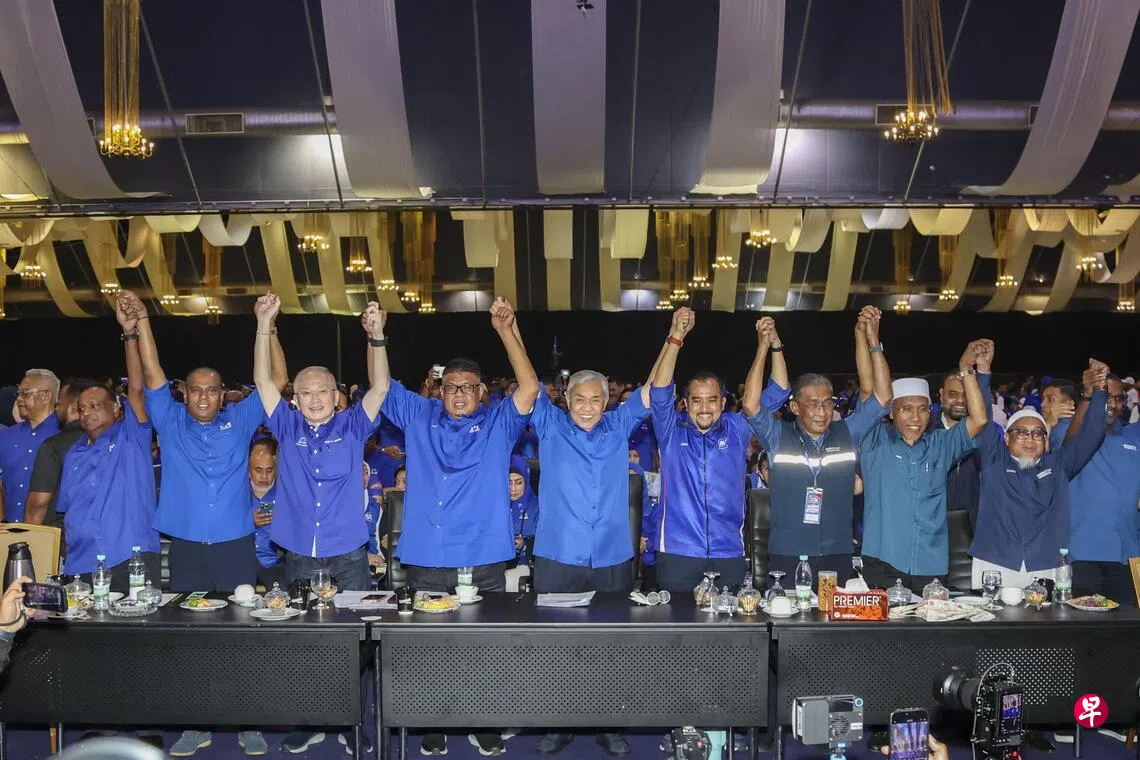
Malaysia’s Barisan Nasional (BN) and Perikatan Nasional (PN) have swept to power on a “blue wave” in the Melaka state election, jointly winning 24 seats for a commanding majority of more than two-thirds. Pakatan Harapan (PH), led by Prime Minister Anwar Ibrahim, retained just four seats, one fewer than in the previous election, underscoring its struggle to recover from a string of electoral defeats.
Voting in the 16th Melaka state election took place on Saturday (14 November). According to official results released by the Election Commission at about 11pm, BN won 21 seats: 18 for the United Malays National Organisation (Umno), two for the Malaysian Chinese Association (MCA) and one for the Malaysian Indian Congress (MIC). PN secured three seats, with Parti Islam Se-Malaysia (PAS) winning two and Parti Wawasan Negara one.
All four seats won by PH went to the Democratic Action Party (DAP). Anwar’s Parti Keadilan Rakyat (PKR) won none, while former Melaka chief minister Adly Zahari of Parti Amanah Negara failed to retain his seat.
BN and Umno chairman Ahmad Zahid Hamidi was the first to declare BN’s victory, at about 8.30pm that evening, based on unofficial results. He also announced that Melaka Umno chief Ab Rauf Yusoh would remain the state’s chief minister.
Melaka PH chairman Adly subsequently conceded defeat at a press conference. He said PH accepted the outcome with an open mind and respected the choice of Melaka’s voters.
PH chairman Anwar congratulated BN on its victory in a Facebook post. He stressed that the federal government would put the people first and strengthen cooperation with the Melaka government to advance the state’s development.
Melaka’s state assembly has 28 seats, with 15 needed for a simple majority. BN and PN together won 24 seats, five more than the 19 needed for a two-thirds majority.
This marks another state election victory with a majority of more than two-thirds for BN, following the Johor election in July and the Negeri Sembilan election in August.
Liew Wui Chern, an assistant professor of international relations and political science at Malaysia’s Universiti Tunku Abdul Rahman, told Lianhe Zaobao (LHZB) that, including the Sabah election last November, PH had lost four state elections within a year. This showed that it had yet to rebuild voters’ trust.
He said that although the DAP retained its four seats in Melaka, turnout in constituencies with predominantly ethnic Chinese voters was lower than in Malay-majority constituencies. PKR and Amanah failed to win a single seat. This indicated that PH’s previous efforts, including its pledge to accelerate reforms, had not worked.
Liew said, “Some may say the DAP has held on to its support base, but that amounts to making no progress. All its previous efforts have come to nothing.”
He said PH could no longer rely on slogans if it wanted to regain voters’ trust; it had to deliver tangible results.
Malaysian political scholar Phoon Wing Keong also attributed the successive defeats primarily to PH’s lacklustre institutional reforms since taking power at the federal level, as well as Anwar’s constant political calculations, vacillation and compromises, which had disappointed supporters.
Meanwhile, Umno and PAS had found that they could regain power in the name of “Malay unity” as long as they avoided splitting the vote. Phoon told LHZB that these factors had left Anwar’s government struggling to reverse its disadvantage. Its immediate priority should be to do its utmost during the remainder of its term to deliver the political reforms society expected, so that it could leave a political legacy.
He also said PH’s performance in Melaka showed that its previous formula for winning mixed constituencies no longer worked. “Since the change of government in 2018, Malaysia has been searching for a new political order, and its outlines are now gradually becoming clear. The future political order will centre on Malay political unity, bringing political stability. The DAP will remain the choice of non-Bumiputera communities seeking progressive values, while local parties in East Malaysia will serve as a balancing force with a degree of autonomy. This is the new political order emerging within the structural constraints of a society in transition.”
Oh Ei Sun, a senior fellow at the Singapore Institute of International Affairs and principal adviser at Malaysia’s Pacific Research Center, agreed that the Malay unity narrative was the main reason for BN and PN’s victory. He expected the two coalitions to continue their Melaka model of cooperation in Malaysia’s next general election. Whether they would govern together afterwards would depend on how many seats each won, before they considered their choice of partners.
As for whether BN and PN would press their advantage by pushing Anwar to dissolve Parliament early and call a general election, all three analysts said such a move would be unlikely to succeed. Anwar’s government has signed a confidence-and-supply agreement with 13 opposition Members of Parliament led by Parti Pribumi Bersatu Malaysia president Muhyiddin Yassin. Together with the backing of East Malaysian parties in the unity government, this means Anwar still commands sufficient support in Parliament at this stage.
