

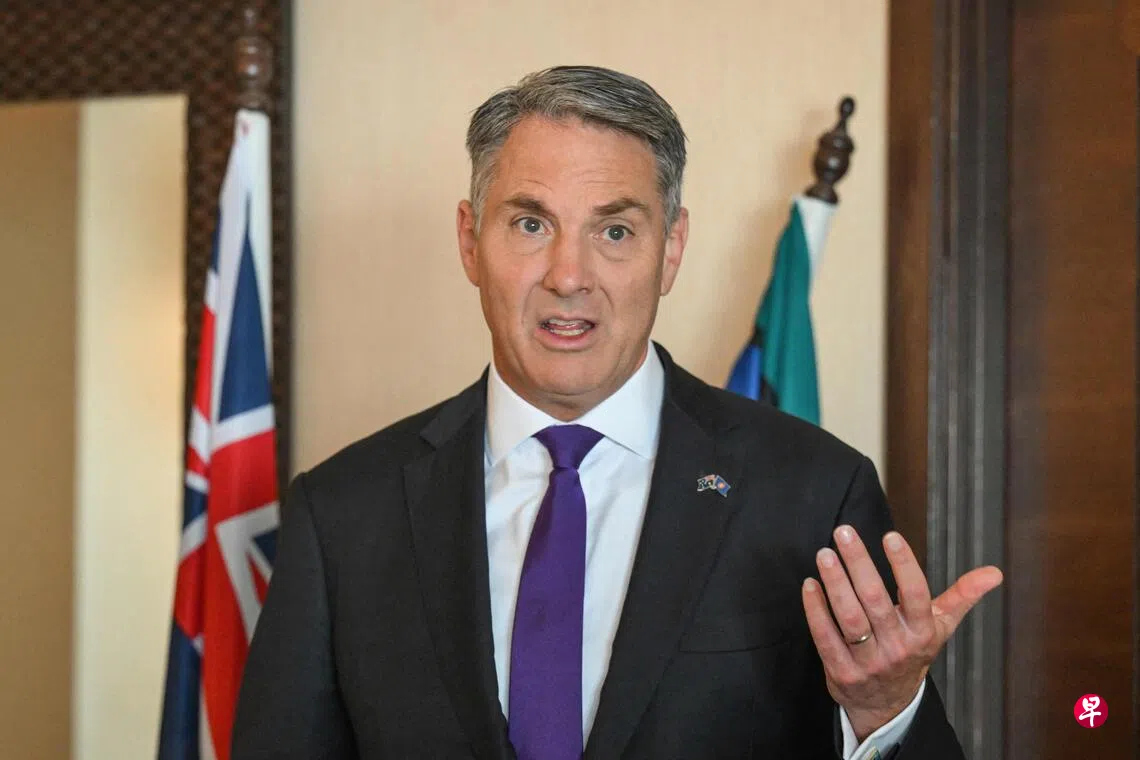
Richard Marles, deputy prime minister and defence minister of Australia, said China was undertaking the world’s largest conventional military build-up since the end of the Second World War, creating a “condition of pressure” in Southeast Asia.
Speaking to the media on Thursday (29 October) while attending the ASEAN Defence Ministers’ Meeting-Plus (ADMM-Plus) in Cebu, the Philippines, Marles said China continued to expand its military power in the region without providing sufficient strategic assurances to allay other countries’ concerns or explaining the reasons for its build-up, exacerbating regional tensions.
He acknowledged that China’s increasingly assertive posture posed a challenge to Australia, which depended heavily on the rules-based international order and international law.
“We need to be ensuring that how we understand the rules of the road continue to apply, because for a middle power like Australia, it is actually the rules which give us agency,” Marles said.
He therefore called for deeper ties with ASEAN allies and partners, and stronger cooperation to safeguard regional security together.
China has recently stepped up deployments of various warships in the South China Sea. In July this year, Australia protested China’s test launch of a missile capable of carrying a nuclear warhead in the South Pacific, criticising the move as destabilising for the region.
Marles also met US Secretary of War Pete Hegseth on the sidelines in Cebu on Wednesday (28 October). According to a statement from the US Department of Defense, the two agreed that China’s growing military strength in the region made it necessary for the US and Australia to move swiftly to implement defence cooperation, including stepping up military deployments. They also agreed to increase investment in Australian air bases and enhance joint logistics capabilities.
Responding to Marles’ remarks at a regular press briefing on Thursday, Guo Jiakun, a spokesperson from China’s Ministry of Foreign Affairs, said China remained committed to peaceful development.
Its military development was aimed at safeguarding national sovereignty, security and development interests, Guo said, and was never directed at any country, nor did China engage in military expansion. He said the relevant parties should take an objective view and stop making irresponsible remarks.
The defence minister of another regional partner, Shinjiro Koizumi of Japan, told ADMM-Plus on Wednesday that the risk of “dangerous miscalculations” was rising as the regional military balance shifted rapidly. Although he did not name China, his remarks were widely seen as referring to Chinese military activities in the South China Sea.
Koizumi said the security environment around ASEAN was “rapidly deteriorating” amid the growing risk of “coercion against vulnerable countries”, natural disasters and conflicts worldwide affecting supply chains and energy supplies. He called on ASEAN to stand united in addressing these challenges.
Koizumi also met Hegseth that day. They subsequently announced an agreement to establish facilities in Japan for the joint production of advanced medium-range air-to-air missiles, and agreed to cooperate on building a defence system along the “first island chain”. The “first island chain” refers to the islands between China and the Pacific Ocean.
The two also exchanged views on the regional situation and agreed to further strengthen the deterrence and response capabilities of the Japan-US alliance.
