

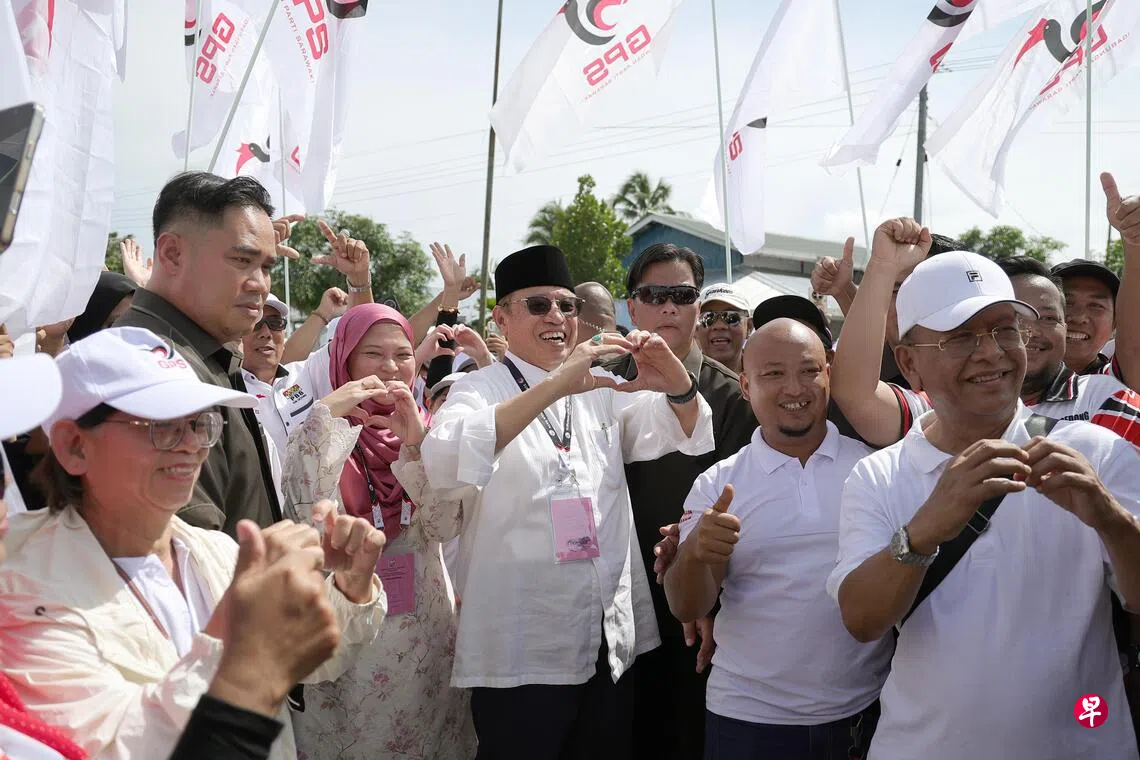
Nominations for Malaysia’s 13th Sarawak state election concluded smoothly on Saturday (28 November). After nominations closed, the Election Commission announced that the incumbent ruling coalition, Gabungan Parti Sarawak (GPS), had won 29 of the state assembly’s 82 seats uncontested. This leaves it just 13 seats short of the simple majority of 42 needed to form the government.
According to Malaysian media reports, including Sin Chew Daily (《星洲日报》) and Oriental Daily News (《东方日报》), those returned unopposed included Sarawak caretaker Premier and GPS chairman Abang Johari Tun Openg. He was re-elected automatically as the sole successful nominee in his incumbent seat of Gedong.
The large number of uncontested wins in this Sarawak election arose mainly because Parti Keadilan Rakyat, led by Prime Minister Anwar Ibrahim, Barisan Nasional, led by Deputy Prime Minister Ahmad Zahid Hamidi, and the opposition Parti Islam Se-Malaysia had announced before nomination day that they would not contest. The prevailing view among commentators is that these Peninsular Malaysian parties are sitting out the election to build goodwill with GPS, hoping to secure its support should the next general election produce a hung parliament.
Lau Zhe Wei, an assistant professor of international relations and political science at Malaysia’s Universiti Tunku Abdul Rahman, told Lianhe Zaobao that the concessions made by Peninsular Malaysian parties in this Sarawak election, and their efforts to court GPS, showed that they lacked confidence in winning enough seats at the next general election to govern at the federal level on their own. This also means GPS will remain a kingmaker, influencing who takes power in Putrajaya after the next general election.
Lau added that the goodwill gestures might do little to benefit the Peninsular Malaysian parties themselves. “All this does is keep GPS from viewing them unfavourably and leave room for talks on cooperation. It will not soften GPS’s ‘Sarawak first’ stance. GPS will still refuse to compromise on any future issue involving Sarawak’s interests.”
GPS is currently part of the federal unity government and holds 23 seats in the lower house of parliament. Of the chamber’s 222 seats, Sarawak accounts for 31 — enough to play a pivotal role in determining the political balance.
DAP’s seat tally will reflect Sarawak voters’ appetite for an opposition voice
With GPS expected to win by a landslide, Lau said the key question now was how many of the 14 seats contested by the Democratic Action Party (DAP), a major component of Pakatan Harapan, it could win, and whether it could retain its existing two seats. The results would indicate whether Sarawak voters still wanted an opposition voice in the assembly amid GPS’s dominance.
According to the Malaysian Election Commission’s website, 168 candidates were confirmed eligible to contest Sarawak’s 82 state seats. Besides the 29 uncontested seats, there will be straight fights in 29 constituencies, three-cornered contests in 15 and four-cornered contests in nine.
Besides GPS and DAP, the parties contesting include Parti Bansa Dayak Sarawak, Parti Bumi Kenyalang, Parti Bangsa Malaysia and Parti Aspirasi Rakyat Sarawak. There are also 22 independent candidates.
Speaking to reporters after nominations closed, Abang Johari Tun Openg said GPS’s uncontested wins in multiple constituencies reflected public confidence in its government.
Abang Johari Tun Openg, who also chairs Sarawak’s Parti Pesaka Bumiputera Bersatu, thanked allies in the unity government for not contesting this Sarawak election. He said this reflected the good understanding and cooperation between the federal and state governments.
Responding to questions in Johor Bahru, Johor, that day, Barisan Nasional and UMNO chairman Ahmad Zahid Hamidi also said the outcome was the result of unity between GPS and its allied parties.
Polling for the Sarawak election will take place on 12 December.
