

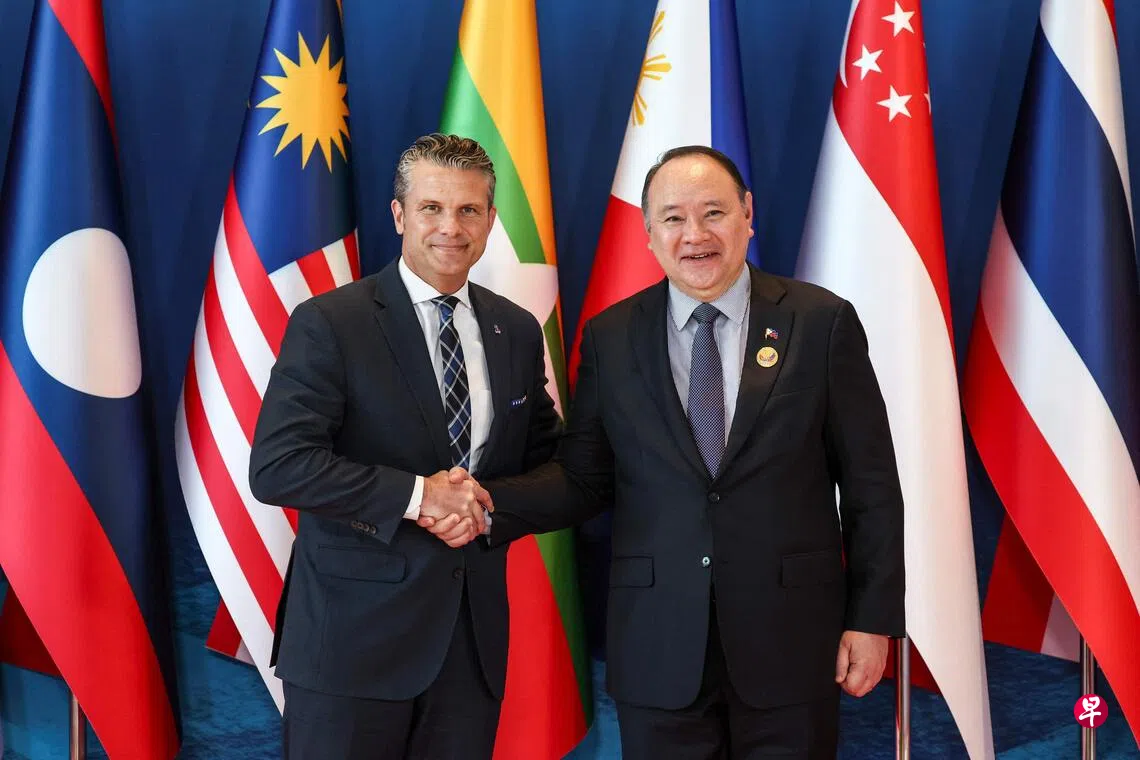
US Secretary of War Pete Hegseth has proposed establishing a US-ASEAN defence cooperation framework to guide efforts to deepen ties.
Speaking at the ASEAN Defence Ministers’ Meeting-Plus in Cebu, the Philippines, on Wednesday (28 October), Hegseth said the US was ready to work with ASEAN countries according to their circumstances and priorities to safeguard “shared interests that are overlapping and clear”.
Hegseth said the defence cooperation framework would provide practical guidance for cooperation between the two sides for years to come, stressing that the next few years would be “critically important”; next year marks the 50th anniversary of relations between the US and ASEAN.
In recent years, the US has sought to strengthen regional defence partnerships to counter China’s influence. Hegseth assured ASEAN countries on Wednesday that Washington would defend its own interests and those of its partners, and deliver on its commitments through practical cooperation. This would include strengthening maritime domain awareness, improving interoperability between their armed forces and deepening cooperation between their navies.
“These are not symbolic things. They are concrete demonstrations of what serious partners do,” Hegseth said. “Serious partners train together, learn together, plan together and build confidence and competence necessary to prevent conflict.”
Hegseth described the US approach as “strong, quiet and clear”: taking a sufficiently firm stance to deter coercion and aggression while avoiding unnecessary escalation or public posturing, and ensuring that allies and potential adversaries clearly understand the US position.
According to the Pentagon, Hegseth plans to focus on strengthening deterrence and expanding burden-sharing in the region during the talks. Earlier this year, he praised Asian allies for increasing their investment in defence.
The Philippines, a US treaty ally, has repeatedly clashed with China in disputed waters in the South China Sea in recent years. Manila said this month that China’s military and coast guard deployments in the disputed waters nearly doubled in September.
Under Philippine President Ferdinand Romualdez Marcos Jr, Manila has steadily strengthened military ties with Washington, including allowing US forces to deploy weapons systems, holding large-scale joint military exercises and expanding US access to military bases.
The defence ministers of the US, Japan, Australia and the Philippines also met on Wednesday. The four countries had previously formed an informal multilateral defence grouping known as the “Squad”.
Japanese Defence Minister Shinjiro Koizumi held talks with Hegseth on the sidelines on Wednesday. They agreed to cooperate on building a defence system along the first island chain and discussed effective measures to deter adversaries from launching attacks. The first island chain refers to the islands between China and the Pacific Ocean.
Hegseth will also attend the ASEAN Defence Ministers’ Meeting-Plus on Thursday (29 October). Eight partner countries will take part, including Australia, China, India, Japan, New Zealand, South Korea and Russia.
However, with the Philippines holding ASEAN’s rotating chairmanship this year and relations between the two countries strained, China has decided to downgrade its representation. It will send only the defence attaché at its embassy in the Philippines to Thursday’s meeting, rather than Defence Minister Dong Jun.
