

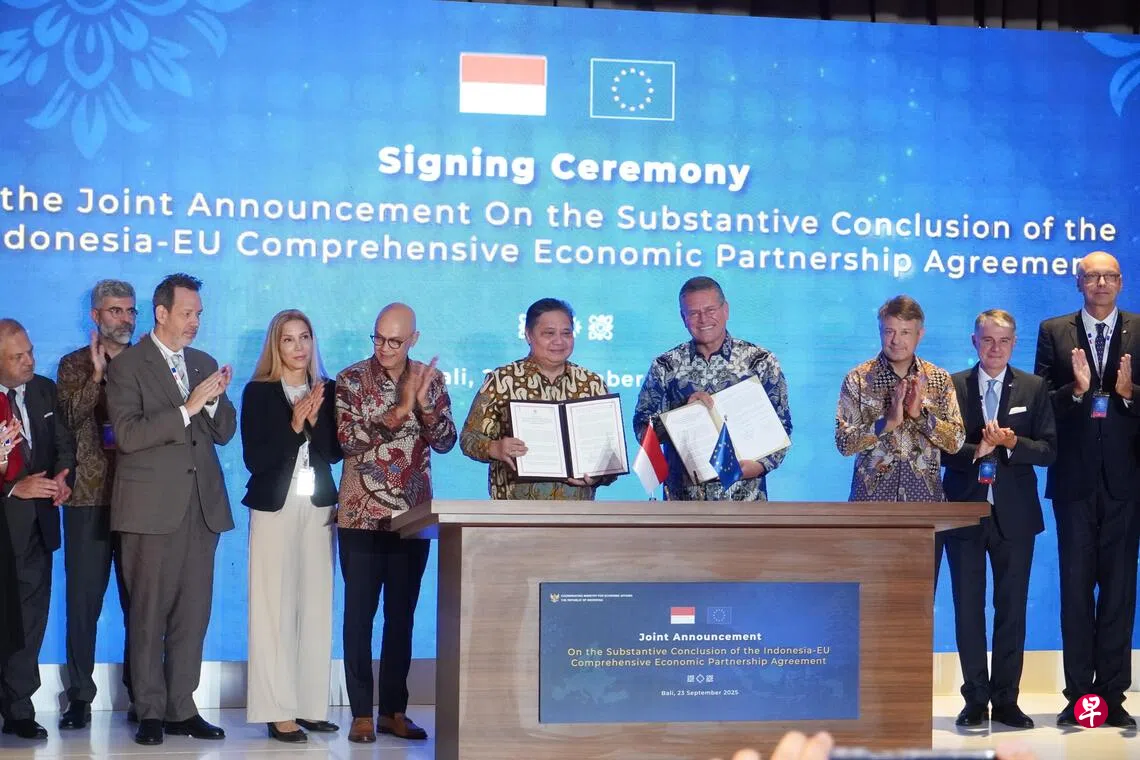
After nearly 10 years of negotiations, the EU and Indonesia have formally signed a comprehensive trade agreement and an investment protection agreement to open up their markets, diversify trade and offset the impact of additional tariffs imposed by US President Donald J. Trump.
AFP and Reuters reported that European Commission President Ursula von der Leyen and Indonesia’s Coordinating Minister for Economic Affairs Airlangga Hartarto attended the signing ceremony in Brussels on Saturday (21 November).
The agreements are expected to take effect in early 2027 at the earliest, as they still require European Parliament approval and both the EU and Indonesia must complete their respective internal ratification procedures.
According to an EU statement, the trade agreement is expected to boost EU exports to Indonesia, Southeast Asia’s largest economy, by nearly 40% within 15 years.
Von der Leyen said at the ceremony: “This is one of the most ambitious agreements the EU has concluded in Asia… Together, we represent a vast market of 730 million people.”
She also thanked Indonesian President Prabowo Subianto and said he would visit Brussels on 11 December.
Negotiations on the agreement took nearly 10 years and were concluded last year. Faced with challenges from the US and China, the EU is stepping up efforts to diversify trade, and the deal with Indonesia is part of that broader strategy.
Brussels said the Indonesia–EU Comprehensive Economic Partnership Agreement (CEPA) and the accompanying Investment Protection Agreement (IPA) would open up investment in strategic sectors such as electric vehicles, electronics and pharmaceuticals.
The trade agreement will also eliminate tariffs on more than 98% of European goods exported to Indonesia, including food, agricultural products and industrial goods, saving more than €600 million (about S$850 million) in tariffs annually.
Airlangga said about 90% of Indonesian goods exported to the EU would enjoy duty-free access. This is expected to benefit Indonesia’s main exports to the bloc, including palm oil, footwear, textiles and fishery products.
He hailed the agreement as a “new chapter” in Indonesia–EU economic relations, stressing: “The benefits for our exporters are concrete and measurable.”
