

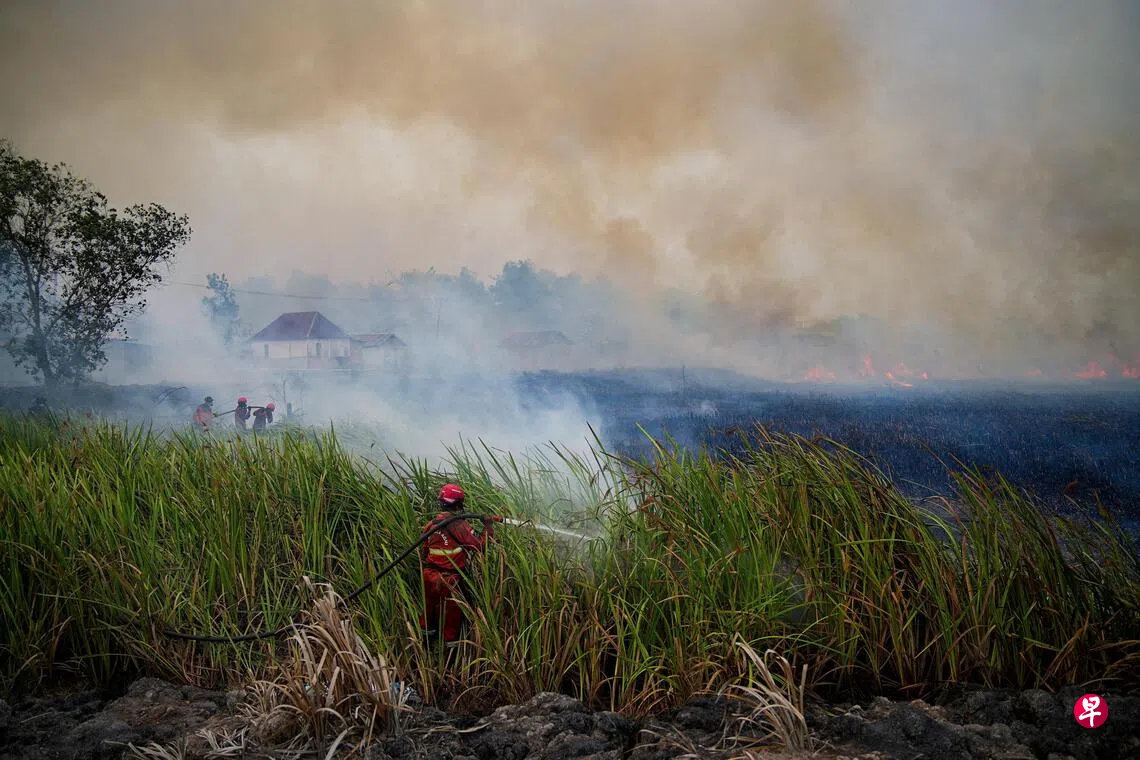
(Jakarta) Indonesia plans to buy a fleet of high-capacity firefighting aircraft in 2027 to strengthen its rapid response to forest fires and reduce its longstanding reliance on foreign aid.
The Jakarta Globe reported that BNPB Chief Kristomei Sianturi said on Thursday (19 November) that the plan would give Indonesia its own firefighting fleet capable of carrying out large-scale water drops. However, he did not disclose the number or type of aircraft to be purchased, or the expected cost.
Indonesia has relied on assistance from the Australian government because it lacks aircraft with comparable water-carrying capacity. Australia has deployed water-bombing aircraft capable of carrying up to 15 tonnes of water to help fight fires.
Kristomei Sianturi said Indonesia already had sufficient manpower for emergency response and could mobilise up to 71,000 personnel from various government agencies to fight fires across the country. Nevertheless, Indonesia still welcomed international assistance during major disasters, “but it must match what we actually need and provide capabilities that Indonesia does not yet possess”.
Economic losses from forest fires reach S$40 billion
The economic and health costs of Indonesia’s forest fires this year have also drawn attention. The latest study by Indonesia’s Center of Economic and Law Studies (CELIOS) found that forest fires and haze this year had caused economic and public health losses of as much as 565.03 trillion rupiah (about S$40 billion).
According to an assessment by the centre’s researcher Galau D. Muhammad, losses from damage to physical assets and disruption to economic activity alone amounted to 2.69% of gross domestic product.
He said this showed that reliance on extractive industries did not necessarily bring economic benefits to the regions where they operated, especially when industrial activity caused environmental damage. “Disaster response is not an act of government generosity or 'aid,' but rather the fulfillment of the people's basic rights to a livable environment and health. In fact, dependence on extractive industries has proven to be a losing proposition for these regions.”
Beyond the economic losses, public health has also been severely affected. The research centre estimated that 17.4 million people across 12 Indonesian provinces were at risk of developing or had already developed acute respiratory infection symptoms, with related medical costs potentially reaching 224.65 trillion rupiah (about S$15.9 billion). Haze pollution reportedly claimed 1,700 lives in August alone this year.
Dzatmiati Sari, advocacy and outreach coordinator at Indonesian energy transition organisation CERAH, said environmental protection and social welfare policies would struggle to be truly effective as long as the government continued to provide budget allocations, subsidies and incentives for extractive industries and coal financing.
Indonesia revokes forestry concession held by Sukanto Tanoto’s Royal Golden Eagle group
Indonesian authorities announced on Friday (20 November) that they had revoked a major forestry concession held by PT Riau Andalan Pulp and Paper (RAPP), a company controlled by tycoon Sukanto Tanoto.
RAPP is part of Tanoto’s Royal Golden Eagle group. The revoked concession covers 338,536 hectares, an area roughly four times the size of New York City. The forested land has suffered repeated peatland fires, and unauthorised mining and other activities have been found there.
According to the Bloomberg Billionaires Index, Tanoto has a net worth of about US$21.1 billion (about S$27.2 billion), making him one of Indonesia’s wealthiest entrepreneurs. Most of his wealth comes from Singapore-headquartered Royal Golden Eagle, whose businesses span pulp, paper and palm oil, among other sectors.
