

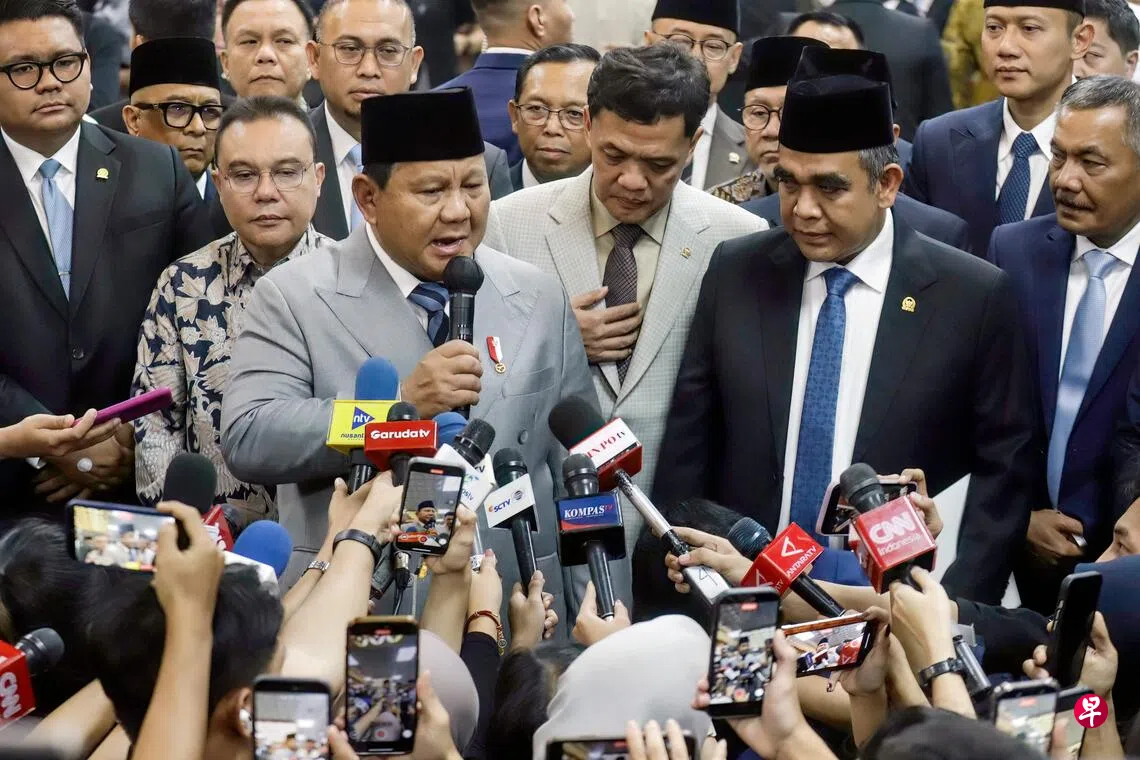
Indonesia’s next vice-president will be either a close confidant of President Prabowo or a non-partisan minister with extensive experience in business and politics. Analysts say the eventual choice is likely to become Prabowo’s running mate when he seeks re-election in 2029. The ruling coalition’s choice between the two candidates will also reveal whether its member parties are willing to let a single party hold both the presidency and vice-presidency.
Prabowo on Monday (23 November) formally nominated Coordinating Minister for Human Development and Cultural Affairs Sugiono and Agriculture Minister Andi Amran Sulaiman as vice-presidential candidates to parliament. He said they were chosen for their “achievements, dedication and loyalty to the country”.
Parliament is scheduled to hold a plenary session on 11 December to elect one of the two as the new vice-president.
A military and political insider versus a business heavyweight
Sugiono, 47, is known in Indonesian political circles as Prabowo’s “ideological son”. A former military officer with close ties to the president, he served as Prabowo’s private secretary and was a founding member of Prabowo’s Gerindra party. He has held senior party posts, including deputy leader and executive deputy chairman, and became secretary-general in August last year.
Sugiono was elected to parliament in the 2019 and 2024 general elections. After taking office in October 2024, Prabowo appointed him foreign minister, before promoting him to coordinating minister for human development and cultural affairs this October.
Amran, 58, is a businessman from South Sulawesi whose Tiran Group has interests spanning plantations, mining and trade. He served twice as agriculture minister under former president Joko Widodo, widely known as Jokowi, and retained the post in Prabowo’s cabinet. He has also headed the National Food Agency since October last year. In January this year, Prabowo awarded him the Bintang Jasa Utama, a first-class service medal, for helping advance food self-sufficiency.
Although Amran has no party affiliation, he helped Jokowi’s 2014 election campaign as a coordinator of volunteer organisations in eastern Indonesia. His family has an extensive political and business network. His relatives include Jhonlin Group owner Samsudin, one of the main financial backers of Prabowo’s 2024 campaign.
Analysts: Prabowo may seek sole control, ending dual centres of power
Yanuar Nugroho, a visiting senior fellow at Singapore’s ISEAS – Yusof Ishak Institute, told Lianhe Zaobao that Prabowo’s nominees show that he now sees the vice-presidency as an extension of the presidency, not a partnership of the kind he had with former vice-president Gibran Rakabuming Raka, Jokowi’s eldest son.
“In 2024 the post was coalition currency: he needed Jokowi’s voters, and Gibran was the price. Now he needs nobody’s votes, so he chose from his own cabinet: two men without an electoral base of their own or without party affiliation... The signal is clear: no more twin centres of power in Indonesian politics.”
Yanuar said the election of Sugiono would signal a generational transition within Gerindra’s leadership. An Amran victory, by contrast, would indicate parliament’s preference for a candidate from outside Java to provide balance.
Nicky Fahrizal, a researcher at Indonesia’s Centre for Strategic and International Studies, said in an interview that Prabowo’s nomination of Amran was intended to ensure continuity in policy implementation, while Sugiono’s nomination reflected the value he placed on loyalty. This showed the president wanted sole control, free from interference arising from a vice-president’s political manoeuvring.
Secret parliamentary ballot will test ruling coalition’s discipline
Both candidates, however, raise concerns. Yanuar said that while Sugiono could bring greater cohesion to the leadership, having Gerindra hold the presidency, vice-presidency and parliamentary speakership would leave few political checks and balances. Amran’s lack of party affiliation would preserve the balance within the ruling coalition, but his family ties would raise questions about the vice-president’s potential business entanglements.
Yanuar said: “Still, the vote is a secret ballot, a real election rather than acclamation.” He added: “Coalition partners may quietly prefer Amran because he does not shift more power to Gerindra. So the margin will be a barometer of coalition discipline: near-unanimity confirms Prabowo’s grip; a visible split would be the first sign that parties are thinking about 2029 on their own terms.”
Nicky added: Selecting Sugiono would serve as a test case for Gerindra to field an all-party ticket in the 2029 presidential election, whereas choosing Amran indicates that Prabowo and Gerindra aim to expand their voter base outside Java.
