

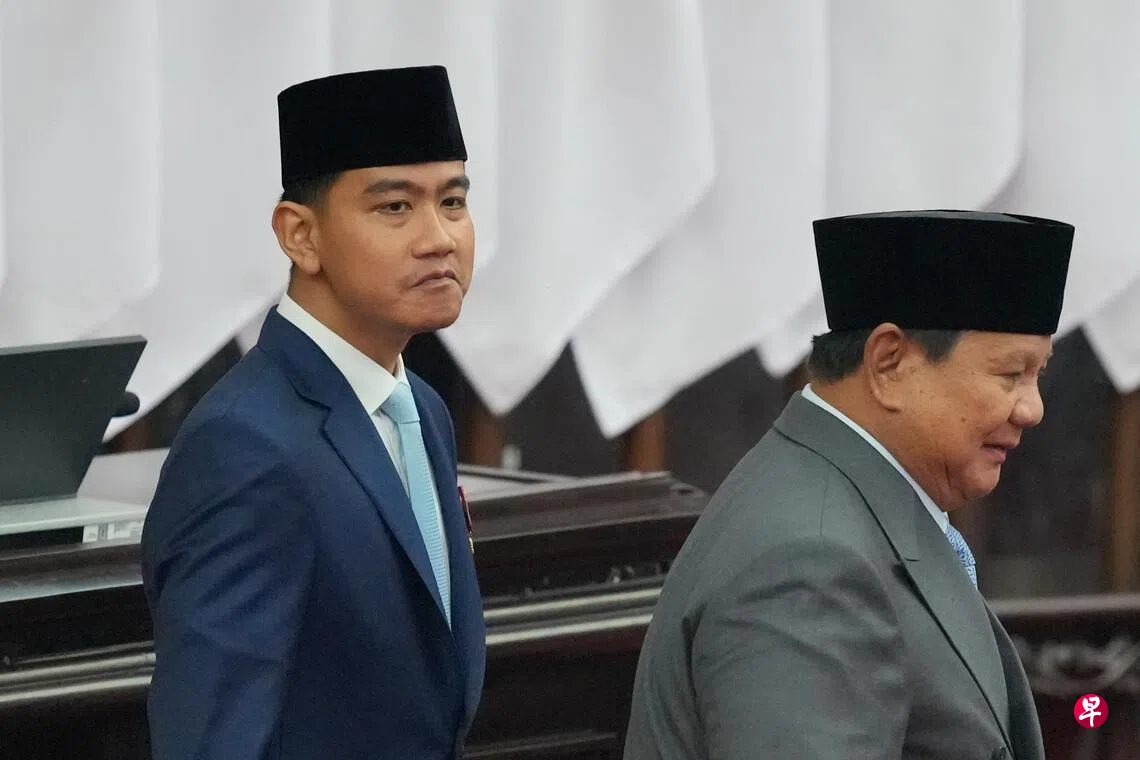
Indonesian President Prabowo Subianto has accepted Vice-President Gibran Rakabuming Raka’s resignation, according to people familiar with the matter. Gibran has recently faced pressure in parliament for impeachment and accountability over a dispute about his overseas educational qualifications.
Bloomberg cited sources familiar with the matter as saying that Gibran tendered his resignation during a meeting with Prabowo on Wednesday (11 November) evening. Budi Arie Setiadi, leader of the pro-Joko Widodo volunteer organisation Projo, also confirmed the news.
Two sources in Indonesia’s Regional Representative Council, the upper house of parliament, also said Gibran would formally submit his resignation letter to the upper house on Thursday (12 November) morning. The upper house oversees the process of approving resignations and will take part in selecting his successor.
Gibran faces impeachment risk over educational qualifications
Gibran, 39, is the son of former Indonesian president Joko Widodo. He studied overseas and used the certificate in question to meet the eligibility requirements for the 2024 general election. Under Indonesian electoral law, vice-presidential candidates must have completed upper secondary education or hold an equivalent qualification.
However, Indonesia’s Constitutional Court and Supreme Court ruled separately last month that the “upper secondary equivalency certificate” Gibran submitted for the 2024 general election was invalid. According to Indonesia’s election commission, Gibran attended secondary school in Singapore for two years before enrolling at an affiliated college of the University of Technology Sydney in Australia.
Saan Mustopa, deputy speaker of Indonesia’s House of Representatives, said earlier on Wednesday that 120 lawmakers from eight political parties in the House had jointly submitted a petition calling for Gibran’s impeachment. The lawmakers believe that, based on the court rulings, Gibran is no longer eligible to serve as vice-president.
The day before his formal resignation, Gibran met Prabowo for more than two hours. Gibran reportedly indicated then that he intended to resign, but told the media after the meeting that Prabowo had encouraged him to seek verification of the relevant documents through the courts to address the allegations.
A senior Indonesian government official told The Straits Times on Tuesday (10 November) that Gibran intended to resign formally only after exhausting all legal avenues, including seeking a review of the case by the Supreme Court.
However, Indonesian legal experts believe the Constitutional Court and Supreme Court rulings are final, leaving no room for further recourse. Gibran is also unlikely to be able to halt impeachment proceedings through the courts.
Analysis: Gibran’s resignation highlights Indonesia’s political power struggle
Gibran’s resignation could reshape the political coalition led by Prabowo. Under Indonesia’s constitution, if the vice-presidency falls vacant, Prabowo must nominate two candidates. The People’s Consultative Assembly must then convene to elect a successor within 60 days.
This will give Prabowo a decisive say in choosing his new deputy and affect the balance of power among the parties supporting him.
Gibran’s resignation could mark a turning point in relations between Prabowo and Joko Widodo. The two forged an alliance before the 2024 general election, allowing Prabowo to draw on Joko Widodo’s political network and popular support to win the presidency, while paving the way for Gibran to become Indonesia’s youngest vice-president.
Sana Jaffrey, a researcher at the Australian National University, said it was hard to imagine lawmakers acting against Gibran without Prabowo’s knowledge or tacit approval.
“Prabowo’s silence suggests that he wants Gibran removed from office but is unwilling to bear the political cost of openly pushing for it, particularly a possible backlash from Joko Widodo’s supporters, whose backing helped him win the presidential election.”
She added that the crisis showed how the political fortunes of a small elite were being placed above the country’s need for effective, stable governance. “Prolonged uncertainty over the balance of power at the top will only deepen concerns at home and abroad about Indonesia’s future direction.”
