

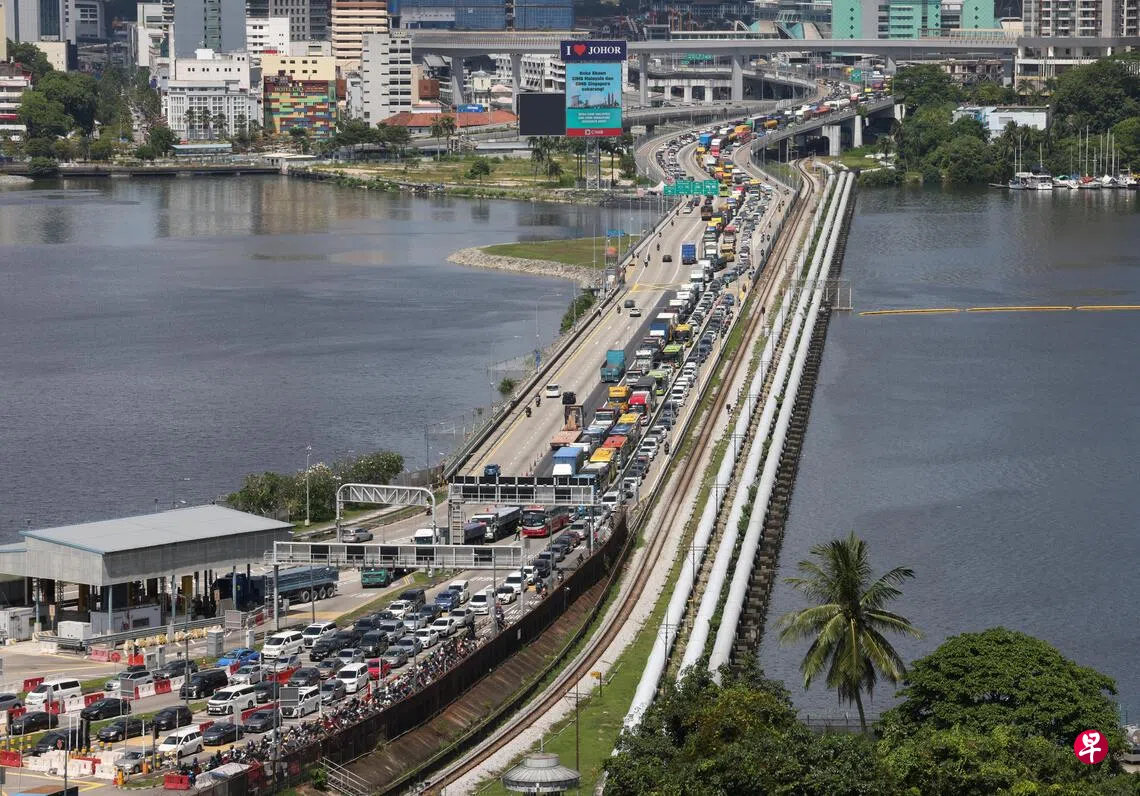
Malaysia’s Investment, Trade and Industry Minister Johari Abdul Ghani said plainly that many Malaysians choose to cross the causeway to earn a living in Singapore primarily because wages there are more attractive. Some Malaysian manufacturers, despite earning hundreds of millions of ringgit a year, offer only the minimum wage of RM1,700 (about S$534), making it difficult to attract local workers.
According to The Star, Johari sternly criticised some highly profitable Malaysian companies for being too stingy towards local workers while answering questions in the lower house of parliament on Monday (2 November).
“Some of these companies make hundreds of millions of ringgit in annual profits, yet when it comes to paying local workers RM2,000, they refuse and still insist on offering the minimum starting salary of RM1,700. They want to pay TVET graduates the same wages as foreign workers.”
Johari said the Malaysian government had trained about 400,000 skilled workers through technical and vocational education and training (TVET). Yet many manufacturers remained reliant on cheap foreign labour, preferring to offer skilled workers the same low pay as migrant workers.
He rejected the stereotype that Malaysians were unwilling to work in factories because they were lazy, noting that about 100,000 Malaysians cross the Causeway to work in Singapore every day, including holders of diplomas, bachelor’s degrees and master’s degrees.
“Why do they take up those jobs, even though the work is more or less similar to what is done in our factories? Because there is economic value.”
Johari also pointed to the large number of Malaysians switching to work as private-hire drivers precisely because it offered reasonable financial returns. “If the job does not provide economic value to them, they will not take it.”
Addressing the worsening imbalance in the labour force, Johari acknowledged that tackling employers’ entrenched over-reliance on migrant workers would be far from easy. He said there were currently about 2.6 million legally registered foreign workers nationwide.
Together with the large number of undocumented migrant workers remaining in the country, this would pose significant long-term risks to Malaysia’s labour market and industrial upgrading.
To improve workers’ pay, the Malaysian government raised the national statutory minimum wage in its 2027 Budget. From June next year, the monthly minimum wage will rise from RM1,700 to RM2,000, a move the government expects to benefit more than four million workers. However, micro, small and medium-sized enterprises with annual sales below RM50 million will be exempt for now.
The government will also set a minimum starting salary of RM2,500 for workers in semi-skilled jobs and university graduates, and encourage government-linked investment companies and government-linked companies to raise their living wage benchmark for employees from RM3,100 to RM3,400.
As traditional forms of employment grapple with low wages, higher education institutions are also seeking new ways forward.
According to Sin Chew Daily, Kelantan Sultan Muhammad V said in a speech at Universiti Malaysia Kelantan’s convocation on Sunday (1 November) that, as artificial intelligence (AI) and the digital economy profoundly reshape the workplace, university graduates should move beyond the conventional mindset of passively seeking work.
Instead, they should become “pioneers of opportunity and creators of jobs”, harnessing technology to develop new business models and cross-border e-commerce to meet the opportunities and challenges brought about by industrial transformation.
