

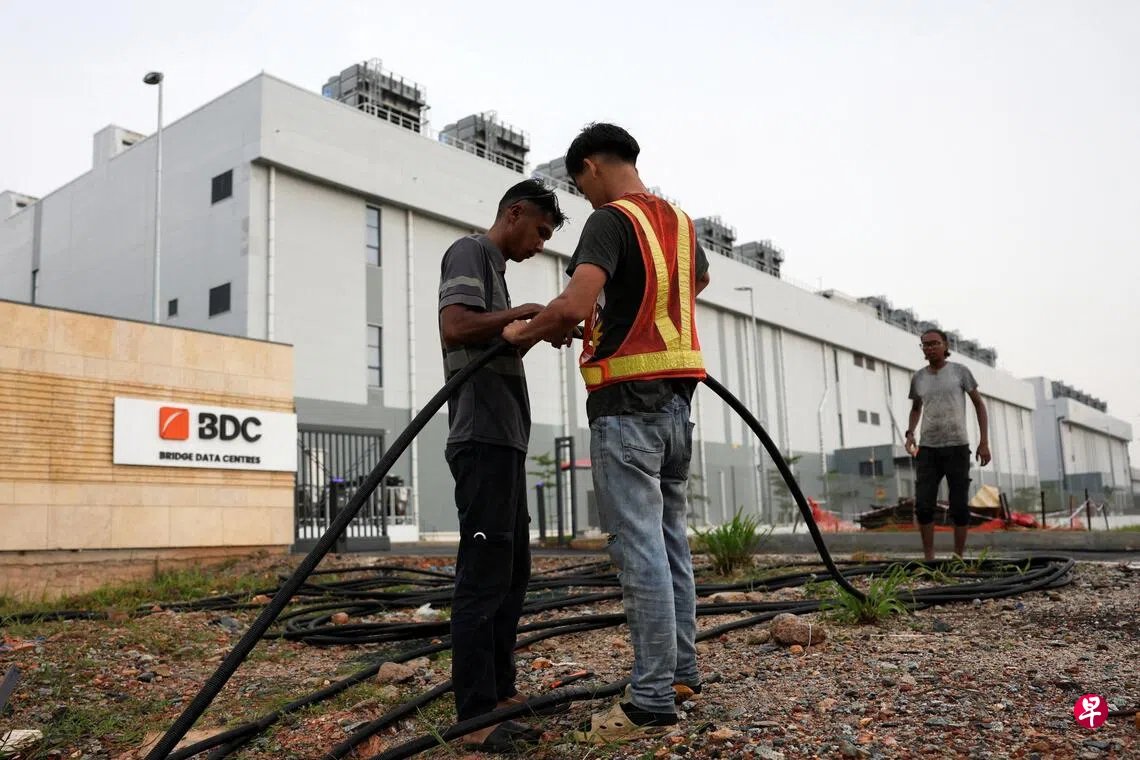
(Johor Bahru) The Johor state government released figures on Friday (20 November) to counter concerns that the boom in data centres could consume large amounts of water and threaten household supplies. It said the approved water allocation for the Malaysian state’s 19 operating data centres accounts for just 1.05% of its total treated water output. The state government also rejected claims blaming data centres for falling water levels in the state’s dams, reiterating that the dams concerned do not supply water to data centres.
According to The Star and Nanyang Siang Pau, Johor executive councillor for public works, transport, infrastructure and communications Mohamad Fazli Mohamad Salleh released the figures in the state assembly on Friday (20 November), in response to questions about the impact of data centres on water and electricity supplies.
Fazli said the 19 data centres had initially applied for a combined water supply of 73.088 million litres a day, but were ultimately approved for 21.277 million litres a day. This represents just 1.05% of Johor’s current total treated water output of 2.034 billion litres a day, and only 3.35% of total industrial water consumption of 635 million litres.
Fazli said that while the figures show data centres are not the main source of pressure on the state’s water supply, the state government remains cautious about the growing demand from the industry to ensure that it does not affect domestic water supply in the future”.
Addressing recent claims linking falling storage levels at several dams to data centres, Fazli described them as a distortion of the facts. He explained that declining water levels at the six dams under close monitoring — Machap, Lebam, Gunung Pulai II, Pontian Kechil, Upper Layang and Lower Layang — were mainly due to prolonged dry weather and El Nino. The climatic effects are expected to persist until March next year.
Explaining the state’s water supply arrangements, he said Machap and Lebam dams do not supply any operating data centres. Gunung Pulai II and Pontian Kechil dams mainly supply users in the Pontian area, while Upper Layang and Lower Layang dams serve households and industrial users in Pasir Gudang, Plentong, Pandan and Taman Daya. The 19 operating data centres are in fact supplied mainly by the Semangar and Sungai Johor water treatment plants, both of which draw raw water from the Johor River. Falling dam storage levels should therefore not be directly linked to data centres.
On controls at the planning stage, Fazli said Johor had set up a data centre development coordination committee comprising 20 state and federal agencies as early as 2024. All proposed projects must undergo the committee’s comprehensive assessment of water and electricity capacity, green technology, and water and energy efficiency before applying to local authorities for planning permission.
The state government also requires operators to adopt cooling technologies that use little or even no water, such as air-cooled chillers, direct-to-chip liquid cooling and immersion cooling. Nine of Johor’s 19 operating data centres have adopted such water-saving technologies. Of the 19 centres, 11 consume less than one million litres of water a day, while the rest use between one million and 4.17 million litres.
To meet continued growth in water demand from households, businesses and industry, the Johor government has planned four raw water projects, including the Ulu Sedili Besar dam, the Sungai Pontian Besar barrage and a Johor River water storage project. With a combined supply capacity of 1.1066 billion litres, the projects are expected to be completed progressively between 2027 and 2031. Ranhill SAJ is also proceeding with six projects to build or expand water treatment plants, which will add 1.048 billion litres of treated water production capacity.
